
Breath of life
Published:Friday | December 12, 2014 | 12:19 PM



Brakes on drunk driving
The December holiday period, which is often referred to as the 'silly season' for traffic because of the high number of crashes that tend to occur, already seems to be in full swing.
Vice-chairman of the National Road Safety Council (NRSC), Dr Lucien Jones, said in a meeting held with the police last week that a high proportion of persons - about 57 per cent - whose breath was analysed were found to have been drinking.
The tests were administered with the SD-5 breathalyser, which has been proven a safe and reliable method to determine a person's alcohol levels. Jones confirmed that the process is 100 per cent accurate.
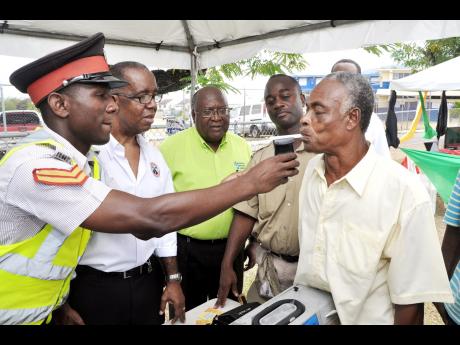
A policeman stationed at Elletson Road in Kingston explained how the breath test is administered.
"A preliminary test must be done first. If you are stopped on the road and you are suspected to be intoxicated, a mini-machine, the SD-5, is used to get a sample of your breath on the scene," the policeman said. "By law, you are not allowed to go over 35 microgrammes. If you go over 34, you will be taken to get a sample of your breath on the Intoxilyzer 8000 evidence machine"
This instrument, according to the NRSC, gives results on an evidence card. It shows the person's name, driver's licence number, the time at which the test was done, and the alcohol level recorded.
"Once you come to the machine, it's just for you to blow into it. Once the machine is prepped, you are given a straw; you insert it yourself and you blow in it. The machine takes the amount of sample that it needs to do a reading," said the policeman.
He emphasised the technology's accuracy.
"It is a very sensitive machine. You cannot even have your cell phone. The person with the alcohol cannot stay inside the room when the evidence is being checked, because it will fail. It is so sensitive," the policeman continued.
The person conducting the breath test on the machine has to be certified to apply it.
The NRSC is continuing its road safety campaign to have the number of traffic deaths reduced. Through public education in the form of advertisements, motorists are being advised not to drink and drive and to designate a driver if other persons are going to drink.
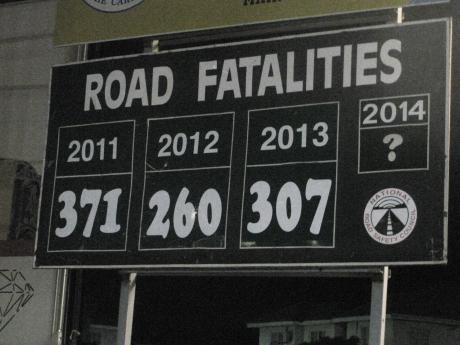
There has been an upsurge in traffic deaths recently, and in mid-December, the country has already gone past the 300 deaths mark, well beyond the Below 240 objective identified as a marker on the way to reduced traffic fatalities. Motorcyclists, especially in the western end of the island, have been especially susceptible to fatal crashes.