
Editorial | Ms Malahoo Forte’s next step
Published:Monday | April 11, 2022 | 12:06 AM
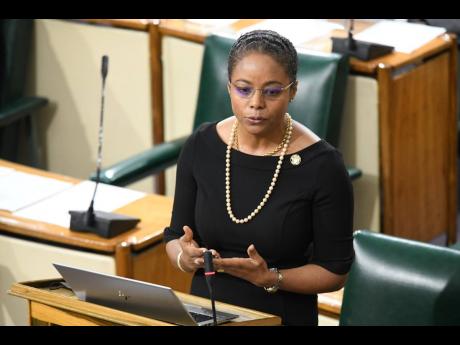
It was always so, and notoriously known to be so, that Jamaica, starting now, could not complete the constitutional requirements for transforming itself from a monarchy to a republic in time for the August 6 celebration of the island’s 60th anniversary of Independence. That is a point that this newspaper has repeatedly highlighted in these columns, even before, and in the immediate aftermath of, last month’s visit to the island by the Duke and Duchess of Cambridge. And it is, in part, why we have long been prodding the Holness administration for action on the matter.
Therefore, the legal and constitutional affairs minister, Marlene Malahoo Forte, broke no new ground last week with her QED (quod erat demonstrandum) lecture on the time it would take for a constitutional reform bill to be tabled, debated, passed by Parliament, and then approved by voters in a referendum.
The more important and immediately relevant issue for the minister to have addressed, which she did not, is her, or the Government’s, work plan for constitutional reform. When will the process begin and end, and what are the administration’s priorities? In other words, either Minister Malahoo Forte or Prime Minister (PM) Andrew Holness should indicate whether there is an intention to sequence the programme.
In any event, there is no reason why a public education programme should not be launched now, not only to inform Jamaicans of the specific deliverables of the reform agenda, but also provide a nuanced explanation of why disengaging from the Queen of Great Britain as our head of state is important.
NOT NEW FOR JAMAICA
Discussion of this matter is not new for Jamaica. It came on the national agenda within the first decade of Independence and was the subject of full-throttled debate by the 1970s. In those days, the People’s National Party (PNP), which was in government at the time, advocated for an executive presidency. The Jamaica Labour Party (JLP) preferred a ceremonial one.
By the 1990s, with P.J. Patterson at the helm of that party, the PNP had relented from its position. Into the early 2000s, there was clear consensus between the parties that the matter would be taken forward. The only point left to be agreed was how the president should be chosen – whether by a two-thirds majority vote of the two houses of Parliament sitting together or separately. The PNP favoured the former; the JLP, the latter. Another, but seemingly less consequential hitch, was Edward Seaga’s loosening grip on the JLP and Bruce Golding’s return to, and leverage in, the party. Mr Golding, however, was, and remains, a declared republican.
Unfortunately, three prime ministers later – Mr Golding, Portia Simpson Miller, and more than six years, so far, under Mr Holness – Jamaica has not crossed over the line.
As this newspaper has argued before, removing the Queen of England as Jamaica’s head of state is no trivial symbolism. Rather, it will be a clear statement of who we are and how we perceive ourselves, which, to paraphrase independent Barbados’ first prime minister, Errol Barrow, is not as stragglers, loitering the hallways of empire, or the rusty, corroded remnants thereof. By retaining the Queen as head of state, Jamaica in a way resembles Estella, the character in the Dickens novel, Great Expectations, who is maid to Miss Havisham, the jilted bride, who, years later, still wears her wedding veil and presides over a crumbling wedding feast. The intellectual remnants of empire.
DIMINISHES LEGACY
In this regard, having the Queen, the matriarch of a dysfunctional Anglo-German family, as our sovereign is incompatible with celebrating Marcus Garvey, Nanny, Sam Sharpe, Paul Bogle and George William Gordon as national heroes. It, in some respects, diminishes, if not betrays, their legacy.
Last month, Prime Minister Holness told the Duke of Cambridge, a future monarch who would also be our sovereign, that Jamaica is moving on. The PM, however, did not say when. There was no deadline.
As Ms Malahoo Forte repeated, a bill to excise, or amend, a deeply entrenched clause in Jamaica’s Constitution has to remain on the table of Parliament for three months after it is laid before it is debated. After the debate, it has to stay another three months before the House can vote on it, following which it goes to the Senate for approval. In each of the chambers, the bill has to be passed by two-third majorities. Assuming it gets through Parliament, there has to be a wait of at least two more months before the legislation is put to voters for their approval.
That is why, long before, and in the immediate aftermath of the 2020 general election, we urged Mr Holness to get going on the matter. The Government must not continue to dither. Ms Malahoo Forte, therefore, has to do more than tell us about the legislative process, which is small-bore stuff. It is urgent to talk about issues such as drafting instructions being given to those who will frame the law.
Concurrent with the bills to remove the Queen should be one to repatriate the Jamaican Constitution, to make ownership of Jamaica’s Constitution an act of the Jamaican Parliament, rather than an Order in Council on behalf of the Queen. That order was signed by a British civil servant, W.G. Agnew, who no one in Jamaica knows, but the product of whose signature carries great symbolic and practical weight on our lives. If Mr Holness starts the process now, these things can be accomplished by next year’s Independence anniversary.
In the meantime, he can give Jamaicans another significant diamond jubilee gift, while removing another of the Miss Havisham-type retentions – by leaving the Judicial Committee of the Privy Council and having Jamaica accede to the Caribbean Court of Justice as its court of last resort. That would widen access to the country’s highest court to a wider group – a less privileged class – of Jamaicans.