
Racquel Moses |COP27 must deliver on climate finance
Published:Thursday | November 10, 2022 | 3:26 AM
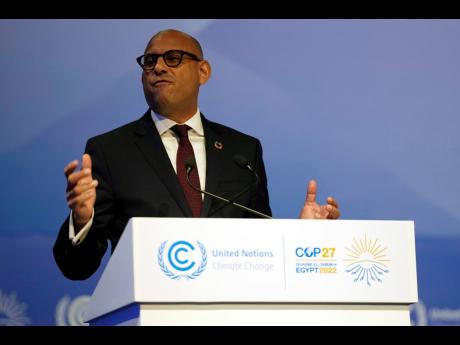
The most important gathering of climate decision-makers is happening from November 7 in Sharm-el-Sheikh, Egypt, as global delegations descend on the seaside town for the next set of climate policy negotiations. COP27, the United Nations’ climate summit, is set to tackle the major challenges affecting the international response to climate change, and map out how best to proceed.
For vulnerable nations bearing the brunt of loss and damage, this is an opportunity to settle long-standing issues on climate finance and a just transition to a sustainable world. For the second year running, finance will be a core consideration at COP, and after some movement during the UN General Assembly (UNGA) in September, when Denmark contributed to the loss and damage fund, there is hope that a resolution is nearing.
Should their pledges come through, it could help develop local resilience-building solutions capable of building back better and future-proofing the same local communities being affected right now. As such, it provides a new tool for civil society and governments to use to fast-track their transition to low-carbon technologies, and find ways of providing the sustainable economic growth for which we are all striving. While we are already on our way to achieving it by our own means, climate finance provides a chance to further strengthen international bonds between countries, and collaborate towards the common future we envisage.
IDENTIFYING THE GAPS
Early into the creation of the Caribbean Climate-Smart Accelerator (CCSA), it became clear that the biggest challenge facing Caribbean entrepreneurs and government projects within the sustainability sector was closing the funding gap between the kind of money that is available and the type of funding projects need. As part of our mission, the CCSA actively networks with private- and public-sector stakeholders to unlock fit-for-purpose funding opportunities. This led to our collaboration on the development of the Resilience Scorecard last year which helps nations identify the gaps in their resilience that they can use as a funding mechanism. The Hon Walter Roban, from the government of Bermuda, and the Hon Simon Stiell, now executive secretary for the United Nations Framework Convention on Climate Change Secretariat, were two early endorsers of the initiative. At COP27, we intend to further promote the scorecard to help island nations and vulnerable communities map out efficient pathways to identifying and funding resilience-building.
However, the critical component to filling these gaps is financing that meets our unique development requirements. The World Economic Forum recently released a report which concluded that emerging markets require almost $95 trillion to transition to low-carbon economies. This is a lot of money for any government, but especially those with limited resources that also have to rebuild their economies following severe weather events intensified by climate change. Private-public partnerships, blended finance, multilateral agreements and regional collaboration on major infrastructure projects are just some of the ways to reach funding goals, but a $95-trillion price tag remains a major challenge. The CCSA, through our quarterly investor forums, has identified a growing interest from the private and philanthropic sectors to take on that funding goal, and tapping into this market is a viable option – but a resolution on climate finance can have a much broader impact.
DELIVERING FINANCIAL SOLUTIONS
Herein lies the importance of COP27. In addition to taking stock of global climate action and finding opportunities to collaborate towards new targets, this COP can have a major impact on future-proofing vulnerable communities. Finance and loss and damage, specifically, have been topics of contention at previous COPs, but following another record-breaking year for climate impacts, a resolution must be reached. Delivering financial solutions to countries on the frontlines of climate change is a must, as Simon Stiell illustrates: “Grenada hadn’t experienced a hurricane for close to 50 years and then in the space of just 10 months, two hurricanes pass through, devastating the island. All of these years later, as an economy, how the country functions is still burdened by the economic effects of those two traumatic hurricanes.”
Stiell continues, “The story of Grenada is no different to any of the other islands, and we can go through the list of hurricane names – Ivan, Emily, Irma, Maria, Dorian; the names just go on and on. This isn’t just about geography. It’s about people. It is about community, it is about people’s way of life. Every face has a name, and it’s all under threat.” This message echoes the calls made by other Caribbean leaders at UNGA, such as Barbados Prime Minister Mia Amor Mottley, Jamaica Prime Minister Andrew Holness, and Bahamas Prime Minister Philip Davis. Heading into COP27, there is hope that climate finance will be progressed. UNGA saw Denmark contribute $13 million to a loss and damage fund, joining Scotland and Wallonia, Belgium, and a few philanthropists, totalling $20 million pledged. This, when compared to the unprecedented damage of $67 billion from Hurricane Ian alone, shows that there is a great deal of ground to cover, many creative solutions to unearth, and a bit of a storm brewing. Nonetheless, this is a good start, and we know there will be other announcements out of COP27. What we need, though, is to ensure that this develops further at COP and turns into a meaningful financial solution for vulnerable communities.
Racquel Moses is CEO of the Caribbean Climate Smart Accelerator. Send feedback to columns@gleanerjm.com.