
Elizabeth Morgan | Economic outlook for CARICOM’s main trading partners
Published:Wednesday | January 18, 2023 | 12:11 AM
This is a follow-up to my article of January 4, on the 2023 foreign trade outlook and agenda. Although there has been talk and action aimed at promoting trade with Africa and questions about improving trade with countries in Latin America and the Caribbean, as well as with Asia, mainly India and China, the principal trading partners in goods and services of all CARICOM member states remain the USA, Canada, the United Kingdom, and member states of the European Union (EU).
In 2022, the recovery in tourism in the Caribbean has been very strong. Over 4.5 million visitors came to CARICOM countries from January to October 2022, which is within reach of 2019 arrival figures. This strong performance has continued into the 2022/23 winter season. Most of these visitors came from the USA, Canada and Europe. As is known, many CARICOM countries, including Jamaica, are now tourism dependent. For trade in goods, most of the region’s exports are going to these same countries.
The CARICOM diaspora is centred in these countries with remittance inflows being important for countries such as Jamaica. Thus, the economic outlook in 2023 in these countries is important for the recovery of CARICOM countries.
CANADA
There tends not to be much reporting on Canada in the region and we do not follow very closely political and economic developments there. It may not have been noted that Prime Minister Justin Trudeau was at last week’s North American Leaders Summit (Canada, Mexico and USA) in Mexico. It seems Canada and Mexico have opened dialogue on how to cooperate taking account of near-shoring, investment, and labour to address supply chain concerns. Haiti was also raised at the North American Leaders Summit. These should be of interest. The most sustained reporting on Canada last year in Jamaica was on the seasonal farm workers’ programme.
Here in the region, many of us mainly see the importance of Canada in its temporary labour programmes and for immigration.
In its economic outlook, for at least the first half of 2023, there is talk of recession in Canada as there is for the global economy. Some Canadian analysts feel this is premature though growth is expected to slow in the first quarter of 2023. Inflation should also be reducing as this is a priority. Unemployment has been relatively low. Canada, with an ageing population, is experiencing a labour shortage which it fills by employing temporary workers and through an immigration policy targeting educated, skilled workers. A recession would be expected to be mild.
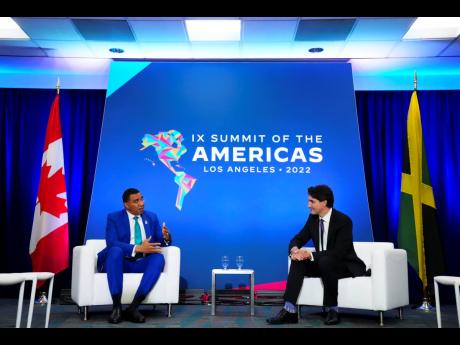
On CARICOM/Canada relations, outside of encounters with CARICOM leaders at Summits of the Americas and within the United Nations, a specific Canada/CARICOM Summit has not been held since July 2007. On trade and investment, there is no operational mechanism for dialogue between Canada and CARICOM.
THE OTHER PARTNERS
The talk of recession also applies to the USA. The slowing of economic growth is expected and measures by the Federal Reserve to lower inflation will continue. The hope is that if there is a recession, it will be mild and short, and will not lead to higher unemployment figures and impact wages. Employment rates have been good. Many analysts are looking to the debate pending in Congress on raising the US debt ceiling to see whether it will be approved.
On CARICOM/US relations, a full summit between CARICOM and US heads was held in Jamaica in April 2015 when President Barack Obama briefly met CARICOM heads. President Joe Biden met with CARICOM heads at last year’s Summit of the Americas. The US/CARICOM Trade and Investment Council last met in June 2019.
The UK economy has been on very shaky ground for a few years. Some would say since Brexit. It is reported that the UK has been in recession since the last quarter of 2022 which is expected to continue into 2023. Forecasters are seeing falling real wages and rising food prices making 2023 another difficult year for UK consumers. The UK has been having a winter of labour discontent. There could be some easing of inflation and unemployment in the course of the year. The UK currently has the weakest economy among the Group of Seven.
On CARICOM/UK relations, a biennial Caribbean/UK Forum was last held virtually in March 2021 and one should be due this year hosted in the Caribbean.
The EU member states, the Euro zone, are also expected to see their economies contracting in the first quarter of 2023. The energy crisis has been particularly difficult for EU countries dependent on oil and gas imports from Russia. Contingency measures implemented by the EU for gas supplies, so far, have helped them through the winter, but gas supplies are still fragile. The EU is also seen as headed into a mild recession. This is a stressful time in the EU with a war in its environs.
In relations with the EU, CARICOM’s meetings with EU member states occur bilaterally or within the OACPS/CARIFORUM/EU context.
This reminds us that the war in Ukraine is still in progress coming up to one year in February. The global inflation problem is directly linked to the Ukraine/Russia war and its impact on oil, gas, and food prices.
So, for CARICOM member states, it is necessary to continue monitoring closely political and economic developments in their main trading partners which could further impact their economies. I hope that, as a group, they will be accorded the opportunity to have more direct talks with these partners especially in the year of CARICOM’s 50th anniversary.
Elizabeth Morgan is a specialist in international trade policy and international politics. Email feedback to columns@gleanerjm.com