
Editorial | Olive branch for public sector workers
Published:Sunday | March 12, 2023 | 12:33 PM
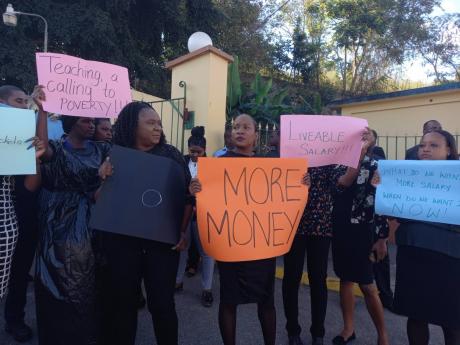
It is expected that Prime Minister Andrew Holness has already opened back channels to the leadership of the public sector unions that are hoping for higher wages from the Government, and that he will publicly offer a balm, or an olive branch of sorts, when he speaks in the Budget Debate this week.
That doesn’t necessarily mean that Mr Holness must offer the unions – including the Jamaica Teachers’ Association (JTA), which has been at the forefront of the agitation – more money, so as to bust the budget and undermine Jamaica’s hard-won fiscal stability. What it requires, though, is a negotiation reset that acknowledges that the people involved in the talks, and those they represent, are intelligent and rational beings, who understand how things work and need not be frightened or railroaded in accepting the Government’s offer. Which, unfortunately, is the perceived tone of the Finance and Public Service Minister, Nigel Clarke, who is the Government’s chief negotiator on the matter.
Dr Clarke has claimed that if outstanding agreements aren’t finalised before the end of the current fiscal year (2022-2023) on March 31, there would be a multi-year delay in the payment of retroactive amounts, starting in 2024-2025. There would be no payments in the coming fiscal 2023-2024.
Further, the minister has raised the spectre of partisan politics in the labour agitation, including sit-ins and sick-outs, rather than it being driven primarily by workers’ self-interest.
“I hope, for the sake of the country, that partisan politics is not weaving its way in,” he said in Parliament last week. “... I say this not because of speculation, but because of the things that have been revealed in our media and social media in recent days. That would be most unfortunate.”
NOT CLEAR
It is not clear what revelations to which Dr Clarke referred and who made them. It would nonetheless be surprising if he conflated the declarations of arbitrary people on social media with the specific aims or intentions of the interests with which the Government is negotiating and those presumptions influenced what happens at the negotiating table.
To be clear, and for the avoidance of doubt, this newspaper agrees with, and continues to support, the broad aims of the salary reform project upon which, after decades of half actions and missteps by previous administrations, the Government embarked on three years ago and Minister Clarke is now attempting to implement.
Indeed, as the minister has several times pointed out, a system with 325 salary scales and 185 allowances was byzantine and untenable. In many cases public sector employees earned more in non-taxable allowances than from their official salaries, whose negatively telling effect came at their retirement with pension calculated on the low formal salaries.
A re-categorisation of positions across the public sector and a rationalisation of salary scales slashed the wage bands by 95 per cent. There are now 16 pay scales. Previous allowances have been rolled into taxable income, which provides a truer reflection of the Government’s wage bill. So, the 11.4 per cent of gross domestic product (GDP) that Minister Clarke projected as compensation in 2023-2024 was likely far closer to the truth than the figures for the previous year.
In addition to the recategorisation of the groups, to bring parity to people doing similar types of jobs, or one requiring the same skills, the Government has offered a 20 per cent increase over three years. The Government has said that none of its employees will be in a worse position than before. The majority will be better off.
Most groups have accepted the new package. However, a handful of critical groups, including the island’s 25,000 teachers, the police and doctors, continue to baulk at the offer. Last week, 60 per cent of JTA, the teachers’ union, delegates voted to reject the offer, which would give the majority of their members, trained graduates, earnings of between J$2.5 million and J$3.6 million, depending on where they fall on the scale. The pre-tax salaries of principals would range between J$5.3 million and $9.4 million.
CAN’T DO BETTER
Dr Clarke has acknowledged that teachers deserve more, but insists that the Government can’t do better. Perhaps it can’t.
But the way to convey that message can’t be to attempt to shut down the dialogue by attempting to scare groups into an acceptance of the offer with an argument of how long they would now have to wait to be paid if they didn’t grab the money – and that it would possibly come in dribs and drabs. That argument insults the creative imagination of the technocrats of the finance minister and the basic common sense of everyone else.
We understand that the cash, rather than the accrual accounting system used by the Government, means that it can’t automatically carry forward into the next year’s budget unspent/unrealised obligations from the previous one.
But unspent monies, if not reallocated, remains in the Consolidated Fund. While funds are fungible, monies can be segregated and escrowed, as the Government did with the amounts that it was prepared to pay the Venezuelan government for its 49 per cent share of the Petrojam oil refinery that Caracas refused to accept. A similar approach might be contemplated with respect to the bargain units that haven’t accepted the administration’s offer. Or the administration might consider tabling a supplementary budget if and when they do. Supplementary budgets are a norm for governments, which have to react to developments during the financial year.
None of this necessarily requires that the Government add to the spending for the financial year, so isn’t contingent on the performance of the economy.