
Editorial | Republic, CCJ as one package
Published:Tuesday | April 18, 2023 | 8:08 AM
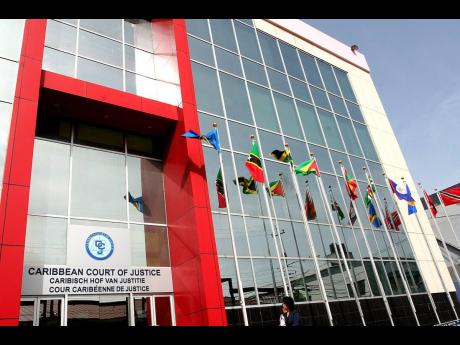
Even after last week’s first public disclosure of the matters on which it is already agreed, it remains unclear how the Constitutional Reform Committee has structured its work and its timetable for delivering its report to the Government.
This matter must be addressed so that there is transparency in its efforts and the public can be sure that there is logic and rationality to the sequencing of its deliberations – and, therefore, action on its report(s). This is important in the context of the announcement, prior to the committee’s launch, that its initial focus would be on recommendations for Jamaica to drop the British monarch as its head of state and transform itself into a republic with a president.
By that token, it may be presumed that in less than a month of its appointment, the committee has accomplished that part of its mandate and is in a position to move on. Indeed, at a press conference last week, Marlene Malahoo Forte reported that after its first five meetings, the 14 members agreed on a non-executive president to replace King Charles (represented in the island by a governor general) as the island’s head of state – a matter on which there has been consensus for at least 28 years, going back to 1995 when a parliamentary joint committee adopted the recommendation of an earlier constitutional commission.
BREAK NEW GROUND
On this matter, the current committee did break new ground although it is unlikely to have required any heavy lifting. They agreed on an electoral college of all members of the two Houses of Parliament sitting jointly to elect a president nominated by the prime minister, after discussion with the leader of the Opposition. What was not recommended was the special majority by which the president must be elected. As the former prime minister, P.J. Patterson, declared 15 months ago, the mode of electing a president could have been decided in a short meeting between the political leaders.
So on the face of it, but for any technical recommendations on the shaping of constitutional amendment bills to remove the King as head of state and his replacement by a president, the first phase of the committee’s mandate appears over.
Except that removing the British monarch as head of state is insufficient as either a symbolic or practical act in repatriating Jamaica’s sovereignty from a former colonial overlord. Extricating from the monarchy and detachment from the Judicial Committee of the Privy Council (JCPC) as Jamaica’s final court must be a single scheme in the same package.
Broadly, the King’s Privy Council, or private advisers, is one of the residues, though much watered down, from when the monarch exercised prerogative powers, wielded with the help of their advisers through various committees.
While the scope of the monarch’s prerogatives and the substance and role of the Privy Council retreated over the centuries, the JCPC was formally established by the British parliament in 1833 to hear appeals from ecclesiastic courts and special bodies as well as from courts in the Empire, including Jamaica.
In theory, an appeal from the Court of Appeal in Jamaica to the JCPC is a prayer to the King for justice from a Jamaican subject although the actual exercise of the judicial powers is by judges of the Supreme Court of England, Wales, and Northern Ireland. There is hardly a more powerful symbol of acquiescence to monarchy than a petition to the King for justice.
PRACTICAL VALUE
Symbolism apart, there is great practical value in Jamaica withdrawing from the JCPC and acceding to the criminal and civil jurisdictions of the Caribbean Court of Justice (CCJ). Jamaica is already a member of that court in its original jurisdiction as the interpreter of the Revised Treaty of Chaguaramas that governs the Caribbean Community (CARICOM). In its original jurisdiction the CCJ confirmed in Jamaican Shanique Myrie’s case the right of CARICOM citizens to hassle-free movement within the community. It is that ruling by the court which is now giving Belize pause in imposing restrictions on Jamaicans travelling to that country.
In that 1995 parliamentary committee report, there was consensus on Jamaica joining the civil and criminal jurisdictions of the CCJ once it was established. In a decade and a half of existence, the CCJ has received acclaim for the quality of its jurisprudence.
Moreover, the CCJ is potentially far more accessible to Jamaicans in terms of cost and travel. Jamaicans travelling to the CCJ in Trinidad and Tobago do not need visas as they do to go to the UK, the home of their king. Further, Jamaica helped to shape this highly insulated court as well as to the trust fund that finances its operations. The island’s taxpayers enjoy limited value from their investment.
All logic says that the constitutional reform committee should recommend delinking from the monarchy and accession to the CCJ as a single package.