
Garth Minott | Farm workers and social justice
Published:Monday | May 8, 2023 | 12:20 AM
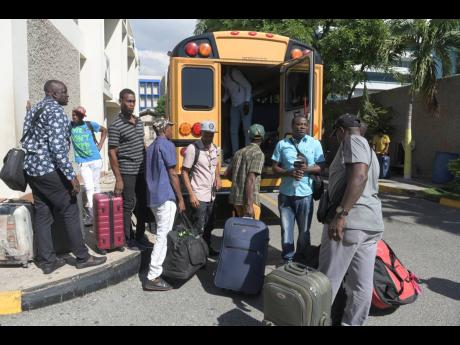

It’s here at last. The long-awaited report on conditions of work by farm workers in Canada, which was promised by the Ministry of Labour in February this year, focusing on investigations relating to the conditions under which farm workers function. A programme which preceded our Independence in 1962, and provided well-needed income for a wide cross-section of Jamaicans, mostly males, came to the public’s attention last year.
With the minister engaging in much public relations, to include support for the employers and seemingly less so for the workers, there was an abundance of public outcry for information pertaining to the true state of working conditions, often referred as slave-like in nature. The furore led to a very speedy visit by the minister to selected farms in Canada. This resulted in a very robust and resounding support by the minister for the employers while raising questions about former farm workers who are said to be mischief-makers, especially in positing what are deemed to be false claims and reports concerning conditions of workers.
Good working conditions are critical if Jamaicans who offer themselves on farms in North America are to give of their best and receive a fair day’s work for the requisite remuneration. Though concerned for the interest, wellbeing and welfare of the employers, who contribute to Jamaica’s gross domestic product (GDP), the minister, of necessity, has to have the best interest of the Jamaican people in mind and the workers who work assiduously under very difficult circumstances. One such difficulty is working in extremely cold weather, and, if we are to go by reports in the media, often with very little protection by way of warm clothing.
Without arriving at a premature judgement, seeing that I do not have the privilege of reading the long-awaited report, it is vital that the Jamaican people, at home and in the diaspora, are provided the requite facts surrounding the case and then let the chips fall where they may. Of course, while there might very well have been extenuating circumstances for the delay in the production of the final report, and give or take a month, it is good news and very refreshing to know the report is now available. With funding for the report provided by tax-payers, I anticipate that it will be made available for public consumption and will be posted on the ministry’s Website.
RECOMMENDATIONS
I am especially interested in the facts of the case and the recommendations made by the fact-finding team. The goal is to ensure there is no repeat of the experiences which gave rise to the reports of abuse in the first instance. Though initial media reports suggest there was no ‘slave-like’ conditions of work, it is worthy of note that both the guidelines of the International Labour Organization (ILO) and the Jamaican Charter of Fundamental Rights provide the framework within which Jamaicans are to live and work with their best interest protected and preserved at all times and at all cost.
According to the ILO, countries, such as Jamaica, which ratify the Migration for Employment Convention (MEC), are duty bound to ensure assistance and information are provided for migrant workers and to take steps to mitigate misleading propaganda relating to their working conditions. Governments of the countries from which migrant workers leave to seek employment are to ensure, among other things, that medical services are provided and savings and earnings are transferred with relative ease. Jamaican workers are not exempt from these principles and the report should serve as a benchmark to reinforce these principles.
For the receiving countries, the ILO’s MEC requires that countries in which these persons work are to ensure workers are treated no less favourable than their citizens, including conditions of employment, health insurance, freedom of association, including unions and social security. These conditions of work are designed to ensure improved working conditions, especially in which the welfare of the workers is given priority. The Jamaican Charter of Fundamental Rights and Freedoms accords every citizen the right to life, liberty and security, the protection of her/his human right, equality before the law and respect for rights and freedom. Though taking into account the context of the laws of the host country, nonetheless, it is vital that our government does everything possible to protect the rights and freedoms of Jamaicans in general and in particular migrant workers.
NOT THE TIME TO QUIBBLE
Now is not the time to quibble over the veracity or otherwise of the farm workers who brought the matter to public attention. Further, the notion that it was former farm workers who first made the complaint and that current workers are not involved in the impasse is not substantive and though relevant, it’s the fact-finding mission, which includes two experienced trade unionists which hold the key to ensure social justice remains the goal for the migrant or farm workers.
This matter of social justice for farm workers must therefore be kept alive in the public interest and I look forward to reviewing the findings and recommendations as soon as possible with the hope that these will point in a direction which means even better working conditions for migrant workers.
This matter of working conditions of farm workers in Canada speaks to the importance of every Jamaican to have her/his voice heard and the need to prioritise social justice in the interest of all workers whether at home or in the diaspora.
Rt Rev Garth Minott is Anglican Bishop of Kingston. Send feedback to columns@gleanerjm.com