
Editorial | PEP encouraging, but …
Published:Tuesday | June 27, 2023 | 12:20 AM
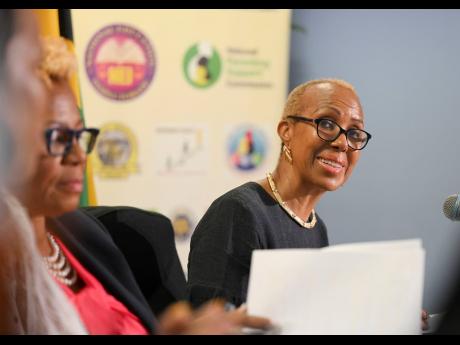
Like Fayval Williams, this newspaper welcomes this year’s significantly improved performance in the Primary Exit Profile (PEP) exams by grade-six students.
But as much as we are encouraged by the data Ms Williams released last week, they must be robustly stress-tested to ensure the integrity of the foundation upon which the island’s high schools are intending to proceed with the teaching of this cohort of students, and on which the education minister will rest education policy.
This is important, for although the PEP exams are now in its fifth year, the 2023 results are the only ones directly comparable with those of the year of its launch – 2019. The COVID-19 pandemic, which disrupted in-school teaching and learning, caused the exams to be severely bastardised between 2020 and 2022. So, there is no consistency in the data from which indisputable trend lines might have been tracked and aberrations or systemic problems observed.
Nonetheless, while these PEP results point in the right direction and are hopefully reflective of an irreversible change for the better, the outcomes remain modest. There is no cause to pop Champagne. Celebrations must be restrained.
For example, of the more than 36,000 students – mostly in the 11 to 12 age range – who took the exams, only 60 per cent were proficient, or highly proficient, in language arts. In mathematics, 57 per cent were proficient, or highly proficient.
CONVERSE
The converse is that 40 per cent of the students who will enter high school completed their primary education without falling anywhere on the scale of proficiency in language arts. The same applies to 43 per cent of the students in maths.
The real positive development is that the ratio that showed some level of grade-appropriate mastery in maths was 16 percentage points better than in 2019, when this assessment of students in their last year in primary school transitioned from the Grade Six Achievement Test to PEP, which places greater emphasis on analytic thinking. In language arts, the improvement was five percentage points.
Indeed, the improvement, based on the reported figures, was in all subjects.
Although more students are now making the cut, further particulars, such as mean scores in each subject, and the proportion of students that fall within specific ranges on the spectrum of proficiency – or non-proficiency – are required to determine the quality of the outcomes. This is another important measure of how well Jamaica is educating its children.
Indeed, in drilling down into the 2019 PEP results, the Patterson Commission on education transformation pointed out in its report nearly two years ago that a third of Jamaica’s children were leaving primary schools illiterate. Additionally, after six years in primary school, 56 per cent could not write “and 57 per cent could not identify information in a single sentence”.
YET TO BE DETERMINED
Ms Williams’ data clearly suggest that those outcomes can only have improved. But beyond the quantity, the quality of the improvement is yet to be determined. Is proficiency improving/increasing merely on the margins, or beyond?
Ms Williams acknowledged that there is “a lot of work still to do” in the island’s primary schools and in the early-childhood system, the first rung of the education ladder.
She must get on with it, without the distraction of fanciful ideas, like the one she floated recently about introducing vocational training and education in primary schools.
It is for sound reasons that in most education systems globally, including countries where TVET (technical and vocational education and training) is a critical part of national education, like Germany and Scandinavia, technical and vocational education begins at the secondary level.
Mastering language arts and the basics of maths, and being able to think analytically, are core elements of TVET education. The basics start in primary school, and the complexity rises for secondary students.
In primary schools, Ms Williams and her technocrats should be laser-focused on a critical mission: ensuring that every student leaves in the upper end of the proficiency spectrum in language arts and in the basics of mathematics. If they master those two subjects, they are very likely to be suitably proficient in all others.