
Editorial | CARICOM’s consequential decision
Published:Sunday | July 9, 2023 | 12:14 AM
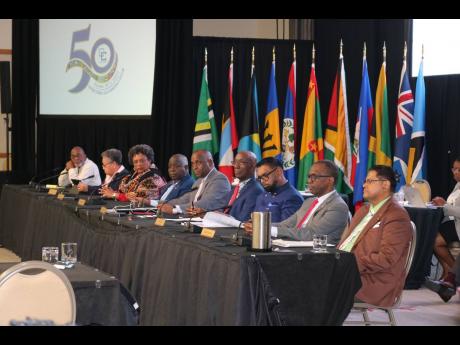
If there is no 11th hour volte-face, Caribbean Community (CARICOM) leaders last week took what will be their most consequential decision in the half a century of the current iteration of the regional integration movement.
They agreed at their summit in Port of Spain to, by next March, go the full hog on the right of citizens of the community to live and work in each other’s countries. While this unfettered freedom of movement is already enjoyed by citizens of the Organisation of East Caribbean States (OECS) (a group of seven countries in the Leeward and Windward Islands that are separately members of the community) it is not an obligation of CARICOM, whose existing arrangement covers only a limited category of skilled workers.
This development is profoundly important on two fronts:
First, it is the second vital pillar upon which CARICOM’s ambition to transition to a genuine single market and economy must stand – the free movement of labour. The other, though still a work in progress, the free movement of capital, is largely in place. For the most part, the member states that are signatories to the agreement on the single market and economy adhere to the unrestricted right of CARICOM nationals to establish firms anywhere in the community.
Second, it underlined the energy of the past three years – unmatched since the early days of the community – to get things done, starting with the 2021 launch of a report on how to reignite CARICOM by a commission chaired by Avinash Persaud, a Barbadian economist who is close adviser to that country’s prime minister, Mia Mottley.
THINGS OF SIGNIFICANCE
There are many things of significance in the Persaud report. From this newspaper’s perspective, however, two were critical. One was about advancing the free movement of labour, a prerequisite for establishing a single market and economy, as recognised by the Revised Treaty Chaguaramas, the agreement upon which CARICOM rests.
But under the existing regime, sporadically, and grudgingly, expanded over the treaty’s five decades, a limited group of citizens can live and work freely across the community: university graduates; artistes; musicians; sportspersons; media workers; nurses; teachers; artisans with the regional Caribbean Vocational Qualification; holders of associate degrees or comparable qualification; household domestics with a Caribbean Vocational Qualification (CVQ), or its equivalent; specified agricultural workers.
However, the process for obtaining the documentation certifying this right to free movement is often tedious and cumbersome – deliberately so, some people believe.
The Persaud Commission recommended that the old arrangement be chucked out in favour of free movement being available to anyone with passes in three subjects in the Caribbean Examination Council’s (CXC) Caribbean Secondary Education Certificate (CSEC) exams.
Said the commission: “This appears to be a marked lowering of the threshold, but it is a woeful fact that more than two-thirds of our school-leavers do not have this qualification. Maybe this new rule would encourage more high-school students to see obtaining a couple of CSECs as a viable route to opportunity.
“Equally important, however, is that we propose that those that have this qualification do not need any specially obtained documentation other than electronic verification that they do. All a CARICOM national needs to show an immigration official, or any other to assert their rights, is their mobile phone with a secure certificate from CXC, or, in the future, this information could be embedded in machine-readable passports, perhaps using blockchain technology.”
EMBRACED GOOD SENSE
It appears that the leaders have embraced the good sense of this recommendation, perhaps on the back of the evidence that the OECS economies haven’t sunk under the weight of their scheme. Neither has Antigua and Barbuda, where there has been an influx of Jamaicans and other members’ nationals in recent decades. In Jamaica’s case, free movement within the community could be among the answers to the frequent complaints by employers of a shortage of skills in some critical areas, leading to government’s threats to import them.
Roosevelt Skerrit, the prime minister of Dominica, who is CARICOM’s current chairman, is right that the capacity of labour to move freely in the community is at the “core of the regional integration movement”.
There are, however, aspects of the treaty that will require amendments, as well other legal issues to work through, which leaders said should be accomplished by next March. The sense of commitment and urgency with which the matter was addressed causes us to be cautiously confident that this deadline will be met.
We are encouraged, too, by the alacrity with which the heads of government last year moved on that other important recommendation of the Persaud Commission – a mechanism allowing for a multi-track community. Members who want to implement agreed policies can do so, even if others are not ready, once a third of the group are willing to participate and a threshold of the others don’t object. This should help to free CARICOM from its often highlighted failure to act on decisions taken by the leaders at their summit. In other words, like-minded members can get on with it.
There are many other things to be done for CARICOM to achieve its recognised possibilities. For now, though, we are happy with this opportunity to breathe life into the community.