
Editorial | Kenya: Haiti and beyond
Published:Thursday | August 3, 2023 | 11:26 AM
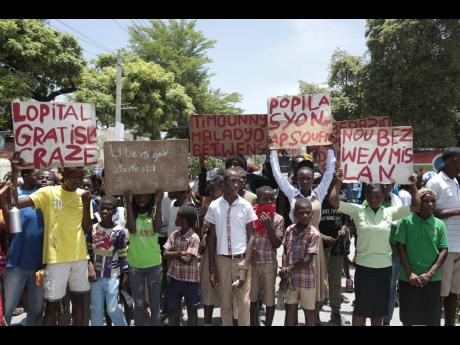
Kenya’s willingness to lead a multinational security force in Haiti is a critical development for millions of Haitians traumatised by more than two years of internal insecurity, since the 2021 assassination of President Jovenel Moïse.
Hopefully, Kenya will soon get the necessary support – economic, manpower and legal endorsement – to move ahead with the mission, in which Jamaica and other Caribbean Community (CARICOM) states must also assert leadership. Happily, CARICOM is already involved in efforts to help Haitians fashion solutions to their problems.
But Kenya’s decision may have potentially wider geopolitical implications. For it suggests, possibly, a further step in a deepening relationship between the Caribbean and Africa, with implications for cooperation between this region and countries of the Global South. Kenya has been at the forefront of the recent efforts at expanding the transatlantic contacts.
Political instability in Haiti is, of course, neither new nor recent. But the country’s old problem of weak institutions of democratic governance, and the inability of its political elite to forge sustained political consensus, was fractured further by Mr Moïse’s killing – apparently orchestrated by internal and external political factions.
VIOLENT GANGS
That crisis is now overlaid by the rise of violent gangs that operate with impunity, unchecked by the country’s weak, and crumbling, national police. Hundreds of ordinary Haitians and scores of police officers have been killed by the gangs, which have carved out territory, kidnap for ransom, and sometimes restrict movement, even blockading ports. The United Nations has warned that millions of Haitians face food insecurity. Many have fled the country.
For several months, Haiti’s interim Prime Minister Ariel Henry has appealed for a United Nations-endorsed international security force to help stabilise the country. While Jamaica and a handful of the states have said they would contribute manpower to such a force, until now no country with the necessary security heft came forward to be at the forefront of the project. It has not helped that past experiences with foreign security initiatives have caused large swathes of Haitians – as well as many external groups – to distrust, or be wary of, such interventions in Haiti, especially when engineered by major Western powers.
The announcement last weekend by Kenya’s Foreign Minister Alfred Mutua that his country had “accepted to positively consider leading a multi-national force to Haiti”, could possibly change the old political and cultural dynamic, leading to a better outcome this time. Once it gets the Security Council’s backing to assemble what would be a non-United Nations force, Kenya, Mr Mutua said, was ready to deploy 1,000 police officers to help train the Haitian national police and assist it to “restore normalcy in the country and protect strategic installations”.
The cultural gulf between Haitians – who won their independence in a revolution that overthrew French slavery – is unlikely to be as wide with a force composed largely of East Africans and Caribbean security officials, than if the security officials were mainly from Western countries. Moreover, Kenya, with respect to Haiti, does not bring political baggage.
DE FACTO OCCUPATION
However, while the multinational force is important to stabilising Haiti’s security, its mandate, by whatever process, implied or real, must not evolve into a de facto occupation. So, even as CARICOM’s Eminent Persons Group attempts to coax Haiti’s political factions to democratic consensus, and the region helps in institution building, ownership of the outcomes must be authentically Haitian. They cannot be imposed.
Regarding Kenya’s involvement in this project, it is, on its face, a continuation of the initiatives of recent years of CARICOM more aggressively engaging Africa. Kenya has emerged as an important conduit through which that relationship is being expanded.
During the COVID-19 pandemic CARICOM forged an agreement to acquire vaccines through the African Union’s African Medical Supplies Platform. In 2021, CARICOM and Africa held a virtual summit, largely at the initiative of Barbados’ Prime Minister Mia Mottley, who has sought to re-energise relations with the continent. And last year, an Africa-Caribbean investment forum was held in Barbados.
These initiatives were facilitated mostly by former Kenyan President Uhuru Kenyatta, who visited the Caribbean in 2019 and co-hosted the virtual summit nearly two years ago.
Mr Kenyatta’s successor, William Ruto, has continued his predecessor’s forthright promotion of cooperation between countries of the Global South, which makes a deepened partnership with CARICOM, and an initiative as the one proposed for Haiti, quite understandable. But for distance, Mr Ruto might well mistake the Caribbean for a continental neighbour to Kenya’s west.