
Don Dobson | Gender diversity and governance in sports organisations
Published:Monday | August 7, 2023 | 12:06 AM
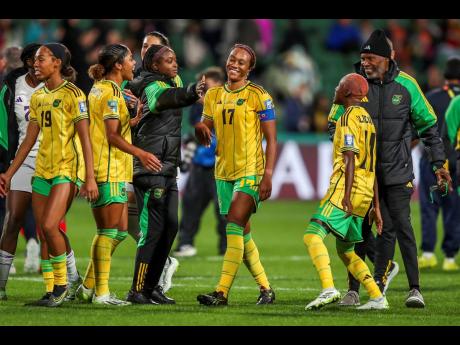

With the FIFA Women’s World Cup in full swing and the history-making Reggae Girlz making us proud with every kick of the ball, now seems like an opportune time to revisit the topical issue of gender diversity in sports, specifically female representation on the boards of sports organisations.
Women represent a significant, untapped resource that can enable sports teams and clubs to be stronger and more agile. Gender diverse boards have access to more diverse resources, achieve higher organisational performance, and are more responsive and resilient as they can tap into the unique skills, experiences, contacts and networks that women possess.
For perspective, in their study on women representation in the boardroom of Canadian sport organisations, Professor for Sport Management at Bielefeld University, Germany, Pamela Wicker, and Associate Professor at Brock University, Canada, Shannon Kerwin, found that organisations with medium women representation (on average 3.9 women, or 44.9 per cent) generate significantly higher per capita revenues than those with high and low women representation. This suggests gender equality, rather than gender skewedness, is associated with higher financial resources.
Accordingly, Jamaica’s sports organisations, particularly national governing bodies of sport, may want to move post-haste to adopt a gender-diversity policy or gender equality as an organisational value, and include and operationalise the promotion of gender equality in their statutes. A starting point could be gender quotas requiring that their boards and committees consist of 30 per cent of either sex.
WHY 30 PER CENT?
According to critical mass theory, for an organisational minority or subgroup, for instance women, to influence and positively impact an organisation’s culture and/or performance, it needs to reach a certain threshold or critical mass. This threshold is approximately one-third of the group, and, in terms of gender, could be translated to three women or 30 per cent women, depending on the size of the board. The more balanced a group, the greater the likelihood that both the majority and the minority will have meaningful influence, as gender-based differences become less important and the focus is on the abilities and skills that women and men bring to the table.
This is supported by research carried out by a team led by Dr Jasmin Joecks of the University of Tuebingen, Germany, which explored the link between gender diversity in the boardroom of listed German firms and firm performance based on critical mass theory. The team concluded that a critical mass of women, approximately 30 per cent female representation, was necessary for an organisation to realise the advantages of a gender-diverse board. Their results suggest that a more gender-diverse board composition will only enhance performance if diversity is sufficiently large, and that boards with a critical level of 30-plus per cent females (three-plus women on the board), outperform male boards and is associated with higher organisational performance.
DOESN’T TRANSLATE TO INFLUENCE
While a quota system is important for the numerical presence of women on boards, it does not always translate to women having more power and authority and can easily become a box-ticking exercise. For a quota system to be effective, if that is the approach favoured by an organisation, it must be used in conjunction with other measures, for example, the appointment of women directors to influential board roles. Women need to be in leadership positions, not just be board members.
In theory, Jamaica’s sports organisations should not have a problem recruiting women to serve in leadership positions, given the success of the country’s women in business and management, and in the sporting arena. One might recall the 2018 International Labour Organisation publication Women in business and management: Gaining momentum in the Caribbean, which reported that Jamaica had the highest proportion of women managers in the world at 59 per cent. In terms of sporting performance, Jamaica’s women have won 32 of the country’s 49 Olympic medals since 2004, and the women’s senior national football is the only national team from the English-speaking Caribbean, male or female, to qualify for consecutive FIFA World Cups.
RESEARCH
Some of the country’s national governing bodies of sport have already made headway in the area of gender diversity. In a 2021 study which involved 12 of the Jamaica Olympic Association’s 43 member federations, six of the participating organisations reported having at least 30 per cent women directors as board members (‘Good Governance in National Governing Bodies of Sport in Jamaica: An Analysis of the Jamaica Olympic Association’s Member Federations’ – unpublished dissertation).
It would augur well for the Jamaica Olympic Association to commission research on women’s representation among its members in terms of numerical representation, influence and decision-making power, and explore the relationship between gender diversity and organisational performance. Such studies would support data-driven policy formulation and interventions to promote gender diversity, good governance and ultimately, stronger sporting bodies in Jamaica.
Don Dobson is a Chevening Scholar and a member of the board of the Sports Council for Glasgow, Scotland. Send feedback to columns@gleanerjm.com.