
Editorial | Irresponsible Kamla
Published:Sunday | August 13, 2023 | 12:06 AM
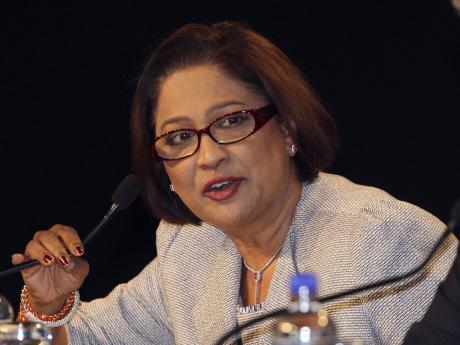
This newspaper might, in other circumstance, have ignored the recent tirade by Trinidad and Tobago’s opposition leader, Kamla Persad-Bissessar, about the financial strength of the NCB Financial Group (NCBFG) and its subsidiary, Guardian Holdings Limited (GHL), as just another rant by a politician seeking to rile an electorate against a government to gain advantage for her party.
But to ignore Ms Persad-Bissessar and failing to call out her egregious behaviour would be equally irresponsible, with potentially bad consequences for the Caribbean Community (CARICOM), upon whose financial sector she, with seeming cynicism, apparent selfish motive, and malice aforethought, courted systemic financial crisis. The point is that Ms Persad-Bissessar, former prime minister and current holder of high constitutional office, can’t have been ignorant of what could flow from her actions.
The NCB Financial Group, which is listed on the Jamaica Stock Exchange, is majority-owned by the Jamaican businessman, Michael Lee-Chin. NCBFG is the ultimate parent (61 per cent) of Guardian Holdings Limited, which is headquartered in Port-of-Spain and is separately listed on the Jamaican and Trinidadian exchanges.
It is a quirk of history and, perhaps, business cycles, that GHL is owned by Mr Lee-Chin. Guardian entered Jamaica during the island’s financial sector meltdown of the 1990s, buying the stripped-down business of the collapsed Mutual Life Assurance Company when cash-rich Trinidadian firms were acquiring cheap assets in Jamaica. It is at that time, and under similar circumstances, that Mr Lee-Chin bought NCB Jamaica, one of the financial institutions from which the Government had culled dud assets. Four years ago, Mr Lee-Chin completed a drawn-out acquisition of GHL.
IN THE NEWS
Recently, the NCB Financial Group has been on the news. Mr Lee-Chin fired the group’s two top executives, the CEO, Patrick Hylton, and chief financial officer, Dennis Cohen. Mr Lee-Chin the group’s chairman, curiously appeared to blame the executives for the group’s prolonged failure to pay dividend to shareholders. He also wished to claw back on their salaries to cut costs.
Neither information in the public records nor statements from regulators suggest that NCBFG or its subsidiaries are stressed although the profits and operating ratios aren’t as robust as during its previous years of heady growth. NCBFG net profit in 2022, before other comprehensive income, was approximately J$40 billion.
Indeed, in the midst of the management kerfuffle last month, the Bank of the Jamaica (BOJ), the industry’s regulatory authority, declared NCBFG and its member companies to be “profitable, strong, and possessing sufficient capital and liquidity, which are above regulatory requirements”.
Financial institutions exist, and thrive, on their customers’ confidence – people’s belief that they will get their money when they want it. But no bank would be able to return all the money owed to depositors if they all demanded their funds at the same time. Which doesn’t happen unless something takes place to induce panic, triggering a run on the bank, which, in some situations, can lead to a systemic crisis.
That is the potential danger Ms Persad-Bissessar courted in her Port-of-Spain remarks: the near equivalent of shouting fire in a crowded theatre.
The leader of the United National Congress (UNC) conflated NCBFG’s failure to pay dividends, the decline of its share price, and the recent management contretemps into a contrived balance-sheet crisis. Then she linked that with NCBFG’s raising of bonds for the Trinidad and Tobago government, some of which were, seemingly, underwritten by Guardian Holdings and subscribed by Trinidadian institutions.
She also claimed a coincidence between presumed losses in the Trinidad and Tobago government’s Heritage and Stabilisation Fund and NCBFG’s supposed “financial turmoil” and wanted to know if the former had invested in the latter.
MORPHED
Then Ms Persad-Bissessar’s speculation morphed to “the potential failure of the NCB Financial Group”, which would “pose a systemic risk to our financial sector”.
“There can be a cascading failure in our financial system due to the interconnecting linkages between NCB Financial Group, Guardian Holdings Limited, and local banks and financial institutions in our country,” she said. In that scenario, the portfolios of “tens of thousands of our citizens” would be in jeopardy, as was the case with the collapse of Lawrence Duprey’s Clico holdings in 2009, an event that had ripple effects across CARICOM.
Except in the post-Clico debacle, the regulatory powers of the Trinidad and Tobago central bank over the financial sector was greatly enhanced. A new insurance industry law was passed in 2018, and amended two years later, to further tighten the companies’ regulatory ratios, widen the authority of the regulator to intervene in companies that fall short of the requirements, and to impose greater transparency on insurance firms and their parent groups. There is no sign that Guardian Holdings is in need of these prescriptions.
This is a matter that is not one of mere domestic politicking, if that was Ms Persad-Bissessar’s intent. The ultimate goal of CARICOM, of which Trinidad and Tobago is a member, is to transform itself into a single market and economy. The community’s greatest success so far on that front is in the free movement of capital. Financial services companies are the greatest beneficiaries of this.
So Ms Persad-Bissessar is right about the growing interconnectedness of financial services companies. Not just in Trinidad and Tobago. Systemic risks are now regional. Which is why resourceful regulators who cooperate across borders are necessary. This interconnectedness is another reason why irresponsible politicians shouldn’t induce panic in crowded theatres.