
Peter Espeut | Our controversial heritage
Published:Friday | October 13, 2023 | 12:06 AM
Every year during National Heritage Week we are fed a sanitised diet – almost national myths – concerning our history and our heroes. We glory only in certain (more positive) aspects of the heritage we have inherited from our ancestors, and we choose to ignore the less noble parts of our patrimony.
We glory how Nanny and the other Maroons fought the British soldiers and the Jamaican militia – and won – signing a peace treaty with the colonial government. We call the Maroons “freedom fighters”, but we close our minds to the fact that after signing that treaty, they became bounty hunters, turning in runaway slaves (or their ears) for the reward money, and putting down rebellions by slaves seeking their freedom.
We glory in the resistance to slavery and the revolts of Tacky and Blackwall and Sam Sharpe, while choosing to forget the constant betrayal of slave revolts by “loyal” slaves. No slave revolt in Jamaica was ever successful. Sucking up to the Backra Massa is part of our heritage too!
Although today we call them heroes, Deacon Sam Sharpe, Deacon Paul Bogle and Deacon George William Gordon were vilified – and ultimately executed – by plantation Jamaica as unsavoury characters who challenged the status quo, holding back progress; but many elements of that status quo (gross inequality, landlessness, homelessness, illiteracy, injustice, police brutality) remain with us today, woven into the fabric of modern Jamaican society. We honour these martyrs as heroes, but not the causes for which they gave their lives. It is somewhat superficial.
Marcus Garvey, Norman Manley and Alexander Bustamante bucked colonial Jamaica, and were not considered heroes by them; Garvey and Bustamante were, in fact, incarcerated by the civil authorities. What is the message that their lives should be sending to contemporary Jamaicans, especially during National Heritage Week? Is it that heroes are persons who see something seriously wrong with the society in which they live, and have the courage and the will to make personal sacrifices to criticise and advocate and battle to change it? Do the authorities of independent Jamaica want any more effective heroes to appear on the landscape?
PROTEST
Protest is part of our heritage, and we do a lot of it, but without seeking to be heroes. And I am not just talking about blocking roads. Rastafarianism, backed up by Reggae music – which has been elevated to a global movement – is aggressive protest against Eurocentric Jamaican society (including Christianity). And (read “Jamaica Genesis” by Diane Austin-Broos) Pentecostalism is a similar if more benign version of the same thing. Hundreds of thousands of Jamaicans daily live lives of protest against an unjust social and economic order in a very un-heroic manner.
If truth be told: garrisons, “christening pickney first”, graft, nepotism, cronyism, kick-backs, influence-peddling, vote-buying, ballot-stuffing and political donmanship are all part of our political heritage; and every year, more and more Jamaicans actively protest against this corrupt system by dropping out into what the polls call the “uncommitted”, and suffer the ignominy of being accused of “apathy”.
And the real heroes of our youth – the real role models they seek to emulate – are assorted DJs and dancehall artistes, whose music promotes misogyny, violence, scamming, conspicuous consumption and sexual profligacy, and who operate on the borderline of criminality, notoriety and politics. No Jamaican youth seeks to emulate Nanny, Sharpe, Bogle, Gordon or Garvey. There are the official National Heroes, and then there are the real heroes Jamaicans admire and adulate.
Our primordial Jamaican heritage is our natural environment – flora and fauna, in ecosystems including forests, coral reefs, rivers and mangroves; and rather than glorying in our natural heritage, the government and private sector have joined together to exploit as much of it as possible for private gain (through deforestation and mining, for example, giving “development” a bad name). To be an environmentalist in Jamaica today is to be vilified, to be considered backward – a Luddite and even a troglodyte – and against “progress”. You never see environmentalists in the National Honours lists, which is only to be expected: national honours (with titles such as “Honourable” and “Most Honourable”) are part of the political spoils, to be shared among the dwindling political classes and their supporters.
LIONISE CHRISTIAN MISSIONARIES
We lionise Christian missionaries who laboured to make Jamaica a “Christian country” [like William Knibb (we gave him an OM), Jacob Zorn, Hope Masterton Waddell, Joseph Dupont SJ (a statue of him was placed in the Parade by public subscription), and Henry Bleby], while at the same time perpetuating superstition and spiritualism as our heritage and culture (like Bruckin’s, Dinky Mini, Kumina, Pukkumina, Gereh, Zella, Revival Zion, Burru, Obeah and Myal; and don’t forget belief in dreams, divination, and number systems like drop-pan – aspects of our cultural heritage we are actively passing on to the next generation). We haven’t really made up our minds what parts of our conflicting and contradictory cultural heritage we want or don’t want to keep.
If heritage is what we pass down from generation to generation, then illiteracy is a big part of it. Our layered multi-quality (much of it poor quality) education system makes sure that Jamaica’s class system is replicated from one generation to the next; both parties have made sure of that! And we studiously ignore the solutions contained in, e.g. the 2004 Rae Davis Report and the 2021 Patterson Report. I guess it is harder to “fool up” educated people.
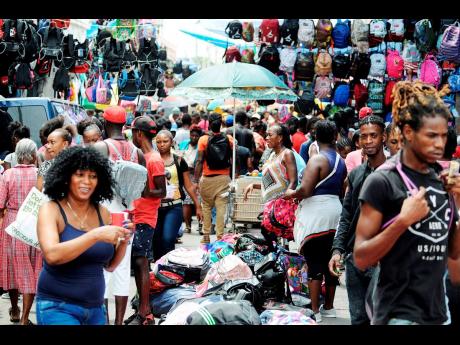
Small-scale higglering is another large and long-standing part of our economic heritage, which we seek to preserve at all costs, whether it is sidewalk-vending or street food. In fact, the iconic Jamaican woman is a higgler, and the national costume – on display at the Miss World and Miss Universe pageants – is the getup of a market vendor complete with bib and straw hat. How many of today’s young Jamaican women aspire to that?
Give us vision lest we perish!
Peter Espeut is a sociologist and development scientist. Send feedback to columns@gleanerjm.com