
Editorial | Tavares-Finson’s flaccid case
Published:Monday | August 5, 2024 | 12:07 AM
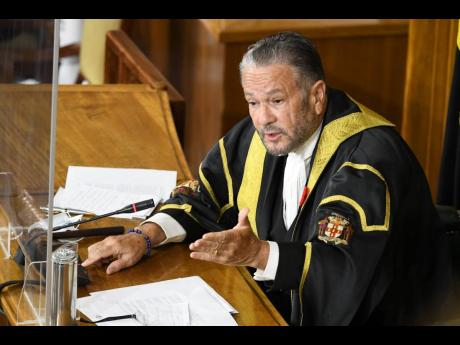
Like any other Jamaican, and as one of the initial defence lawyers in the case, Tom Tavares-Finson is in his right to welcome the Court of Appeal’s decision against ordering the retrial of Vybz Kartel and his buddies for the murder of Clive ‘Lizard’ Williams.
But as a minister of justice and president of the Senate, the upper chamber of Jamaica’s Parliament, it cannot be right for Mr Tavares-Finson to use process that led to the court’s decision, to implicitly trash, as this newspaper interprets his remarks, the quality of jurisprudence in the island’s courts.
Neither is the outcome of the Kartel matter a sound basis for what we see as a subliminal assault of the Caribbean Court of Justice (CCJ). Nor is it an argument for maintaining the Judicial Committee of the Privy Council, which is based in London, as Jamaica’s apex court.
Mr Tavares-Finson is worthy of providing a more substantial intervention on the Privy Council-CCJ debate. The offices he holds demand it of him.
Vybz Kartel is the stage name for Adidja Palmer, a popular Jamaican dancehall DJ. In 2014, Kartel and three associates – Shawn ‘Shawn Storm’ Campbell, Kahira Jones and Andre St John – were convicted for killing Williams, whose body was never found.
The group was each sentenced to life imprisonment, having to serve long stretches before being eligible for parole.
CONVICTIONS UNSAFE
The Privy Council, however, held that the convictions were unsafe because the presiding judge allowed a juror, who attempted to bribe other members of the panel to return not-guilty verdicts, to stay on the case.
The judge heard about the bribery attempts on the last day of a very involved, 64-day hearing. The prosecution, who, on its face, had most to lose, was willing to continue with the compromised juror. The trial judge ruled in their favour. That position was upheld domestically by the Court of Appeal.
The issue decided by the Privy Council was not whether Karl and his co-accused were guilty of the crime. The ruling had to do, primarily, with procedural justice.
The Privy Council held that there was a possibility the uncompromised jurors could possibly overcompensate for the actions of the tainted colleague.
Additionally, unlike the Court of Appeal, the Privy Council did not believe that the trial judge had done, or could have done, enough to remedy any potential consequential bias against Kartel and the others.
“In coming to this conclusion, the Board is mindful of the very serious consequences which may flow from having to discharge a jury shortly before the end of a long and complex criminal trial,” the Privy Council said. “It is also very conscious of the danger of deliberate attempts to derail criminal trials, in particular in their closing stages, by engineering situations in which it becomes necessary to discharge the jury.”
It is true, as Mr Tavares-Finson said, that the Privy had “quashed Kartel’s conviction” and may have indeed given credibility to “various objections” raised by his defence lawyers at the trial.
UNDERLYING MESSAGE
What we question is the implication, or underlying message, in this statement by Mr Tavares-Finson: “I think the fair treatment of this kind of high-profile matter by the Privy Council is another reason why many Jamaicans, including myself, support its retention as our country’s final court.”
That remark, of course, has to be read in context of the ongoing debate on whether Jamaica should leave the Privy Council and accede to the civil and criminal jurisdictions of the CCJ.
It seemingly falls into the camp of those who have argued that “pure justice” comes from the Privy Council and London.
This newspaper raises no question about the soundness of the Privy Council’s decision in the Kartel matter, but reminds Mr Tavares-Finson of this observation by US Supreme Court justice, Robert Jackson, in the 1953 case Brown V Allen: “Whenever decisions of one court are reviewed by another, a percentage of them are reversed. That reflects a difference in outlook normally found between personnel comprising different courts. However, reversal by a higher court is not proof that justice is thereby better done. There is no doubt that, if there were a super-Supreme Court, a substantial proportion of our reversals of state courts would also be reversed. We are not final because we are infallible, but we are infallible only because we are final.”
Further, the alternative currently on the table to the Privy Council as Jamaica’s final court is the CCJ, whose jurisprudence, by implication, Mr Tavares-Finson impugns, without offering an analysis of its judgments, whether done personally or by some other competent authority. Which, by the way, has received high commendations for its judgments.
Additionally, if we take his statement at face value, Mr Tavares-Finson could not countenance a Jamaican final court.
Nor does he seem bothered by the philosophical underpinnings, in the context of Jamaican sovereignty and independence, of appeals to the Privy Council being petitions to a king in London.
He seems not to have given thought either to the observation by Bruce Golding, his former party leader and prime minister that Jamaica, ultimately, does not have the power to decide whether it keeps the Privy Council. That is in the gift of the British parliament which can choose whether or not it maintains the 1833 law that established the court.