
Editorial | The CCJ and choosing judges
Published:Tuesday | August 27, 2024 | 12:05 AM
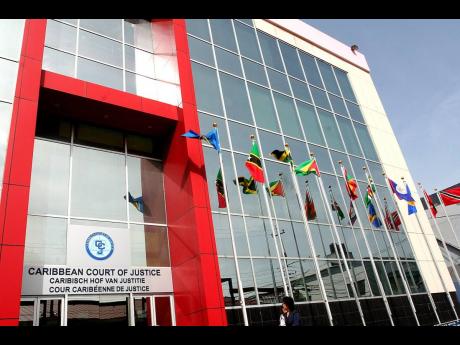
While The Gleaner celebrates Chantal Ononaiwu’s elevation to the bench of the Caribbean Court of Justice (CCJ), the development is a reminder that Jamaica has unfinished business with the court. Jamaicans should know where their governments stand on the court.
At the same time, the process by which Dr Ononaiwu was selected reinforces our position on the urgent need for a new mechanism by which judges are appointed in Jamaica. The system must be transparent and competitive, with the public knowing who is being considered and the criteria by which successful candidates are selected.
Jamaica already participates in the CCJ in its role as the interpreter of the Revised Treaty of Chaguaramas (RTC), the agreement that established the Caribbean Community (CARICOM) as a regional single market and economy.
Indeed, the CCJ’s most consequential ruling so far with respect to its original jurisdiction was the case brought by a Jamaican woman, Shanique Myrie, that established the right of CARICOM citizens to hassle-free movement within the community.
However, the current administration has been disinclined to have Jamaica accede to the CCJ’s criminal and civil jurisdictions, which would mean replacing the Judicial Committee of the Privy Council in Britain as the island’s apex court.
KEPT ISSUE OUT
The Government kept the issue of the final court out of the current round of discussions on reforming the island’s Constitution, focusing instead on its plan to remove the British king as Jamaica’s head of state.
Neither has it indicated what its preferred final court might look like despite a promise that Prime Minister Andrew Holness would have declared a definitive position on the CCJ several months ago.
With the political Opposition tying any support for the removal of the monarchy to accession to the CCJ, thus rendering the constitutional reform process moribund, it is urgent that the Government clarify the basis of its aversion to a regional court, thereby allowing for a robust debate of the issue.
This newspaper supports Jamaica’s transition from the monarchy to a republic. But we also believe that ditching the Privy Council and joining the CCJ ought to be a single, indivisible exercise.
Regarding Dr Ononaiwu joining the bench of the CCJ, she will be the second Jamaican on the court after Justice Winston Anderson, its most senior judge after the president, Adrian Saunders. Justice Anderson could, possibly, become the CCJ’s next president when Justice Saunders reaches the court’s mandatory retirement age of 72 in 2026.
Dr Ononaiwu’s suitability for the CCJ post can hardly be in question although she has not previously been a judge.
Most recently, Dr Ononaiwu was the director of external trade at the CARICOM Secretariat. However, she is a graduate in law from The University of the West Indies (UWI). She also holds law-related master’s and PhD degrees from Cambridge and Oxford universities, respectively. She has lectured in trade and investment and public law.
However, Dr Ononaiwu was not merely ushered on to the CCJ bench. She was among applicants from nine countries, including the United States, Canada, Britain, Nigeria, and Sri Lanka. Four candidates were short-listed and interviewed by the Regional Judicial and Legal Services Commission (RJLSC), which appoints CCJ judges.
Put another way, the job was widely advertised and the process of her appointment rigorous.
“This process ensures that our court continues to be a beacon of fairness and excellence, characterised by the utmost professionalism and impartiality,” said Justice Saunders, who chairs the RJLSC.
ROBUST AND TRANSPARENT
It is for a similarly robust and transparent approach to the appointment of judges to Jamaica’s courts, especially for the posts of chief justice and president of the Court of Appeal, for which The Gleaner has campaigned. Indeed, we continue to insist that the recent elevation of Marva McDonald Bishop to the presidency of the Court of Appeal should be the last time there is an absence of transparency and competition for these offices. That has nothing to do with the competence of Justice McDonald Bishop or the esteem in which she is held by this newspaper, which is high.
At present, Jamaica’s Constitution effectively gives the power to appoint the chief justice and the president of the Court of Appeal to the prime minister. He only has to consult with the leader of the Opposition before making his recommendation to the governor general.
That, on its face, places constitutional limits on the approach we, and many other Jamaicans, recommend. It need not be the case, if the Government wishes to be creative, until the Constitution has been reformed.
First, there is little, in our view, that stops the Legal Services Commission, which appoints other judges, from advertising judgeships and declaring the qualities being looked for in judges. With respect to the chief justice and the president of the Court of Appeal, the prime minister can, if the circumstance arises, adopt the approach used by the Canadians, whose prime minister (PM) is constitutionally responsible for appointing the judges to the country’s top court.
Essentially, Canada has outsourced that process to an independent body, while keeping within the constitutional framework.
The committee advertises for, then short-lists and interviews the best candidates, from whom they may propose three to the PM to make his choice.
Two eminent Jamaicans, Chief Justice Bryan Sykes and Jacqueline Samuels-Brown, KC, who practises at the private Bar, sit on the RJLSC. Maybe they, too, should begin to loudly make the case for Jamaica’s reform.