
Elizabeth Morgan | USA main beneficiary of its foreign aid
Published:Monday | February 17, 2025 | 9:57 AM
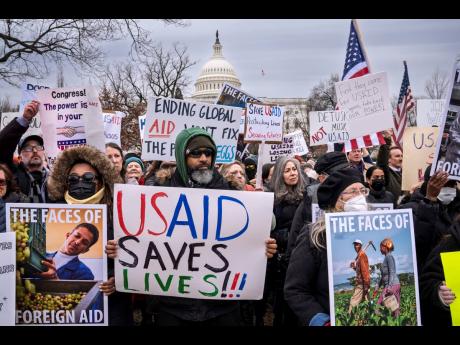
The United States provides foreign assistance to Latin American and Caribbean countries to support development and other US objectives. The emphasis of US policy in the region has shifted over time … Over the past decade, top US funding priorities for foreign assistance in the region have included addressing the underlying drivers of migration, combating drug production [and] strengthening security and the rule of law. US agencies also have prioritised programmes intended to counter HIV/AIDS and instability in Haiti, address security concerns in the Caribbean, and respond to the political and humanitarian crises …
– Extracted from the Congressional Research Service Summary for Latin American and the Caribbean, November 2024.
THE RECENT developments in the USA have brought US foreign aid (overseas development assistance, ODA) to public attention. This aid is or was administered through the US Agency for International Development (USAID). USAID, created in 1961, is now being closed.
All developed countries provide ODA to developing countries both in cash and kind. Developing countries, including China, to the extent possible, also provide ODA or technical assistance. In the 1970s, to assist developing countries in their development, within the UN system, and particularly through the United Nations Conference on Trade and Development (UNCTAD) and the decades of development, an ODA target was set. Developed countries were to contribute 0.7 per cent of Gross National Income (GNI).
ODA CONTRIBUTION
The USA has never met this target. Currently, the ODA provided by developed countries is as follows: Norway – one per cent; Germany – 0.8 per cent; Switzerland – 0.6 per cent; European Union collectively – 0.6 per cent; United Kingdom – 0.58 per cent; Japan – 0.44 per cent; Canada – 0.38 per cent; New Zealand – 0.31. per cent; United States – 0.24 per cent; Australia – 0.20 per cent.
Note that the US’s ODA is 0.24 per cent of its GNI. Nevertheless, the USA is the largest donor due to the size of its economy.
US ODA policy
The USA’s ODA policy is set by the administration of the political party in power highlighting its interests. USAID implements that policy with funding approved by the Congress. The Senate Foreign Relations Committee has oversight of all foreign relations matters including the USAID.
The current Secretary of State, Marco Rubio, as a Republican Senator, served on the Senate Foreign Relations Committee. It is reported that, as a Senator, he was supportive of the work of the USAID.
Under the Obama administration, 2008-2017, and the Biden administration 2020-2025, promoting human rights was an important issue. It included the rights of the homosexual and transgender community. Diversity, equity and inclusion (DEI) was a policy of the government.
The USA has felt that it had the mission to promote human rights and democratic principles around the world. The Obama-Biden administrations also supported other issues such as climate change mitigation, security and health.
The Republican Party in office (G.W. Bush 2001-2009; D.J. Trump 2016-2021), through the USAID, also promoted its interests.
There are some issues, such as security through the Caribbean Basin Security Initiative, which have had bipartisan support. In fact, in health care, the US programme supporting HIVAIDS called ‘The US President’s Emergency Plan for AIDS Relief (PEPFAR)’, was established by Republican President George W. Bush in 2003 and has continued under all administrations since.
Also, note that there are rules and regulations governing which countries are eligible to receive aid. Countries in CARICOM, which are classified as high and upper middle income countries, are not eligible for ODA, unless under special circumstances. Haiti receives most US aid in the CARICOM region. Jamaica is also a recipient.
DO THESE POLICIES REFLECT THE INTERESTS OF THE AMERICAN PEOPLE?
It would seem that these foreign aid policies reflect the interest of the majority of the American electorate who supported the party holding the presidency. In 2008, Barack Obama won 53 per cent of the popular vote and, in 2012, 51 per cent. In 2020, Joe Biden won 51 per cent of this vote. In 2016, although not winning the presidency, Hillary Clinton won the popular vote by 48 per cent. In 2024, Donald Trump was the first Republican to win the popular vote since 1988. He won by 49.8 per cent.
Polls have shown that Americans support rights for homosexual and transgender people. A majority of Americans continue to support same-sex marriage. Polls also show that, generally, Americans support DEI programmes in the USA. Most Americans also support legal abortion.
This would indicate that the policies of the Democratic presidents in office reflected the interest of the majority of the voting population.
DOES US FOREIGN AID REFLECT THE INTERESTS OF RECIPIENT COUNTRIES?
The US administrations, through USAID, determined what foreign aid programmes/projects they offered in recipient countries. They determined which non-governmental organisations to support. So, for example, the USAID, following administration policy, would finance groups in Jamaica which do not have majority support in this country and are counter to existing laws. Of course, the recipient government would support projects/programmes on its agenda (climate change, health, security, and others).
The goods and services supplied under aid projects must be secured from the USA. So, much of the money goes back to the US. It is tied aid.
So, US foreign aid, while having good outcomes in recipient countries, are designed largely to benefit the donor, the USA.
TAKING THE SLEDGEHAMMER APPROACH
So, it would seem that this Trump administration, following customary practice, could have reviewed the programmes being implemented by the USAID and revise and/or introduce ones that reflect its own policies. Instead, it seems the sledgehammer approach has been taken aimed at publicly destroying the agency and removing what is left to the State Department (the Foreign Ministry).
Other countries, concerned about the use of taxpayers’ money and exerting their influence, have reviewed and revised their foreign aid policies and programmes with little fanfare. They wanted to ensure that ODA is a tool of foreign policy. The Canadian International Development Agency was incorporated into Global Affairs Canada (the Foreign Ministry) in 2013. In the UK, the Department for International Development was rebranded in 2009 as UK Aid and was incorporated into the Foreign, Commonwealth and Development Office (the Foreign Ministry).
The main conclusion here is that US aid has always been implemented in the US interest through USAID. This freezing of aid provides another opportunity for countries in the CARICOM region to assess options and look to their development.
Elizabeth Morgan is a specialist in international trade policy and international politics. Send feedback to columns@gleanerjm.com