
Peter Espeut | The 1,700th anniversary of Nicaea
Published:Friday | May 23, 2025 | 12:07 AM
Bible quiz time!
First question: Did the Holy Spirit stop revealing truth to the Church after the last book of the Bible was inspired and written? Fundamentalist churches say yes! “If it is not in the Bible, it is not true”, they claim. “If God wanted us to believe something important, he would have inspired Bible writers to include it in the Bible”. “The Bible is the only source of certain truth”. “The Bible is the ultimate source of truth”.
Of course, the Bible does not make this claim about itself. In fact, Jesus clearly tells his apostles – the first leaders of the Church He founded – that there are important truths still to be revealed. “I have much more to say to you, more than you can now bear. But when he, the Spirit of truth, comes, he will guide you into all the truth” (John 16:12-13).
And so the correct answer to the first question is decidedly “NO!” The Holy Spirit continues to reveal important truths to his Church, down to the present day.
Second question: Which came first: the Bible or the Church? Of course the Church came first. The Acts of the Apostles begins with the birthday of the Church (Pentecost) and along with the letters of Paul and the other apostles tells us of her early history.
In fact, the Bible came out of the Church. It was only at the beginning of the 3rd century (220 AD), that the New Testament was fully formed in the sense that its content was sharply defined and universally received, and all the present 27 books were recognised as being inspired by God. Many other books were rejected, such as the Gospels of Thomas and Mary Magdalene, Paul’s Letter to the Laodiceans, the Letter of Barnabas, and hundreds more. This decision to accept 27 books was led by the Holy Spirit, and confirmed by the Bishops in the Council of Rome in 382 AD.
No Christian denomination in existence today challenges the content of the New Testament canon as fixed by the Catholic Church in the 4th Century.
I always wonder how fundamentalists would have survived for 400 years without the Bible!
Last question: Does the Bible claim to be ultimate source of truth?
Many say “yes!”, and quote 2 Timothy 3:16-17 as their authority:
“All Scripture is inspired by God and is useful for teaching, rebuking, correcting and training in righteousness, so that the man of God may be thoroughly equipped for every good work”.
The ultimate
reference point
What a weak statement: “useful for …”. Paul could have said that “all scripture is the ultimate reference point by which truth is to be judge”, but he did not!
What Paul did say is that “the Church of the living God [is] the pillar and foundation of the truth” (1 Timothy 3:15). Or to quote another translation: “the pillar and ground of truth”.
It is the Church that Jesus founded, guided by the Holy Spirit, that is the final arbiter of truth; and that is why the Church could fix the number of books in the Bible. There is no divergence between Scripture and Tradition: the Bible is part of the Tradition of the Church.
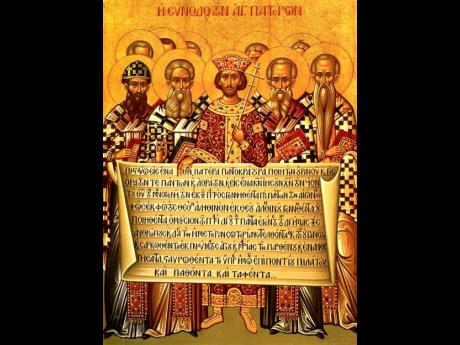
I give this long introduction to point out that last Tuesday (May 20) Christianity celebrated the 1,700th anniversary of the start of the Council of Nicaea in 325 AD at which the Church resolved some serious controversies plaguing Christianity at the time, and which still has impact today.
Quoting scripture, the presbyter Arius claimed that only the Father was eternal, and that Jesus, the Son – begotten by the Father, and “the first-born of all creation” (Col 1:15) – was not. In other words, “There was a time when he was not”. Jesus, then could not be divine, and God is not a Trinity of Persons. This was a fundamental challenge to orthodox Christianity!
Bishop Athanasius of Alexandria refuted Arius. The Son is begotten, yes, but eternally begotten. “There was never a time when he was not”. Using the language of the day, Athanasius declared that the Father and the Son were “homo-ousios” (homos = same, ousia = being, nature substance), which translates into Latin as “consubstantial” and into English as “one in being”. And so the Father and the Son (and the Holy Spirit) share the same divine nature but are three distinct persons.
The Christian Church still teaches this Trinitarian theology today, and the formula which came out of the Council of Nicaea is known as the Nicene Creed – recited weekly by many Christian congregations.
Recently I was invited to take part in a theological discussion by a group which did not accept the Trinity because it was not clearly defined in the Bible. As I tried to explain to them, before we could argue “Trinity” to come to some agreement, we had to agree on how the Bible is to be used, and about the possibility of theology and development of doctrine. Building on the Bible, the Holy Spirit has led the Church to deepen her understanding of the Godhead. For fundamentalists, Revelation has ceased, and the Holy Spirit has ceased to speak (except to them, of course).
My good (and late) friend Ian Boyne – the local leader of the Armstrongites (I miss him dearly) – did not believe in the divinity of the Holy Spirit, and we had many a civil debate on the subject.
The Nicene Creed says that the Holy Spirit “proceeds from the Father and the Son” – God from God.
It is the Christian doctrine (maybe I should say “dogma”) in the Nicene Creed first written 1,700 years ago which is held by many of the Christian denominations in Jamaica, that provides the basis for the fellowship we share. We would do well to meditate on its words as we search for deeper unity.
The Rev. Peter Espeut is a Roman Catholic deacon and is Dean of Studies at St. Michael’s Theological College.