
Editorial | After the Cricket West Indies summit
Published:Friday | August 15, 2025 | 12:12 AM
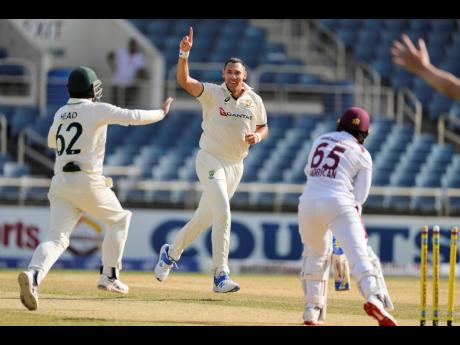
Many important things were apparently said or acknowledged at this week’s desperation ‘summit’, mustered by the honchos of Cricket West Indies (CWI), to grapple for solutions to the crisis that has long beset the game in the region.
But judging from the public comments, so far, by key participants in those discussions, one critical issue appears not to have been on the agenda of the meeting.
Or, if it was, it may not have been central to the debate, or not sufficiently so, for it to be addressed by the people who spoke at Monday’s media conference on the conference’s outcomes. They include CWI CEO, Chris Dehring; its director of cricket, Miles Bascombe; the chairman of the board’s cricket strategy and officiating committee, Enoch Lewis; and former great players, Clive Lloyd and Brian Lara.
Put another way, while the idea of broad stakeholder support as being critical to game’s recovery was liberally canvassed, no one at the briefing mentioned stakeholder participation in the context of the larger governance questions that have dogged CWI for decades. Neither did anyone suggest that it was raised as among the critical matters to be taken to the CWI governors.
Perhaps that was merely an oversight in the circumstances of an early post-meeting review. Which is why The Gleaner looks forward to CWI’s early publication of a formal conference summary and the “action plan” that Mr Dehring said his management team will take to CWI board.
ABSENCE OF CRITICAL FACTORS
For The Gleaner is clear. While some of the sport’s technical shortcomings, such as the training of coaches and improving the quality of pitches, may be easily addressed, there is unlikely to be fundamental transformation in the absence of two critical factors: the rediscovery of a philosophical framework for West Indies cricket; and the full acceptance of the notion of West Indies cricket as a public good.
If the latter is embraced, it highlights the contradictions of the narrow ownership and control of CWI by six territorial boards. Which then ignites the governance debate, and the several, mostly unimplemented, recommendations for the organisation’s overhaul.
In other words, in this newspaper’s view, any sustainable project to lift West Indies cricket out of its decades-old funk has to reckon with the Patterson Report and the Wehby Report, or a mix thereof.
After the great team of Clive Lloyd/Viv Richards era, from the mid 1970s to the early 1990s, the decline began to set in the mid-1990s, despite the periodic emergence of extraordinarily talented players and sporadic outstanding performances by the team, especially in the shortest, T20, format.
Indeed, in recent years, the West Indies has been ranked at the bottom, or near the bottom, on the global league table of cricket teams in all formats of the sport. That is a source of pain for most West Indians, for whom cricket wasn’t mere sport. It was symbolic of the region’s aspiration – from colonies of Empire, to independent nations that held a space where they dominated, and when they didn’t, were globally competitive.
AGONISING NEW LOW
However, West Indies cricket fell to an agonising new low at Sabina Park last month, when the team was bundled out by Australia for a measly 27 runs in the second innings of a Test match. It was the second lowest score in Test cricket’s history, and symptomatic of the quality of the team, especially in the longer formats of the game, where there is greater demand for discipline, concentrated effort and intellectual enterprise.
It was the shame of Sabina Park that spurred CWI president, Dr Kishore Shallow, to convene this week’s summit in a desperate search for answers – or probably to demonstrate that he wasn’t oblivious to, or a blasé about, the crisis.
Obviously, there are technical deficiencies in many of today’s players. According to Mr Dehring, among the proposed remedies for these problems were improved cricketing facilities across the Caribbean; higher quality of domestic competition; improved coaching at all levels; and the development of high-performance centres and cricket academies in the region.
As encapsulated by Mr Bascombe, the conference framed the problems as “systemic”, whose solutions were “not Cricket West Indies’ alone”.
Added Mr Lewis: “We have to find a way, not Cricket West Indies, but collectively – all of us in the West Indies.”
The Gleaner agrees. But collective action, in the context of cricket as a public good and expected taxpayers’ support to fund transformation, isn’t tenable with an oversight body that is a narrowly-held private entity – and which perceives itself as such. There is too little public accountability.
In this regard, the proposal of nearly two decades ago by the committee chaired by the former Jamaican prime minister, P.J. Patterson, for the remaking of the CWI and the governance of West Indies cricket, remains relevant. Patterson recommended the introduction of a 23-member Cricket West Indies Council, which would annually review the state and management of West Indies cricket and to set strategic goals. CWI would also be transformed to a publicly listed company.
Nearly a decade later, the late Jamaican businessman, Don Wehby, in a nod to Patterson, suggested a stakeholders advisory body, and lessening the dominance of the territorial associations of CWI by having their membership of CWI boards.
If not Patterson, a mix of Patterson and Wehby should be on the agenda.