
Our Jamaica
Looking Glass Chronicles - An Editorial Flashback
Published:Tuesday | April 1, 2025 | 8:25 AM
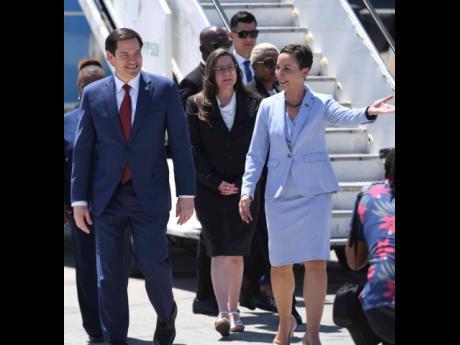
US Secretary of State Marco Rubio’s recent visit to the Caribbean included reassurances on re-evaluating travel advisories for Jamaica, acknowledgement of America’s role in the island’s gun crisis, and a softened stance on the Cuban doctor programme. While Caribbean leaders welcomed the dialogue, concerns linger about potential fallout from Trump-era trade policies, especially proposed levies on Chinese-built ships, which could threaten Jamaica’s logistics hub ambitions and raise import costs across the region.
Marco Rubio in the Caribbean
Jamaica Gleaner/30 Mar 2025
GIVEN THE unpredictability of Donald Trump’s administration, last week’s swing through the Caribbean by US Secretary of State Marco Rubio went reasonably well for the region.
In Jamaica, Mr Rubio promised to re-evaluate travel warnings cautioning Americans against visiting the island because of the country’s high levels of crime. Those advisories have bitten into the island’s critical tourism industry.
Yet Prime Minister Andrew Holness reported that crimes against visitors “represent less than 0.01 per cent of the more than three million visitors to Jamaica annually” and that the island has made progress in reducing all major crimes.
“I think we need to analyse that and just ensure that the status we’re currently in accurately reflects the status quo and takes into account the progress you’ve already made this year and made last year, year over year…” Mr Rubio said at a press conference.
And with America seeking the region’s support to help halt the trek of criminals to the US, Mr Rubio acknowledged that “many of the guns and the weapons that are being used by gangs to commit acts of violence here in Jamaica are purchased in the United States and then shipped here”.
“We want to commit to doing more to stop that flow at the same time as we do more to commit to increasing your capacity,” he said.
APPEARED MODERATE
He also appeared to moderate, at least with respect to Jamaica and the Caribbean, America’s previously hawkish stance against the use of Cuban doctors in the region’s health systems. Washington had threatened visa restrictions on countries that use them, claiming that the doctors, supplied under bilateral arrangements with Havana, were victims of human trafficking.
Caribbean leaders, including Prime Minister Holness, whose medical services would buckle without the presence of the Cubans, pushed back against this characterisation of the scheme.
According to Mr Rubio, the Trump administration has no Cuban provision of medical assistance per se, but with the structure of the programme, which, he claimed, breached international labour standards.
“Perhaps Jamaica is one of those (where the programme adheres to proper labour practices), and that’s fine. But I’m describing generally what the programme has been,” Mr Rubio said.
Caribbean governments seemed willing to undertake tweaks to the scheme with Cuba to assuage Washington.
Notwithstanding the affability displayed by Mr Rubio at all stops – Jamaica, Guyana, Suriname – while stressing America’s wish for partnership with the region on security and economic development, it would be unwise for the Caribbean to be lulled into a false assuredness that all the region’s concerns have been addressed, or secured. Indeed, there is a great likelihood – as this newspaper noted previously with respect to alumina refining in Jamaica – that Caribbean economies could still face collateral damage from Mr Trump’s policies as he pursues America’s economic and geopolitical rivalry.
LOGISTICS HUB
Jamaica’s intention of developing the island into a global logistics hub – an issue addressed favourably in Kingston by Secretary of State Rubio – for example, could be an early casualty of this competition. But even before that regional economies would face higher costs from a related element of Mr Trump’s effort to lure manufacturing back to the United States – in this case shipbuilding.
A review initiated last year by the previous Biden administration at the behest of unions, reported that in 1999 China’s share of global shipbuilding tonnage was a mere five per cent. By 2023 it had climbed to 50 per cent.
Fifty years ago, when Japan and South Korea dominated shipbuilding, American shipyards had 75 vessels under construction. Now they build five a year.
To reverse the trend, the US Trade Representative (USTR) has recommended fees of up to US$1 million for vessels owned by Chinese maritime companies to enter US ports. Alternatively, they could face a fee of US$1,000 per tonne on the net tonnage being transported by vessels.
With respect to Chinese-built ships operated by foreign companies, the port entry cost could be as high as a million-and-half dollars. The levies would fall relative to the proportion of Chinese vessels in their fleets, with the lowest being $500,000 if the fleet was 25 per cent Chinese-built.
President Trump is reportedly drafting an executive order to give effect to these fees.
Since logistics hubs (even if centred around so-called nearshoring operations promoted by Prime Minister Holness) revolve around moving cargo by ships, these levies in Chinese-built vessels could, in a competitive, and extremely price-sensitive industry, hit Jamaica’s aspirations to expand its logistics and port operations.
Moreover, as the Barbadian Prime Minister, Mia Mottley, told business leaders in Bridgetown last week, the US move would cause prices to spiral on all imports into the Caribbean. But she argued the policy would also affect Americans, especially Florida which is “an engine for commerce in the Caribbean” given the firms there “are making money from the logistics” of transshipping goods to the hemisphere.
In Guyana, Mr Rubio noted that trade wasn’t his remit, but promised to “explain to those who are in charge of trade policy that there are some implications to applying it to certain nations who are partners and who are seeking to develop their economies in ways that I think serve the national interest of the United States, not to mention the national interest of our partners nations”.
The bottomline: these issues, and others, highlight the need for a deepened, coordinated approach by Caribbean Community (CARICOM) countries in dealing with Mr Trump’s policies.
THE OPINIONS ON THIS PAGE, EXCEPT FOR THE ABOVE, DO NOT NECESSARILY REFLECT THE VIEWS OF THE GLEANER.
To respond to a Gleaner editorial, email us: editor@gleanerjm.com or fax: (876) 922-6223. Responses should be no longer than 400 words. Not all responses will be published