
REPARATION CONVERSATIONS
Verene Shepherd | A handbook for reparation advocates in the post-colonial Caribbean
Published:Sunday | January 30, 2022 | 12:06 AM

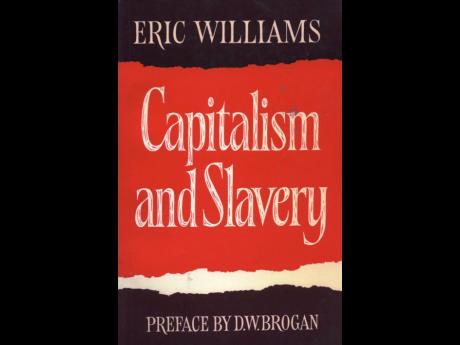

In this edition of Reparation Conversations, a collaborative initiative between the Gleaner and the Centre for Reparation Research at The University of the West Indies, the place of Eric Williams’ Capitalism and Slavery in the reparation discourse and the reason it is referred to as a handbook for reparation advocates are explained.
Last week, news broke that Eric William’s seminal thesis detailing Britain’s capitalistic involvement in the transatlantic trade in enslaved Africans (TTA) and chattel slavery would at last be published in the United Kingdom (UK).
Indeed, it was one of the most shared media reports, Donna Ferguson of the UK Observer newspaper indicating that “84 years after his work was rejected in the UK, and 78 years after it was first published in America, where it became a highly influential anti-colonial text, [Eric] Williams’s book, Capitalism and Slavery, will finally be published in Britain by a mainstream British publisher”. Williams, of course, studied in the UK at Oxford University, and his book emerged out of his doctoral thesis. The work was published only by the University of North Carolina Press in 1944 but will now be published by Penguin. It is, arguably, one of the three most critically acclaimed history books of the 20th century, all written by Caribbean intellectuals, the others being They Came Before Columbus by Guyanese Ivan van Sertima and How Europe Underdeveloped Africa by another Guyanese, Walter Rodney.
From the perspective of reparation activists, though, the surprising thing is not that British publishers rejected the book, but that 78 years after its damning findings, Britain has refused to apologise to the descendants of the people devastated by chattel slavery for what has been deemed a crime against humanity or to engage in a meaningful conversation about reparation. Nevertheless, Capitalism and Slavery remains an indispensable handbook for reparation advocates in the post-colonial Caribbean.
Some may say, “How come?” as Eric Williams never expressed a view about reparation in his path-breaking work. For example, Adom Getachew, in her February 2017 article “Reparation and the Recasting of Eric Williams Capitalism and Slavery” suggests that Williams was pursuing a different path in the modern period of decolonisation, stating: “Writing at the dawn of decolonisation, when the promise of the postcolonial state’s capacity to transform the legacies of colonialism was as yet untested, Williams placed his hopes in anticolonial nationalism and postcolonial institutions, not reparation as it is now articulated, as engines of transformation. His vision was couched in the language of independence and autonomy, and his political imagination was structured by a commitment to, and faith in, the capacity of the state.”
OWN EXPECTATION
For Getachew “the answer to the problem of dependence for Williams was not a demand for reparation[s] but the creation of a West Indian Federation”. She does remind us that in his concluding remarks at the 1943 conference co-organised at Howard University with Rayford Logan and Franklin Frazier, Williams reiterated what he wrote in Capitalism and Slavery - that Caribbean economic predicament was attributable to the development of Europe at the expense of the Caribbean – but, she says, he argued that federation would make possible an economic development that was otherwise impossible, and give the Caribbean area a bargaining power in the world which its isolated units did not then have. A unified political and economic structure, Williams and other Caribbean federalists hoped, would redirect Caribbean economies towards producing the goods needed domestically and create a programme for development and industrialisation. Federalists believed that over time, the federation would transform dependence into self-sufficiency. As we now know, the Federal project collapsed in 1962, ending Williams’s vision of a preferred model for a self-sufficient and independent Caribbean.
Britain had its own expectation of federation. Despite its debt to the region, Britain was anxious, as Gordon K. Lewis claims in The Growth of the Modern WI, to use federation as a means of discarding its then unwanted responsibilities as a colonial power. But this was something that Williams had always recognised. After all, it was he who said that the “British Empire was a magnificent superstructure of American commerce and naval power on an African foundation”. When Trinidad & Tobago and Jamaica were negotiating with Britain for independence, they fully expected a “golden handshake”. Britain offered one, but it was as unacceptable as the terms imposed for its allocation: the money should be used to buy British goods, not for the development of local industries and infrastructure.
A THORN
Williams eventually took the money, but, says his daughter, “… he was always a thorn in the British backside thereafter” in his critique of British colonialism and Britain’s failure to contribute in a more meaningful way to the development of the Caribbean. These actions were firmly anchored in the genre even if not framed in the explicit language of reparation, just like Capitalism and Slavery.
However, by the mid-1960s (and just as Arthur Lewis had done in 1939), others had started to posit the view that formal independence and nationalism had failed to fulfil the promises of development, democracy, and autonomy and that reparation was a better option. The reparation demand rests on the political claim that slavery and the trade in enslaved Africans were crimes against humanity, that these crimes are deeply connected to contemporary global inequalities, and that the root of these crimes is traceable to the fact that the slavery project enriched Europe and impoverished the Caribbean. It is to Capitalism and Slavery that reparationists have turned to bolster their claim.
It took several decades after Lewis and Williams for heads of government of CARICOM to realise that as Getachew puts it, “we live in an age that can no longer conceive of its aspirations for post-colonial futures in the terms and idioms that animated Williams and other federalists”.
CARICOM might not be the grand unifying project of Federation as conceived by Williams, but it has stepped in to share in the activism of Rastafari, civil society, and academics and is participating in the conversation about finding a solution – reparation – to the underdevelopment caused by British colonialism; and Williams’ 1944 argument in Capitalism and Slavery that Britain’s rise to a position of global power had been dependent on the Caribbean and Africa has been used to good effect. The TTA and plantation slavery and associated enterprises made industrialisation in England possible as they did the emergence and profitability of financial institutions. Capital generated from the Caribbean facilitated the development of banks; slavery profits swelled the coffers of towns and cities like London, Bristol, Birmingham, Liverpool, Manchester, Glasgow, Edinburgh; enriched families and individuals; and established educational and religious institutions. Royal families throughout Europe developed financial interests in the TTA; and slavery was profitable for the British economy.
As a result of the evidence that Williams, J.A. Rogers, in his review of Capitalism and Slavery, “complimented Williams for showing better than I can recall ever having seen what the New World owes to the Negro, the victims of slavery and the slave trade, for its development, particularly in its pioneer stage; as well as England for its rise from a small power to the world’s greatest empire.”
Prof Verene Shepherd is the director of CRR. Send feedback to reparation.research@uwimona.edu.jm.