
Imani Tafari-Ama | Reparations without resolve
What Jamaica must learn from the UNGA vote
Published:Saturday | April 4, 2026 | 11:05 PM
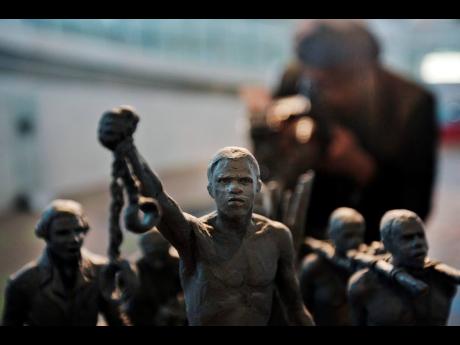
On March 25, the United Nations General Assembly (UNGA) voted to recognise transatlantic slave trade as the “gravest crime against humanity”. Enslavement is also called ‘Maafa’, Swahili for total disaster.
The UNGA development has been widely celebrated as a historic breakthrough. However, the proposal, which was spearheaded by Ghana, revealed deep fractures in the voting. There were 123 countries in favour, three against (US, Israel, and Argentina), and 52 abstentions, including the United Kingdom and European Union (EU) states.
This division declares that culpable countries doubled down on their refusal to accept responsibility for past crimes that resulted in the current divide between the Global North and the Global South. White supremacy also informs rejection of African demands for reparatory justice, including apology, restitution, and structural redress.
Was the UNGA gesture more symbolic than substantial? Beyond debates and resolutions, UN agencies seem unable to get things done. And we must also ask, to what extent will this moral victory be backed by material responses from the culpable countries? For decades, their stony silence to reparatory justice advocacy has been deafening. And what of our own political representatives?
The Caribbean Community’s (CARICOM’s) Ten Point Reparations Plan is a decades-old framework for addressing the complex trauma suffered by enslaved Africans during the Maafa. The enduring legacy of this damage and the structural mechanisms for reparatory justice have already been hammered out in this model.
Beyond sporadic utterances, though, most CARICOM leaders are not passionate about black issues. They are certainly not going to be numbered among placard-bearing reparations demonstrators. And why has Jamaica, which has been so central to the history of enslavement and resistance, failed to translate decades of reparations rhetoric into sustained political action and public consciousness?
The overwhelming support for the resolution reflects a growing consensus among Global South nations that The Maafa was not merely a historical injustice but the foundation of contemporary inequality. Considering this, we need to look again at the CARICOM Ten Point Plan for Reparatory Justice. That plan is concrete, detailed, and actionable. It calls for a full and formal apology from former colonial powers, debt cancellation, technology transfer, public health and education initiatives and psychological rehabilitation.
REMARKABLY THIN
Although the CARICOM Ten Point Plan provides a road map for reparations, Jamaica’s domestic engagement with this cause remains remarkably thin. This lacklustre performance is our reality even though Jamaica has a National Council on Reparations, which participates in CARICOM discussions. It issues periodic statements. However, these efforts have not translated into a sustained public-education campaign, integration into school curricula, grass-roots mobilisation, or consistent diplomatic pressure.
Instead, reparations discourse in Jamaica remains largely confined to academic circles, occasional media commentary, and symbolic commemorations. This is a weak-willed movement, which speaks the language of justice but avoids the work of political transformation.
Part of the answer lies in political timidity. Serious engagement requires confronting Britain directly, ransacking Jamaica’s political and economic dependency, and involvement in sustained international advocacy. These are not small steps. They demand political courage and long-term strategy, both of which have been in short supply.
Another factor is public disconnect. Many Jamaicans understand The Maafa (slavery) as history but not as a living structure. They do not connect the dots between this brutal system of extraction and current patterns of land ownership, wealth distribution, education inequality, crime, and social instability. Without this connection, reparations appear abstract. They see reparations advocates as a little mad, reparations as a mythical conference topic, not something tangible that communities can achieve.
The Maafa was not executed by Europeans and North Americans alone. Some African elites participated in the capture and sale of enslaved people. This fact is often weaponised to undermine reparations claims. It should not be. European powers racialised and globalised enslavement on an unprecedented scale. They dehumanised Africans, industrialised their sexual and social labour, and built empires and modern economies on their backs.
Ghana has apologised for its central role in the trade in Africans. We, therefore, must include African states in the accountability mix. Africans and Euro-Americans have trauma entangled in the common factor of the Maafa. However, this does not entail equal responsibility because the perpetrators used the platform of brutality to build racial capitalism and shape systemic global inequality. Jamaica, as a site of both profound suffering and resistance, is uniquely positioned to portray this double reality but has not fully done so.
REVEALING
It was revealing to note which countries opposed the UNGA resolution and their rationales. The United States framed its vote in legal terms, arguing against retroactive liability. But beneath that legalism lies supremacist politics and a deeper fear of massive and widespread reparations claims.
Israel’s position reflects the politics of comparative suffering – the concern that elevating enslavement risks creating a hierarchy of atrocities. Yet this argument is invalid because one historical crime does not diminish another. Meanwhile, Argentina’s vote speaks to a long-standing discomfort with its own racial history and a tendency to align with Western legal frameworks.
Equally telling were the abstentions of European powers, including Britain. Abstention is not neutrality. It is a calculated position that allows acknowledgement without accountability. In effect, Europe is saying that while we recognise the past, we reject responsibility for its consequences. This is precisely why symbolic victories, such as the UN resolution, must be leveraged into material demands. Without pressure, acknowledgement will remain empty.
The Jamaican Government and civil society must activate the CARICOM Ten Point Plan as a living model. This means integrating it into school curricula, launching sustained public-education campaigns, and using media to make reparations a household conversation. Second, Jamaica must lead diplomatically, not follow. It should be at the forefront of building alliances with African states, pressuring former colonial powers, and framing reparations as a global-justice issue, not a regional grievance.
Third, communities must understand how historical injustice connects to present-day poverty, violence, and structural inequality. Finally, Jamaica must demonstrate that realising the goal of reparations requires organisation, persistence, and political will. Justice needs action, not just a bag-a-mouth.
Imani Tafari-Ama, PhD, is a Pan-African advocate and gender and development specialist. Send feedback to i.tafariama@gmail.com and columns@gleanerjm.com.