
‘JLP is not Mr Chin’s shop’
Councillor warns against using kinship to settle Samuda succession dispute
Published:Wednesday | April 23, 2025 | 6:25 AM
To access this article in full please login or register today


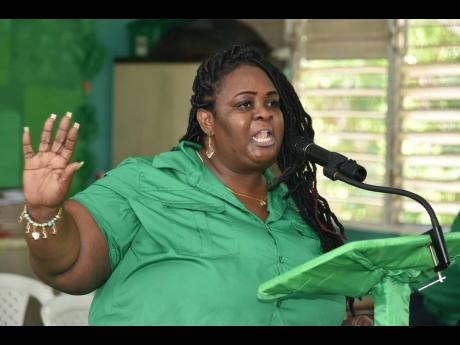

Jamaica Labour Party (JLP) Councillor Susan Senior has cautioned against using family ties to determine who should succeed veteran Member of Parliament Karl Samuda in St Andrew North Central. Senior, who represents the Norbrook division in the...
Jamaica Labour Party (JLP) Councillor Susan Senior has cautioned against using family ties to determine who should succeed veteran Member of Parliament Karl Samuda in St Andrew North Central.
Senior, who represents the Norbrook division in the constituency, made her comments on Good Friday, the same day Senator Delano Seiveright publicly confirmed his bid to replace Samuda, 83, who has held the seat since 1980.
“I’m in full support of Delano Seiveright,” she declared. “He is fitting for the job. He has displayed dedication, commitment, loyalty ... as a caring and kind person.”
Her remarks intensify the internal debate within the JLP over Samuda’s successor. Seiveright’s main rival is believed to be attorney Christian Tavares-Finson, son of senate president and JLP stalwart Tom Tavares-Finson, who previously lost to Samuda in 1993 when the latter ran for the set on a People’s National Party ticket.
A JLP insider said Seiveright’s sudden announcement may have been a strategic move to pre-empt a planned Easter announcement by party leadership favouring Tavares-Finson, and possibly force a delegate vote.
“An announcement appeared imminent from the party leadership,” said the insider, citing intensified campaigning activities for Tavares-Finson.
DECLINED TO COMMENT
JLP General Secretary Dr Horace Chang has declined to comment. So, too, have Seiveright and Tavares-Finson.
Samuda told The Gleaner on Saturday that he had no comment “at this time”.
Senior supported Seiveright’s assertion that his candidacy is about “partnership, not entitlement,” and rejected “family connections or privilege”.
“That statement is definite, [but] it could point out in a lot of directions,” she said. “There’s a lot of people in politics that, when they get a seat, they think that, when the time comes for them to move on, their son or their daughter or grandson should take over. It’s not a [family] business place.”
The councillor was blunt in her criticism of perceived political inheritance.
“The person that really knows the path and is willing to walk the path ... should be rightfully so selected. I’m a councillor, and, if I’m a councillor, I should be able to step from one stage to another to become a member of parliament. It’s not for the [exiting] member of parliament to decide.”
The councillor said the JLP is “not Mr Chin’s shop that, when them leave, them send for another for Chiney brother or niece or nephew. And it must not be encouraged.”
She stressed that political institutions must operate on structure and merit: “No one must hold on to any seat over time, thinking they own it to pass it down to a family member.”
Senior acknowledged that, while Tavares-Finson is a “son of the soil,” she had reservations.
“He never in any way engaged me to say that he has been interested in the seat. Even during an election – general and even local – I’ve never seen him coming forward,” she said.
“That, for me, was a red flag until he come out of the block saying that he would like to run, and then he’s seeking audience with me after. You seek a friend before you need one. And, in politics, for me, you have to show where your loyalty lies.”
Drawing on her own working-class roots and rise through the party ranks, Senior warned that the JLP must be deliberate as it makes a pitch for a third consecutive term.
“They have to have a love for the people, the trust of the people, and also, the space that they’re going to, they have to have an understanding of what it takes to make sure that place is well-represented and well-oiled,” she added.
She argued that the requirements for public office are not based on academic qualifications, but in vision and people-centred leadership.
“It’s your social intervention. It’s the infrastructure and development. It’s how you relate to people … . Visionary. Yeah? So, that’s how I see it.” Senior said.
‘NO OBJECTION’ TO CANDIDACY
In a March 25 letter to Chang, Samuda said his executive had “no objections” to Seiveright’s candidacy and that his own outreach showed “supportive” feedback. He asked Chang to share the letter with the party’s Standing Committee and Operations Council.
Senior acknowledged the delay in naming a successor but urged patience.
“It might look like late, but it’s not really late. Sometimes you have to allow the people to vent, do your survey and find out what is fitting, who is the best person … . Those things take time,” she reasoned.
In January, Chang told The Gleaner that Samuda was reconsidering his exit because of the lack of a clear successor, though an insider claimed the party leadership favoured a candidate Samuda did not support.
In February, Seiveright was endorsed by Councillor Lee Clarke, of the Whitehall division, who warned against parachuting in an unfamiliar candidate.
He said Seiveright had been consistently present in the area, unlike Tavares-Finson, whom he said he had seen only once.
“People should work with people on the ground. Because you can’t say you just go inna politics because of a tradition or anything like that. You go to do something,” he told The Gleaner. “I know who I will support, and I carry a large [number] of voters in my division.”
Seiveright’s standing in the party has risen in recent times. After nearly nine years as a senior adviser to the tourism minister, he was appointed to the Senate in February and, by March 17, named a junior minister – developments that raised speculation about the motives of the party hierarchy.
Seiveright, a former head of the party’s young professional group who helped power the party’s return to office in 2007 after 18 years, said his decision to apply for the seat came after “much reflection [and] honest dialogue”. He acknowledged the “tremendous support” from constituents, saying their “calls, messages, and firm push for clarity and direction have played a big part in this decision”.
He also expressed his “absolute respect” for Prime Minister Dr Andrew Holness.
“I am committed to supporting him and the mission of the JLP as we move forward,” said Seiveright, who, more than a decade ago, supported Holness’ rival, Audley Shaw, in a leadership contest.
The JLP is also seeking to quell disquiets regarding candidate selection in other constituencies, including Westmoreland Western, where the replacement of the incumbent MP Morland Wilson triggered a protest last week.
A week ago, party Chairman Robert Montague said four constituencies were undecided, even as he urged workers to increase their efforts to get the party ready for the election.