
Earth Today | Nature Conservancy publishes first-ever detailed maps of Caribbean coral reefs
Published:Thursday | December 10, 2020 | 12:15 AM

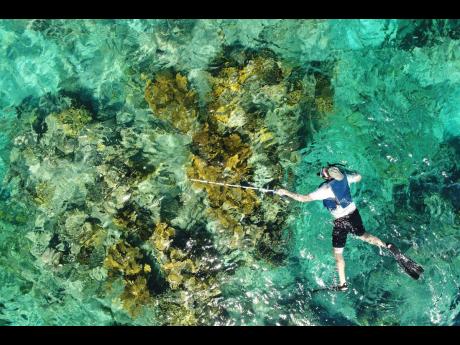
THE NATURE Conservancy (TNC), one of the world’s leading conservation organisations, along with partners, has published detailed maps of important shallow underwater habitats throughout the entire Caribbean, among them all shallow water coral reefs.
“For the first time ever, countries and territories now have a clear picture of the habitats found beneath the waves of the Caribbean. These revolutionary maps will help guide the sustainable use and protection of marine resources for island nations in which 60% of living coral has been lost in the past few decades alone,” said news release from the TNC.
The maps were created by stitching together tens of thousands of high-resolution satellite images, and in some places using aerial fly-over technology, drones, and divers to dig deeper and validate the data.
By utilising data captured from outer space to undersea, scientists were able to map and more accurately interpret the coastal ecosystems throughout the Caribbean. Having accurate and complete underwater habitat data for this region means that there is now cutting-edge guidance available to inform the sustainable use of marine resources on which 44 million Caribbean residents depend.
“You cannot protect what you don’t know is there. Having access to these maps is a game-changing achievement for the Caribbean. Thirty countries and territories finally have access to better, more detailed information about their underwater habitats to help them better protect marine areas, support sustainable livelihoods and prioritise their adaptation to potential climate change impacts,” said Dr Robert Brumbaugh, executive director of TNC Caribbean Division.
Economic success
“Understanding and protecting natural resources is critical to the economic success of these countries,” he added.
Roughly half of all livelihoods in Caribbean communities depend on healthy nearshore and coastal habitats, including fishing and tourism. According to a TNC study published in 2019, every year coral reefs and reef-associated activities generate an estimated $7.9 billion in economic value to the tourism industry and draw nearly 11 million visitors to Caribbean islands.
The maps are intended to inform a diverse array of conservation and policy decisions to protect and restore these essential coastal areas that people depend on. Decision-makers across the region can now use these new maps to identify areas optimal for coral restoration activities, guide climate change adaptation, and identify the best locations for establishing marine protected areas that successfully balance protection and diverse uses.
“The scope of these maps is unprecedented in the region, and the opportunities they unlock to provide a better future for Caribbean ecosystems, and the millions of people who depend upon them, are astonishing,” commented Dr Joseph Pollock, senior coral reef resilience scientist for TNC.
“Using traditional approaches, it would have taken approximately 250 million diver hours to map such a large area. New technologies have helped deliver these desperately needed maps at a tiny fraction of the effort and cost,” he noted.
TNC scientists, in partnership with the Arizona State University Centre for Global Discovery and Conservation Science, worked with Planet Labs Inc to stitch together more than 38,000 high-resolution satellite images – a process similar to putting together a massive puzzle piece by piece. The finalised maps are now available at CaribbeanMarineMaps.tnc.org and TNC is working with Vulcan Inc to make them available on the Allen Coral Atlas in 2021.
The maps reveal in great detail the location of coral reefs, seagrass beds, and other oases of underwater life, making it possible to more accurately monitor the impacts of climate change, measure the effects of hurricanes and identify areas that need protection and restoration.
“Working with TNC to enhance the value of Allen Coral Atlas offerings and data will be a tremendous asset to the coral conservation community,” said Paulina Gerstner, programme director of the Allen Coral Atlas.
“This high-resolution view of Caribbean shallow reef ecosystems perfectly augments the global mapping work being undertaken by the Atlas partnership,” she added.