
Environmental project to rid Riverton of used tyres gets under way
Published:Tuesday | December 28, 2021 | 12:06 AM
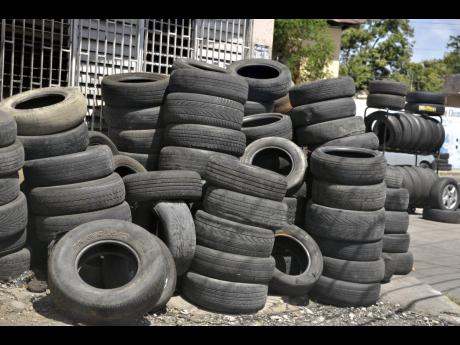
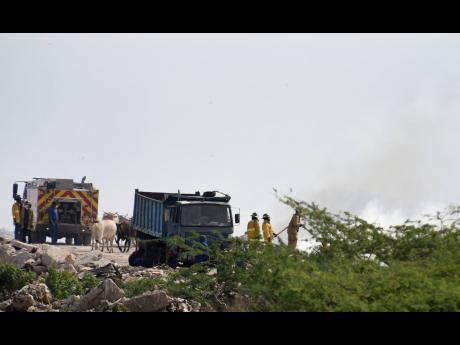
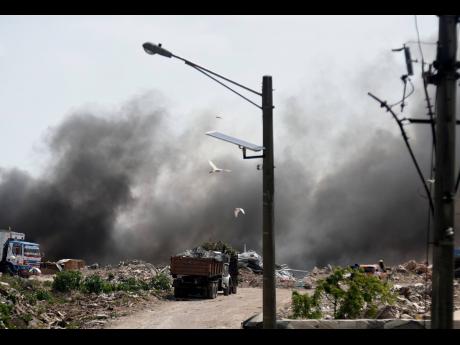

More than two million hazardous, used tyres are to be removed from the Riverton City disposal site in St Andrew under a 10-year project, which will eventually extend to other garbage-disposal facilities across the island.
Already, over 8,700 tyres have been taken from the Riverton facility under the National Programme for the Environmentally Sound Management of End-of-Life Pneumatic Tyres, which is a collaboration between the Government and the Caribbean Cement Company Limited (CCCL).
The programme, which was piloted between July and September 2019, was fully rolled out on October 1.
It is aimed at safely disposing of the millions of used tyres generated in the country annually, which will also result in a reduction in costs associated with storing them.
End-of-life tyres are those that could not or were not reused for their originally intended purpose and were not retreaded. These tyres can be utilised as raw materials for co-processing in cement kilns, in asphalt mix for road construction, as well as in the construction of sports grounds, playground surfaces, and artificial reefs.
In Jamaica, it is estimated that more than two million used tyres are generated per annum, and landfills receive approximately 185,700 tyres per year.
It was recognition of this environmental and health hazard that led the Government to embark on the national programme for which it signed a memorandum of understanding (MoU) with the CCCL for the company to use end-of-life pneumatic tyres in the cement-production process.
Under the arrangement, the CCCL will convert used tyres at disposal sites into an alternative source of fuel at its Rockfort plant, thereby reducing costs and making a positive impact on the environment.
Prime Minister Andrew Holness, who addressed the virtual signing ceremony for the project’s full roll-out in June, said the arrangement will provide a solution to the arbitrary disposal of used tyres and the stockpiling of the material at disposal sites and other areas across the island.
“Most of these tyres are indiscriminately disposed of along roadways, in gullies, stockpiled in open lots, and, of course, stored in our landfills,” the prime minister said.
He noted that stored used tyres not only create myriad environmental hazards, public-health risks, along with other challenges, but they also occupy valuable space when hoarded at disposal facilities.
The prime minister commended the CCCL on the innovation in transforming used tyres into a fuel source.
He noted that the production of cement is a highly intensive, energy-consuming activity, with statistics from the Cement Sustainable Initiative 2002 indicating that it takes approximately 60 to 130 kilogrammes of fuel oil and 110 kilowatt hours of electricity to produce one tonne of cement.
“As such, it is important that the cement industry identifies ways in which it can substitute fossil fuel for sustainable, alternative energy sources. End-of-life tyres are ideal for use as an alternative fuel in cement production,” he noted.
In December 2020, when the Government first announced the programme, Minister of Housing, Urban Renewal, Environment and Climate Change Pearnel Charles Jr. said that phase one of the fully rolled out programme would see the disposal of tyres at the Riverton City disposal site, and phases two and three would involve the development and implementation of an action plan to facilitate the ongoing collection and disposal of the tyres at disposal sites other than Riverton.
“In addition, we will be advancing a comprehensive public education and awareness campaign as a component of each phase of the national programme, and consideration will be given to the promulgation of regulations under the National Solid Waste Management Act, 2001 to govern the management of the end-of-life tyres across the island, National Solid Waste Management Authority (NSWMA) being the implementing agency,” he said.
The minister said that implementation of the programme is crucial as it not only reduces the Government’s operational cost to store the material but addresses serious public health and environmental impacts associated with the long-term storage of these tyres at disposal sites across the country.
These include the leaching of compounds that contaminate soil, ground, and surface water.
Communication and Social Impact Coordinator of the CCCL Chad Bryan told JIS News that through collaboration with the Government, the company is seeking to increase the substitution of traditional fuels with alternative fuels in the cement-manufacturing process in Jamaica with a view to reducing its overall carbon footprint, which is a global key performance indicator.
“We are moving apace to reduce our carbon emissions as a company. To do so, we are using alternative fuel sources in the form of end-of-life pneumatic tyres to drive our cement production. We are playing our part to reduce the harmful effects of greenhouse gases and join with companies and countries around the world in this effort,” he said.
For managing director of the CCCL, Yago Castro, the end-of-life pneumatic tyres programme represents an extension of the company’s mandate of being responsible corporate citizens and will result in positive environmental and social impacts.
“At Carib Cement … achieving environmental excellence is a priority. We dedicate efforts to addressing key sustainability-related issues from biodiversity and conservation to renewable energy, climate change, and emissions monitoring,” Castro said.
Provisions have been made for the allocation of approximately $43 million per annum over the period to be evenly apportioned in the recurrent budgets of the participating ministries to support the execution of the national programme.