
Unions divided on whether to accept Government's compensation offer
Published:Wednesday | November 9, 2022 | 8:04 AM
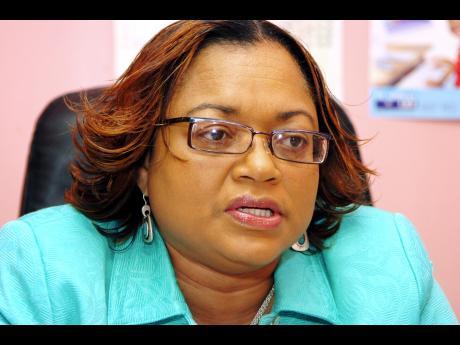
Tension is building among member groups within the Jamaica Confederation of Trade Unions (JCTU), even as Minister of Finance and the Public Service Dr Nigel Clarke warns that public sector workers are in danger of missing this year's payment under the compensation review system.
JCTU President Helene Davis-Whyte on Tuesday told The Gleaner that five of 11 unions are ready to sign off on the finance ministry's offer, but declined to give the names.
“We are at a point of divisiveness because some are ready and some are not,” Davis-Whyte said, confirming that there are tensions within the ranks.
“There are persons who want the money and others who don't. They feel that we need to delve into some issues deeper and so there is a kind of tension, I would say.”
She said work is on in earnest to “smooth out those problems” as public sectors “buckle under inflation”.
With the exception of the police, teachers and nurses, there are approximately 100, 000 public sector workers.
The Jamaica Civil Service Association, which carries the largest membership, is on board.
The finance ministry has agreed to a guaranteed minimum increase of 17.5 per cent on net pay for all public sector workers with effect from April 1. This is expected to be done over three years.
Mileage rate for travel officers is to be increased to $100 per kilometre, up from $56/km at present.
To settle the lack of increase in transport allowances for the 2021/22 fiscal year, there will be a payment of 10 per cent on every level of these allowances. As a result, there would be no increase in rates, as the lump sum would be viewed as a settlement of this obligation.
“At the end of the day, if at all possible, we would want to come away with a unified position,” Davis-Whyte said, adding that the standoff mirrors the negotiations of 2017.
The sticking points, Davis-Whyte said, include whether workers will convert to the new scales on a point-to-point basis or if all will convert to the minimum 17.5 per cent regardless of seniority obtained before.
“We have several issues but the most uniformed of them is the conversion,” Davis-Whyte said.
She said the finance minister's “encouragement” could be seen as intimidation by some unions, but noted that the push for an agreement from Clarke is not new.
On Tuesday, he told the House of Representatives that if an agreement was not struck with unions for this fiscal year, there was no guarantee of when public sector workers would receive the back pay.
“It is absolutely imperative that we conclude in sufficient time that the payments that are due for 2022 are made in the fiscal year 2022/23,” Clarke warned.
He said that the Government has been “very” accommodating in terms of the timeline but said that there is a “natural limit”.
Noting that eight months of payment have already passed and January will make it 10, Clarke said unions must sign in sufficient time.
“Ten months of what we proverbially call back pay is a large amount that is being budgeted for in this fiscal year. If it is not paid in this fiscal year, the space to accommodate it in the next fiscal year does not exist,” the finance minister said.
Clarke has proposed a $60-billion increase to the national budget in the First Supplementary Estimates 2022/2023, which he tabled on Tuesday.
It is comprised of increases to non-debt recurrent expenditure of $52.7 billion, capital expenditure of $1.3 billion and debt service of $6 billion.
Clarke said the increases result in a proposed revised 2022/23 budget of $972 billion.
This comprises non-debt recurrent expenditure at $592.2 billion — which covers recurrent programmes of $280.8 billion and public sector compensation totalling $311.4 billion — capital expenditure at $66.4 billion and debt service at $313.4 billion.
- Kimone Francis
Follow The Gleaner on Twitter and Instagram @JamaicaGleaner and on Facebook @GleanerJamaica. Send us a message on WhatsApp at 1-876-499-0169 or email us at onlinefeedback@gleanerjm.com or editors@gleanerjm.com.