
Earth Today | ‘Solidarity or suicide’
UN boss lays down the gauntlet at climate conference, local stakeholders give their endorsement
Published:Friday | November 11, 2022 | 5:57 AM



“IT IS either a climate solidarity pact or a collective suicide pact.” Those were the options presented by UN Secretary General António Guterres, speaking at the opening of the UN Climate Change Summit (COP27), which began in Egypt this week.
“I am calling for a historic pact between developed and emerging economies – a Climate Solidarity Pact. A pact in which all countries make an extra effort to reduce emissions this decade, in line with the 1.5-degree goal; and in which wealthier countries and international financial Institutions provide financial and technical assistance to help emerging economies speed their own renewable energy transition,” he said.
“It is also a pact to end dependence on fossil fuels and the building of new coal plants – phasing out coal in OECD (Organization for Economic Cooperation and Development) countries by 2030 and everywhere else by 2040. A pact to provide universal, affordable, sustainable energy for all. A pact in which developed and emerging economies unite around a common strategy and combine capacities and resources for the benefit of humankind,” he said.
“The two largest economies – the United States and China – have a particular responsibility to join efforts to make this pact a reality. This is our only hope of meeting our climate goals,” Guterres urged.
Ultimately, he said, humanity has a choice: “Cooperate or perish. It is either a climate solidarity pact or a collective suicide pact.”
And actions, he insisted, must be taken, and urgently, given that “we are on a highway to climate hell with our foot still on the accelerator”.
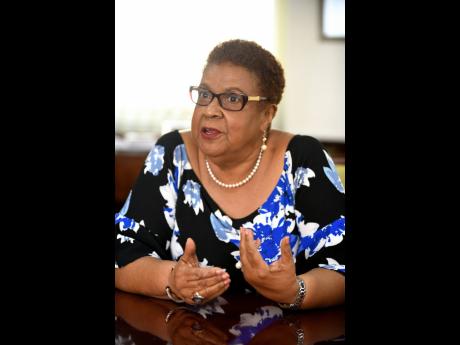
Here in Jamaica, businesswoman and environmental professional Eleanor Jones is in full agreement.
“What this is saying to me is that some of the leaders are tired of the talking and the non-performance, so the gloves are off. We are seeing the terrible destruction that is taking place all around us. Here in the Caribbean we have felt our share,” she said.
“Floods in Belize, floods in Saint Lucia, and then we have the hurricanes. We look outside and we see the challenges there, too. So, I agree with the UN secretary general, we are hurtling into climate hell,” she added.
GET ON SAME PAGE
It is therefore necessary, Jones said, that world leaders get on the same page about what is at stake, and that leaders from both the developed and developing world do the necessary work to mobilise the needed financing to support a comprehensive response, especially from the most vulnerable, including Caribbean small island developing states (SIDS).
“It is all about finance, I think. The developed world have created this problem, and others from the emerging economies have contributed. You ask yourself, don't they see the impact of it now, and the precipitous slide?” Jones concluded.
Indi Mclymont-Lafayette shared Jones perspective on the UN boss' assessment of current climate realities.
“I can understand where the UN chief is coming from, as based on how far we are from the climate targets, it does look like we are heading to climate hell, literally and figuratively,” said the gender specialist and head of Change Communications, who has spent years involved in advocacy for climate justice.
“Caribbean islands already are feeling not only hotter summers, but heat most of the year.
Kingston, Jamaica, seems to be already experiencing climate departure, as every year seems hotter than the one before, so now is the time for action,” added Mclymont-Lafayette.
As such, she said it is mission-critical to mobilise the needed financing to support adaptation, and loss and damage in the developing world.
“It is critical that COP27 makes decisions on increasing climate financing, especially for vulnerable SIDS, with significant sums set aside for adaptation, and loss and damage,” Mclymont-Lafayette insisted.
Of course, without the political will to restrain rising global temperatures, fuelled by greenhouse emissions, at no more than 1.5 degrees Celsius above preindustrial levels, it could all be for nothing.
“Ultimately, none of that matters for SIDS like Jamaica if the political will to push for the 1.5 target is not there. SIDS can only adapt to a point and recover to a point. If the 1.5 target is not met, our islands will disappear. So progress and action towards making 1.5 a reality would be my ideal COP27 priority,” added Mclymont-Lafayette, who for many years championed this very target inside the halls of the annual global negotiations on climate change.