
Earth Today | ‘A peace pact with nature’
Countries make deal to preserve ecosystems
Published:Thursday | December 22, 2022 | 12:15 AM


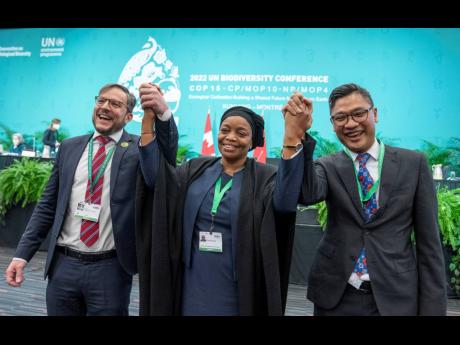
THE DETAILS of a new global agreement to preserve nature and support human health have been hammered out at the recently concluded 15th Conference of the Parties to the United Nations Convention on Biological Diversity (CBD).
The CBD, to which there are 196 parties, was adopted for the conservation and sustainable use of biological diversity and related issues. Biodiversity is the range of living species on Earth, including plants, animals, bacteria, and fungi.
Included in the new agreement are new global targets for 2030, such as to mobilise at least US$200 billion per year in domestic and international biodiversity-related funding from all sources, public and private; as well as to raise international financial flows from developed to developing countries – in particular, least developed countries, small island developing States, and countries with economies in transition – to at least US$20 billion per year by 2025, and to at least US$30 billion per year by 2030.
Also included is for large and transnational companies and financial institutions to ‘monitor, assess, and transparently disclose their risks, dependencies and impacts on biodiversity through their operations, supply and value chains and portfolios’; and to reduce to near zero the loss of areas of high biodiversity importance, including ecosystems of high ecological integrity.
Executive Director of the UN Environment Programme, Inger Andersen, has predicted that the new agreement – the Kunming-Montreal Global Biodiversity Framework – will form “a critical and essential underpinning as we embark on the final stretch to reach the sustainable development goals”.
“This is the first step. Let us pause for but one second to embrace the history we have made here in Montreal and now, let us get down to the business of delivering the framework – for people and for planet,” she added, speaking at the final plenary of COP15.
A PACT WITH NATURE
UN Secretary General António Guterres said of the new deal, “We are finally starting to form a peace pact with nature.”
Local pundits have welcomed the new deal, but caution against over-reliance on external support to preserve essential natural resources and their varied services. They champion, instead, personal responsibility.
“It is a start, and they have 2030, which I think is a very ambitious target … . But I come back to the point of our national responsibility. At the end of the day, the national responsibility is absolutely critical; we must assume national responsibility,” said Eleanor Jones, sustainable development professional and head of the consultancy firm, Environmental Solutions Limited.
“The UN guideline is a good guideline and should be a stimulus for us here in Jamaica to pay attention to more action and less talk. While we are going after climate resilience, we are also destroying our ecosystems services; we are not connecting the dots. We are speaking through too many sides of our mouth. We need action, we need focus, and we need to look at where we want our country to be,” Jones added.
Indi Mclymont-Lafayette, herself a gender and development specialist, agreed.
“I welcome this latest biodiversity deal and targets. It looks ambitious, but it’s needed because there is so much at risk. I was especially struck by the section that says, ‘reduce to near zero the loss of areas of high biodiversity importance, including ecosystems of high ecological integrity’. This is especially relevant for Jamaica, where we continue to fight for the protection of some of our critical biodiversity hotspots, such as the Cockpit Country,” noted the Change Communications boss.
“We have a lot of work to do at multiple levels to build appreciation for how critical it is to take care of Mother Earth, who takes care of us. It’s a balance between preservation and economic development, but Jamaica has to work on a better balance,” she added.