
Freedom Imaginaries: Forced return of Haitians violates international laws
Published:Monday | September 11, 2023 | 8:00 PM
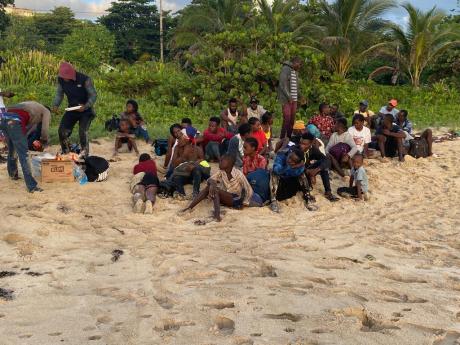
Human rights group Freedom Imaginaries is expressing “deep concern” with what it deems as the “forced return of the second group of Haitian migrants who landed in Portland” on Saturday.
Fleeing their crisis-riddled country, 36 Haitians landed in Portland on the weekend; about a month after 37 of their countrymen arrived in Jamaica.
Today, the government announced that the illegal immigrants were “safely returned” to their homeland.
According to a statement from the Ministry of National Security, following the completion of its immigration checks and security vetting, “the group was denied entry….from the vetting process it was found that there were members who had been previously removed from Jamaica for breaches of entry.”
“This is a flagrant violation of Jamaica's obligations under international law. The 1951 Convention relating to the Status of Refugees and its 1967 Protocol prohibit refoulement – the forced removal of people to a place where they may face risk of persecution, torture or other serious or irreparable harm,” Freedom Imaginaries said today in a letter to Prime Minister Andrew Holness; Senator Kamina Johnson Smith, Minister of Foreign Affairs and Foreign Trade; Dr Horace Chang, Minister of National Security; and Ambassador Alison Stone Roofe, Permanent Secretary Ministry of National Security.
Calling for the Government to provide an explanation for its actions, Freedom Imaginaries said “it is alarming that the GOJ would return Haitian migrants, under the cover of darkness, without due process, in blatant disregard of UN advisories and international law. It is also deeply disturbing that the Haitians were returned within 24 hours of arrival, without an opportunity to recover from their journey to Jamaica.”
The group is calling for the GOJ to suspend the forced return of Haitian migrants and to guarantee the principle of non-refoulment, stating that “We are concerned that the GOJ's decision to return the second group of Haitian migrants without due process could have been a deliberate effort to impede their access to legal support and information on their rights.
“We are also concerned that this decision could be indicative of an emerging policy of draconian responses to vulnerable Haitian migrants in an unlawful attempt to deter future flows of Haitians to Jamaica.”
Freedom Imaginaries is representing the first group of Haitians who arrived in July. The immigrants are seeking asylum.
SEE FULL TEXT OF FREEDOM IMAGINARIES LETTER BELOW:
Freedom Imaginaries expresses deep concern about the forced return of the second group of Haitian migrants who landed in Portland on September 9, 2023. We became aware of this development on the afternoon of September 10, when Attorney-at-Law Malene Alleyne spoke to a police officer in Portland to request access to the Haitians in order to inform them of their rights.
The police officer informed Ms Alleyne that the Haitians had already departed Jamaica.
Government officials later confirmed that at around 3:00 am on September 10, the Haitians were returned to Haiti through the Coast Guard.
This is a flagrant violation of Jamaica's obligations under international law. The 1951 Convention relating to the Status of Refugees and its 1967 Protocol prohibit refoulement – the forced removal of people to a place where they may face risk of persecution, torture or other serious or irreparable harm. This entails a requirement that Haitian migrants must have access to efficient procedures that guarantee an individualised evaluation of protection needs. The principle of non-refoulement has acquired the status of jus cogens, that is, a peremptory norm of international law from which no derogation is permitted.
It is in this context that the UN Refugee Agency (UNHCR) issued an advisory that calls upon states in the region to “suspend the forced return of Haitians to their country,” warning that Haitians who are returned to Haiti may face “life-threatening security and health risks, and further displacement inside the country.”
The UNHCR provided the following guidance, which we brought to the attention of the Government of Jamaica (GOJ) by way of letter dated July 20, 2023:
In view of the current dire situation, we encourage governments to ensure that Haitians have access to protection and support services regardless of their reasons for leaving their country. For those not eligible for refugee protection, this may be achieved through granting of complementary protection, temporary protection, humanitarian admission or other legal stay arrangements until the security situation in Haiti permits safe returns.
Moreover, in our letter dated August 4, 2023, we set out human rights standards that apply in the refugee status determination context, including the right to appropriate information and guidance; the right to a cost-free translator or interpreter; the right to legal representation and cost-free legal aid; the right to be heard; as well as other procedural guarantees inherent in due legal process, including the possibility of recourse to a suitable and effective remedy.
In this spirit of engagement, it is alarming that the GOJ would return Haitian migrants, under the cover of darkness, without due process, in blatant disregard of UN advisories and international law. It is also deeply disturbing that the Haitians were returned within 24 hours of arrival, without an opportunity to recover from their journey to Jamaica.
The GOJ has stated that the reason for this decision is that “it was found that there were members who had been previously removed from Jamaica for breaches of entry”.
This language raises concerns that each individual did not receive an individualised assessment. Importantly, the UN Refugee Convention explicitly prohibits penalisation for “illegal entry”. The Convention only refers to narrow exclusion criteria, which relate to persons who have committed a crime against peace, a war crime, or a crime against humanity; a serious non-political crime; or acts contrary to the purposes and principles of the United Nations. There is no indication that these criteria apply in this case.
We also note reports that the GOJ's reasons for criminal sing the first group of Haitian migrants without allowing them to access a refugee status determination procedure was that they did not request asylum until after they were convicted of illegal entry (after which the procedure was engaged). Yet, the written statement of the immigration officer involved in the preliminary screening process indicates that “during the interviews with each individual they stated that they departed Haiti on June 27, 2023, because of the economic and violent situation in Haiti.”
This, coupled with the well-documented context of violence in Haiti and UN advisories, was sufficient to put the GOJ on notice that the Haitians should not be penalised or forcibly returned, but rather should be granted access to procedures to determine their protection needs.
We are concerned that the GOJ's decision to return the second group of Haitian migrants without due process could have been a deliberate effort to impede their access to legal support and information on their rights.
We are also concerned that this decision could be indicative of an emerging policy of draconian responses to vulnerable Haitian migrants in an unlawful attempt to deter future flows of Haitians to Jamaica.
In this context, we call on the GOJ to suspend the forced return of Haitian migrants and to guarantee the principle of non-refoulment, including by ensuring access to efficient procedures that guarantee an individualised evaluation of differentiated protection needs.
We reiterate our request for a meeting to discuss international law standards for the protection of Haitian migrants to ensure that this situation is not repeated in the future.
We also request the following information so that we can better understand the reasons for the GOJ's decision to forcibly return Haitian migrants to a country where they face a risk of irreparable harm:
- Did immigration officers conduct an interview of each person and an individualised assessment of protection needs?
- Did immigration officers ask each person why they left Haiti, whether they feared returning to Haiti, and whether they had an intention to apply for asylum or refugee status?
- Which statutory provisions formed the basis of the decision to deny entry?
- Was the decision to deny entry notified to each person in writing in their native language?
- Was each person informed of their right to legal representation and to consular assistance in their native language?
- Was a consular official notified and, if so, did they communicate with the group?
- Was the UNHCR notified of the arrival and forced return of the Haitian migrants?
We kindly request a response by September 12, 2023, at 5:30 pm to the address malene@freedomimaginaries.org.
Follow The Gleaner on X, formerly known as Twitter, and Instagram @JamaicaGleaner and on Facebook @GleanerJamaica. Send us a message on WhatsApp at 1-876-499-0169 or email us at onlinefeedback@gleanerjm.com or editors@gleanerjm.com.