
Earth Today | Ready, set, plant
Tree planting featured in post-Beryl recovery efforts at local high school
Published:Thursday | September 5, 2024 | 12:06 AM
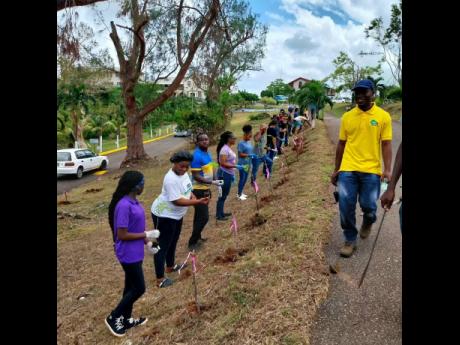

THE FORESTRY Department recently partnered with Hampton School in St Elizabeth to plant trees as part of the educational institution’s post-Beryl recovery efforts.
Done in support of the school’s ‘Restoration Day’ and ahead of the new school term, the agency, together with members of the school community, planted 65 trees, among them ornamental trees, on August 22.
The tree-planting activity was done to improve the school’s resilience to natural disasters, including hurricanes; beautify the premises; enhance its green spaces; increase biodiversity; and enrich the students’ learning experience.
“Our commitment marks a significant step towards fostering environmental stewardship within the community and a hands-on educational opportunity for community members and students to learn about the importance of trees and their role in the ecosystem,” noted Tamara Nicholson, principal director for forest operations at the Forestry Department in a recent release on the initiative.
“Our ladies appreciate being in the outdoors – at break, at study. The shade trees near their benches and their seating areas will really help to make an amenable, pleasant atmosphere. We are most appreciative of that contribution,” added school principal Dr Mahvell Charlton-Brown.
Students will, in the coming months, be able to monitor the growth of the trees and study their impact on the local ecosystem.
The Forestry Department-Hampton School partnership underscores the critical role of community collaboration in promoting environmental sustainability, including through the forestry sector.
Trees serve a range of ecosystem functions, including as sinks for carbon dioxide, one of the greenhouse gases (GHG) whose emission fuels the warming of the planet and with a range of impacts.
Those impacts include rising sea levels, coastal erosion and extreme weather events, including the likes of Hurricane Beryl, which devastated sections of the Caribbean and elsewhere in the world.
Meanwhile, countries globally have been encouraged to pursue resilience that involves trees and forests. The goal of this approach, according to the 2022 State of the World’s Forests Report of the United Nations Food and Agriculture Organisation (FAO), is to enable “societies, communities and individual landowners, users and managers” to “derive more tangible value from forests and trees, while addressing environmental degradation, recovering from crises, preventing future pandemics, increasing resilience and transforming economies”.
The FAO report has proposed three pathways to that resilience, including halting deforestation and maintaining forests to avoid GHG emissions; and restoring degraded lands and the expansion of agroforestry. It has also proposed the sustainable use of forests and the creation of green value chains to help to satisfy “future demand for materials – with global consumption of all natural resources expected to more than double from 92 billion tonnes 2017 to 190 billion tonnes in 2060 – and underpin sustainable economies”.