
PM says government committed to reducing poverty
Published:Thursday | May 22, 2025 | 2:48 PM
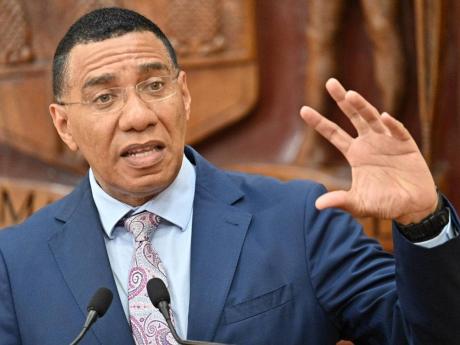
Prime Minister Dr Andrew Holness says the Government is committed to reducing poverty in Jamaica and highlighted that welfare and economic initiatives undertaken over the years have seen more Jamaicans being better off.
Holness, speaking at today's post-Cabinet press briefing, lauded news out of the Planning Institute of Jamaica (PIOJ) that Jamaica’s poverty prevalence for 2023 was estimated at 8.2 per cent, a decline from 16.7 per cent in 2021.
PIOJ Director General, Dr Wayne Henry, disclosed that it was “the lowest figure ever recorded since poverty rates were first measured in 1989”.
The Director General reasoned that the decline in the poverty rate was driven by several factors, which included increases in the national minimum wage, Jamaica’s recovery from COVID-19, improved macroeconomic stability, increased employment and strengthening of social protection programmes.
“Vital support was through the Programme of Advancement Through Health and Education (PATH), the Social Pension Programme, Poor Relief Programme and targeted interventions aimed at generating youth employment and encouraging small-scale agriculture,” he said.
The Prime Minister called the reduced poverty figure ‘a big deal' for Jamaicans, which should be celebrated.
“There are those who would want to make light of it, but I would quickly remind [that] were the data pointing in the other direction, much heavy weather would have been made of it. You wouldn’t stop hearing all the negatives,” said Holness, as he defended the mechanisms used to measure living conditions in Jamaica.
No estimate was provided for 2022, as the Jamaica Survey of Living Conditions was not conducted that year due to the commencement of the National Population and Housing Census.
Poverty data for 2024 is expected later this year, once it is provided by the Statistical Institute of Jamaica.
The economy also grew by an estimated 0.8 per cent during the January to March 2025 quarter, compared with the corresponding period in 2024, the PIOJ has disclosed.
Holness said there can be no naysaying or criticising of the poverty reduction results, arguing that the mechanisms are robust and credible, therefore, Jamaicans can be confident in the data.
“It is a standard tool. We have sought to ensure that our tool that we use to measure is aligned with international standards and indeed the methodology that we use is robust, well tested and aligns very well with global standards,” Holness said.
“We have implemented what I would like to describe as instrumental polices, meaning policies that are directly crafted to treat with the specific elements of poverty,” Holness added.
He acknowledged that there are those Jamaicans who will hear about the poverty reduction and compare it against their lived experience amid higher prices.
Holness said the Government remains on a path of improving lives.
He pointed to increases to the minimum wage, which is set to go up in June, job creation, improved public sector wages, social pension, and free skills training, among other things.
“Now, what is the next step for the Government. The next step for the Government is to end absolute poverty in Jamaica. This is something that I've said before, and it is the intention. At 8 per cent, we're within striking distance of that; we can end absolute poverty,” said Holness.
“We want to ensure that we push this poverty prevalence number way, way down, and then at that point, we revise what is the new threshold for somebody to be considered at or below the poverty line. So it is quite doable, it is within our capabilities to do it, but we must continue with strategic policies, we must continue with the training of our young people so that they can continue to work and earn from their labour and talent. We must continue to improve the social services, access to amenities. We must continue to ensure that our marginalise population is protected by a very effective social safety net,” he added.
Questioned about whether the country's economic growth and declining poverty levels could strengthen the prospect of his ruling Jamaica Labour Party securing a third term when the next general election is called, Holness said it is for voters to look at the work done by the Government.
Holness acknowledged that there is often a “very high level of cynicism” when these numbers are presented to the average person.
This, he theorised, is a biased conditioning resulting from years of a negative economic outlook.
“For decades, the results that you have been given are negative results that you can only be looking for crime to be rising, debt to be rising, growth to be falling off, all the negatives, then you develop a negative bias, you start to look at the glass, not as half full, but as half empty,” he said.
He added, “Our job is to change perceptions, perceptions don’t change overnight, it takes a long time and it takes repeating over and over again."
Meanwhile, Minister of Labour and Social Security Pearnel Charles Jr., who was also at the press briefing, outlined improvements in a number of social protection programmes, which he noted contributed to the reduction in poverty levels.
“If you do an analysis across the board of all of the relevant programmes, you’ll see two things happening: increase and improve,” he stated.
He pointed to the increase in allocation under the Programme of Advancement Through Health and Education (PATH), increase in social pension benefits by 74 per cent, and the introduction of social pension that benefited more than 11,000 Jamaicans.
There was also a 44 per cent increase in the minimum wage in 2023, and an increase in the Ministry’s entrepreneurship grant initiative from $44.5 million in 2020/2021 to $69.4 million in 2022/2023, he stated.
“This low poverty rate is not just a statistic. It is a powerful story of Jamaica’s transformation, of resilience and I dare say of leadership,” he said.
“Thousands of Jamaicans are moving on from struggle to stability, from survival to success,” Charles Jr said.
For her part, Minister of Finance, Fayval Williams, stated that inequality in Jamaica has also declined.
“When we compare the data, 2023 to 2021, our consumption…showed a decrease towards zero, and that is good,” she said.
- Andre Williams / Sashana Small
Follow The Gleaner on X, formerly Twitter, and Instagram @JamaicaGleaner and on Facebook @GleanerJamaica. Send us a message on WhatsApp at 1-876-499-0169 or email us at onlinefeedback@gleanerjm.com or editors@gleanerjm.com.