
Regional & Int’l Briefs
Published:Sunday | December 20, 2020 | 12:27 AM
CARICOM urged to help T&T with Venezuelan migrants
PORT-OF-SPAIN (CMC):
The Caribbean Centre for Human Rights (CCHR) says that, in the wake of the influx of migrants from Venezuela to Trinidad and Tobago, the Caribbean Community (CARICOM) should be asked to help with the crisis.
In a statement, the CCHR also said that the government of the twin-island republic still has a duty to protect human rights, as set out in the Constitution and laws of the country, plus its obligations as a member of the Organization of American States.
“It is possible to secure our borders, protect our national security, mitigate the strain on our economy and preserve relationships with our international partners whilst honouring our obligations under international law,” it pointed out.
“Protecting vulnerable people fleeing a desperate humanitarian crisis does not have to be a zero-sum game.”
The centre noted that the Refuge Convention says that any state too burdened to provide asylum can seek international help, pointing out that Trinidad and Tobago sits next door to one of the worst human rights and humanitarian crises in modern history.
Deporting people back to the risky situation from which they fled is inhumane and breaches Trinidad and Tobago’s obligations under international human rights law, the centre said.
Guyana welcomes ICJ jurisdiction ruling on border dispute
GEORGETOWN (CMC):
Guyanese President Irfaan Ali has welcomed a ruling handed down by The Hague-based International Court of Justice (ICJ) that it has jurisdiction to hear a border dispute between Guyana and Venezuela, which may ultimately determine which has rights to offshore oil and gas fields.
“We have always stood together, we have always recognised together and demonstrated to the international community together that we are one and united, not only on our sovereignty and borders. Today, this victory is no small victory. This victory is testimony to what we can achieve when we are united,” the president said on Friday.
The matter was taken before the International Court back in 2018 under the David Granger administration.
On Friday, the ICJ found that they have jurisdiction to hear a suit brought by Guyana arguing the border was established by an 1899 arbitration between Venezuela and the then colony of British Guiana.
Venezuela’s government had argued the international court had no jurisdiction and it prefers direct talks with Guyana over its claims to a huge, sparsely populated area west of the Essequibo River.
The court has not yet set a date for arguments on the merits of Guyana’s case.
The ICJ is the United Nations’ court for resolving disputes between states.
UK nixes Christmas gatherings, shuts London shops over virus
LONDON (AP):
Millions of people must cancel their Christmas get-togethers and most shops have to close in London and much of southern England, British Prime Minister Boris Johnson said yesterday as he imposed a new, stricter level of coronavirus restrictions on the region to curb rapidly spreading infections.
With just days to go until Christmas, Johnson also announced that a planned easing of socialising rules that would have allowed up to three households to meet in ‘Christmas bubbles’ from December 23 to 27 will be cancelled for some areas and sharply curtailed in the rest of England.
“It is with a very heavy heart that I must tell you we cannot proceed with Christmas as planned,” Johnson said.
He said he concluded there was “no alternative open to me” and people must sacrifice this Christmas to have a better chance of protecting the lives of loved ones.
No mixing of households will be allowed in regions deemed to be Tier 4, except under very limited conditions outside in public places. Travel in and out of Tier 4 areas won’t be allowed, unless essential. In the rest of England, people will be allowed to meet in Christmas bubbles for just one day instead of five, as the government originally planned.
Trump downplays Russia in first comments on cyberattack
WASHINGTON (AP):
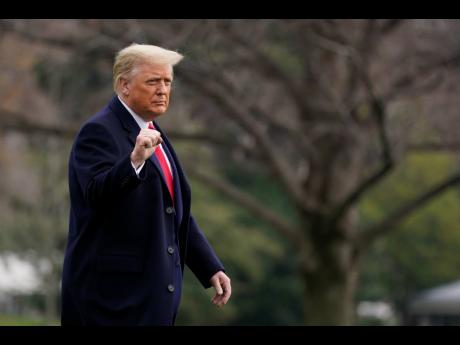
Contradicting his secretary of state and other top officials, President Donald Trump on Saturday suggested without evidence that China – not Russia – may be behind the cyberattack against the United States and tried to minimise its impact.
In his first comments on the breach, Trump scoffed at the focus on the Kremlin and downplayed the intrusions, which the nation’s cybersecurity agency has warned posed a “grave” risk to government and private networks.
“The Cyber Hack is far greater in the Fake News Media than in actuality. I have been fully briefed and everything is well under control,” Trump tweeted. He also claimed the media are “petrified” of “discussing the possibility that it may be China (it may!)”.
There is no evidence to suggest that is the case. Secretary of State Mike Pompeo said in an interview late Friday that Russia was “pretty clearly” behind the cyberattack against the United States.
Officials at the White House had been prepared to put out a statement Friday afternoon that accused Russia of being “the main actor” in the hack, but were told at the last minute to stand down, according to one US official familiar with the conversations.
It is not clear whether Pompeo got that message before his interview, but officials are now scrambling to figure out how to square the disparate accounts.