
Syria
Forgotten children are moulded by IS ideology
Published:Friday | June 4, 2021 | 12:11 AM
AL-HOL (AP):
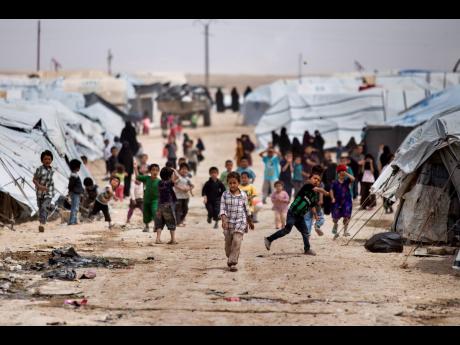
At the sprawling al-Hol camp in northeast Syria, children pass their days roaming the dirt roads, playing with mock swords and black banners in imitation of Islamic State group militants. Few can read or write. For some, the only education is from mothers giving them IS propaganda.
It has been more than two years since the Islamic State group’s self-declared “caliphate” was brought down. And it has been more than two years that some 27,000 children have been left to languish in al-Hol camp, which houses families of IS members.
Most of them not yet teenagers, they are spending their childhood in a limbo of miserable conditions with no schools, no place to play or develop, and seemingly no international interest in resolving their situation.
AWAITING REVIVAL
Only one institution is left to mould them: remnants of the Islamic State group. IS operatives and sympathisers have networks within the camp, and the group has sleeper cells around eastern Syria that continue to wage a low-level insurgency, awaiting an opportunity for a revival.
Kurdish authorities and aid groups fear that the camp will create a new generation of militants. They are pleading with home countries to take the women and children back. The problem is that home governments often see the children as posing a danger rather than as needing rescue.
“These children are ISIS’s first victims,” said Save the Children’s Syria Response Director Sonia Khush. “A four-year-old boy does not really have an ideology. He has protection and learning needs.”
“The camps are no place for children to live or grow up,” she said. “It does not allow them to learn, socialise, or be children ... It does not allow them to heal from all that they have lived through.”
In the fenced-off camp, row after row of tents stretch for nearly a square mile. Conditions are rough. Multiple families are often crammed together; medical facilities are minimal, access to clean water and sanitation limited; the tents flood in the winter, and fires have broken out from use of gas stoves for cooking or heat.