
World expresses outrage, plans stronger Russia sanctions
Published:Thursday | February 24, 2022 | 9:00 AM
BRUSSELS (AP) — World leaders expressed a raw outrage shrouded by an impotence to immediately come to the aid of Ukraine to avoid a major war in Europe, condemning Russia's attack on its neighbour as the European Union and others promised unprecedented sanctions to hit the Kremlin.
NATO has moved to beef up its eastern flank facing Russia and planned a virtual leaders' summit for Friday after President Vladimir Putin warned anyone listening that any interference would “lead to consequences you have never seen in history.”
EU and NATO member Lithuania declared a state of emergency since the Baltic nation borders Russia's Kaliningrad region to the southwest and Russia's ally Belarus to the east.
NATO nations have 100 jets and 120 ships on high alert as deterrence.
“Make no mistake: we will defend every ally against any attack on every inch of NATO territory,” said NATO chief Jens Stoltenberg.
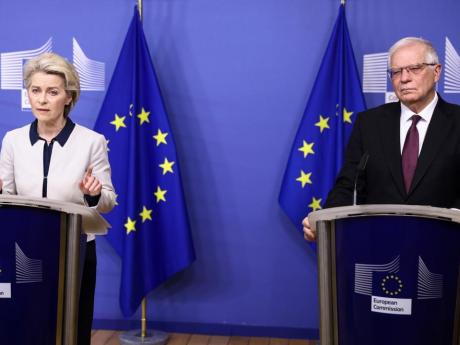
European Commission President Ursula von der Leyen called it a “barbaric attack” on an independent nation that also targeted “the stability in Europe and the whole of the international peace order.” The EU will hold an emergency summit in Brussels.
But no one promised to move in militarily and defend Ukraine as it could touch off a major European war.
So instead, most of the world — but not China — condemned and threatened to hit the Russian elites with, in the words of Von der Leyen — “massive and targeted sanctions.” She will put to EU leaders late Thursday a proposal that “will target strategic sectors of the Russian economy by blocking the access to technologies and markets that are key for Russia.”
She said the sanctions, if approved, “will weaken Russia's economic base and its capacity to modernise. And in addition, we will freeze Russian assets in the European Union and stop the access of Russian banks to European financial markets.”
Like the first package of sanctions that were imposed when Russia recognised the two breakaway eastern Ukrainian republics, von der Leyen said all Western powers were walking in lockstep.
“We are closely aligned with our partners and allies the United States, the United Kingdom, Canada, but also, for example, Japan and Australia,” she said.
Highlighting a widening rift in superpower relations, China stood alone in failing to condemn the attack and instead accused the United States and its allies of worsening the crisis.
And it put its friendship in practice Thursday by approving imports of wheat from Russia, a move that could help to reduce the impact of possible increased Western sanctions. Russia is one of the biggest wheat producers but would be vulnerable if foreign markets block shipments.
In a clear defence of Moscow, China “called on parties to respect others' legitimate security concerns,”
Foreign ministry spokesperson Hua Chunying said that “all parties should work for peace instead of escalating the tension or hyping up the possibility of war,” in language China has consistently used to criticise the West in the crisis.
“Those parties who were busy condemning others; what have they done ? Have they persuaded others?” Hua said.
One thing was clear — weeks of diplomatic cajoling, global crisscrossing of leaders and foreign ministers, and the threat of sanctions against Putin's inner circle had failed to persuade the Kremlin to take one of the most significant measures in Europe since the end of the Cold War.
Overall, more sanctions appear the only option for the foreseeable future. And from South Korea to Australia to Europe, governments were lining up to oppose Putin.
Follow The Gleaner on Twitter and Instagram @JamaicaGleaner and on Facebook @GleanerJamaica. Send us a message on WhatsApp at 1-876-499-0169 or email us at onlinefeedback@gleanerjm.com or editors@gleanerjm.com.