
Ukraine Crisis | Putin puts nuclear forces on high alert as tensions escalate
Published:Sunday | February 27, 2022 | 12:48 PM
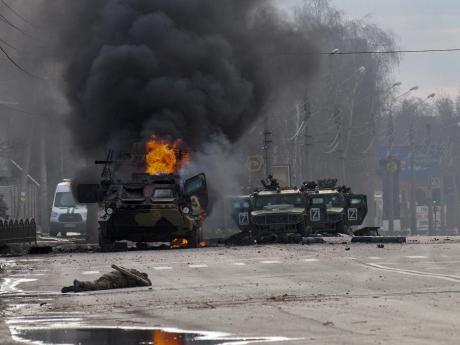
KYIV, Ukraine (AP) —
In a dramatic escalation of East-West tensions over Russia's invasion of Ukraine, President Vladimir Putin put Russian nuclear forces on high alert Sunday in response to what he called “aggressive statements” by leading NATO powers.
The directive to put Russia's nuclear weapons in an increased state of readiness for launch raised fears that the crisis could boil over into nuclear warfare, whether by design or mistake.
Putin's step is potentially putting in play forces that, if there's a miscalculation, could make things much more dangerous, said a senior U.S. defence official, speaking on condition of anonymity.
Amid the mounting tensions, Ukraine announced that a delegation would meet with Russian officials for talks.
But the Kremlin's ultimate aims in Ukraine — and what steps might be enough to satisfy Moscow — remained unclear.
Hours after Putin's announcement, the top official in the European Union said the 27-nation bloc will close its airspace to Russian airlines and fund the purchase of weapons for Ukraine.
“For the first time ever, the European Union will finance the purchase and delivery of weapons and other equipment to a country that is under attack,” said European Commission President Ursula von der Leyen.
The EU will also ban some pro-Kremlin media outlets, she said.
The fast-moving developments came as Russian troops drew closer to Kyiv, a city of almost three million, street fighting broke out in Ukraine's second-largest city, Kharkiv, and strategic ports in the country's south came under pressure from the invading forces.
Ukrainian defenders put up stiff resistance that appeared to slow the invasion.
Putin, in giving the nuclear alert directive, cited not only statements by NATO members — who have rushed to reinforce the military alliance's members in Eastern Europe — but the hard-hitting financial sanctions imposed by the West against Russia, including the Russian leader himself.
Speaking at a meeting with his top officials, Putin told his defence minister and the chief of the military's General Staff to put nuclear forces in a “special regime of combat duty.”
“Western countries aren't only taking unfriendly actions against our country in the economic sphere, but top officials from leading NATO members made aggressive statements regarding our country,” Putin said in televised comments.
U.S. defence officials would not disclose their current nuclear posture, except to say that the military is prepared all times to defend its homeland and allies.
White House press secretary Jen Psaki said Putin is resorting to a pattern he used in the weeks before launching the invasion, which is to "manufacture" threats that don't exist in order to justify further aggression.
She told ABC's This Week that Russia has not been under threat from NATO or Ukraine.
“We have the ability to defend ourselves, but we also need to call out what we're seeing here,” Psaki said.
NATO Secretary-General Jens Stoltenberg told CNN, in reaction to Russia's nuclear alert: “This is dangerous rhetoric. This is a behaviour which is irresponsible.”
The practical meaning of Putin's order was not immediately clear.
Russia and the United States typically have land- and submarine-based nuclear forces on alert and prepared for combat at all times, but nuclear-capable bombers and other aircraft are not.
If Putin is arming or otherwise raising the nuclear combat readiness of his bombers, or if he is ordering more ballistic missile submarines to sea, then the United States might feel compelled to respond in kind, said Hans Kristensen, a nuclear analyst at the Federation of American Scientists.
That would mark a worrisome escalation, he said.
Around the same time as Putin's nuclear move, Ukrainian President Volodymyr Zelenskyy's office announced that the two sides would meet at an unspecified location on the Belarusian border.
The message did not give a precise time for the meeting.
Ukrainian officials initially rejected talks in Belarus, saying any discussions should take place elsewhere, since Belarus has allowed its territory to be used by Russian troops as a staging ground for the invasion.
Earlier Sunday, the Ukrainian capital, Kyiv, was eerily quiet after huge explosions lit up the morning sky and authorities reported blasts at one of the airports.
Only an occasional car appeared on a deserted main boulevard as a strict 39-hour curfew kept people off the streets.
Follow The Gleaner on Twitter and Instagram @JamaicaGleaner and on Facebook @GleanerJamaica. Send us a message on WhatsApp at 1-876-499-0169 or email us at onlinefeedback@gleanerjm.com or editors@gleanerjm.com