
UN: Part of Somalia will reach famine later this year
Published:Tuesday | September 6, 2022 | 12:08 AM
MOGADISHU, Somalia (AP):
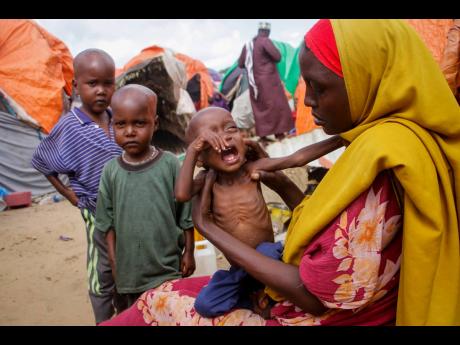
The United Nations (UN) says “famine is at the door” in Somalia with “concrete indications” famine will occur later this year in the southern Bay region. This falls just short of a formal famine declaration as thousands are dying in a historic drought made worse by the effects of the war in Ukraine.
UN humanitarian chief Martin Griffiths told reporters he was “shocked to my core these past few days” on a visit to Somalia in which he saw starving babies too weak to cry. More than 850,000 people are in the affected areas, with tens of thousands more arriving in the months to come, according to UN experts.
A formal famine declaration is rare and a warning that too little help has come too late. At least one million people in Somalia have been displaced by the driest drought in decades, driven by climate change, that also affects the wider Horn of Africa including Ethiopia and Kenya.
Famine is the extreme lack of food and a significant death rate from outright starvation or malnutrition combined with diseases like cholera. A declaration means data show more than a fifth of households have extreme food gaps, more than 30 per cent of children are acutely malnourished and over two people out of 10,000 are dying every day.
Russia’s invasion of Ukraine has been described as a disaster for Somalia, which has suffered from a shortage of humanitarian aid as international donors focus on Europe. Somalia sourced at least 90 per cent of its wheat from Russia and Ukraine before the war and has been hit hard by scarcity and the sharp rise in food prices.
“Ukraine has occupied the narrative,” Griffiths said.
Hungry families in Somalia have been staggering for days or weeks through parched terrain in search of assistance. Many bury family members along the way. Even when they reach camps outside urban areas, they find little or no help.
At one camp outside the capital, Mogadishu, Fadumo Abdi Aliyow showed AP the graves of her two small sons next to their makeshift home. Disease had overwhelmed their weakened bodies. One was four. The other was eight months old.
“I wanted to die before them so they could bury me,” Aliyow said. Another resident of the camp of 1,800 families, Samey Adan Mohamed, said the last meal she and her eight children had was rice a day ago. Today they had only tea.
Camps like theirs are ringed by death, bringing aid workers to tears. “I couldn’t get out of my head the tiny mounds of ground marking children’s graves,” UNICEF’s deputy regional director Rania Dagash said last week. “I’m from this region and I’ve never seen it so bad.”
A formal famine declaration might bring desperately needed funding. But “tragically, by the time a famine is declared, it’s already too late,” the UN World Food Program has said.
When famine was declared in parts of Somalia in 2011, the deaths of a quarter-million people were well underway.
“This is not a repeat of the 2011 famine. It is much worse,” the UN humanitarian agency said last week. At least 730 children have died in nutrition centers across Somalia, it said, and more than 213,000 people are at “imminent risk” of dying.
“You feel like you’re looking at the face of death,” Mercy Corps CEO Tjada McKenna told the AP after visiting the badly hit city of Baidoa. There is not enough therapeutic food to treat the acutely malnourished, said McKenna, who saw many young children and pregnant women. “For every one person I saw, imagine all the people who couldn’t get that far. And so many people were arriving each day.”
At the same time, aid funding has dropped more than 60 per cent from the response to Somalia’s previous drought in 2017, USAID administrator Samantha Power said last week, noting a “degree of despair and devastation” not seen before in her career.
The Horn of Africa region has seen four straight failed rainy seasons for the first time in over half a century, endangering an estimated 20 million people in one of the world’s most impoverished and turbulent regions.