
Hamas accepts Gaza ceasefire proposal
Published:Tuesday | May 7, 2024 | 12:08 AM
JERUSALEM (AP):
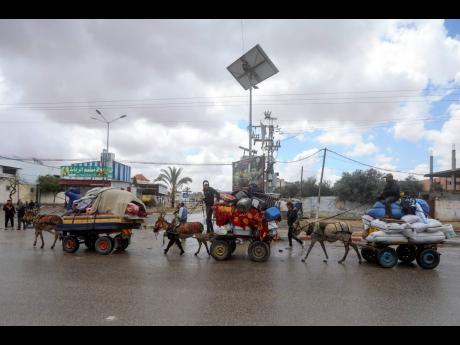
Hamas announced Monday it has accepted an Egyptian-Qatari proposal for a ceasefire to halt the seven-month-long war with Israel in Gaza, hours after Israel ordered about 100,000 Palestinians to begin evacuating from the southern city of Rafah, signalling that a long-promised ground invasion there could be imminent.
There was no immediate comment from Israel on the deal, and details of the proposal have not yet been released. In recent days, Egyptian and Hamas officials have said that the ceasefire would take place in a series of stages during which Hamas would release hostages it is holding in exchange for Israeli troop pullbacks from Gaza.
It is not clear whether the deal will meet Hamas’ key demand of bringing about an end to the war and complete Israeli withdrawal.
Hamas said in a statementthat its top leader, Ismail Haniyeh, had delivered the news in a phone call with Qatar’s prime minister and Egypt’s intelligence minister. After the release of the statement, Palestinians erupted in cheers in the sprawling tent camps around Rafah, hoping the deal meant an Israeli attack had been averted.
Israel’s closest allies, including the United States, have repeatedly said that Israel shouldn’t attack Rafah. The looming operation has raised global alarm over the fate of around 1.4 million Palestinians sheltering there.
Aid agencies have warned that an offensive will worsen Gaza’s humanitarian catastrophe and bring a surge of more civilian deaths in an Israeli campaign that in nearly seven months has killed 34,000 people and devastated the territory.
US President Joe Biden spoke Monday with Israeli Prime Minister Benjamin Netanyahu and reiterated US concerns about an invasion of Rafah. Biden said that a ceasefire with Hamas is the best way to protect the lives of Israeli hostages held in Gaza, a National Security Council spokesperson said on condition of anonymity to discuss the call before an official White House statement was released.
Hamas and key mediator Qatar said that invading Rafah would derail efforts by international mediators to broker a ceasefire. Days earlier, Hamas had been discussing a US-backed proposal that reportedly raised the possibility of an end to the war and a pullout of Israeli troops in return for the release of all hostages held by the group. Israeli officials have rejected that trade-off, vowing to continue their campaign until Hamas is destroyed.
Netanyahu said Monday that seizing Rafah, which Israel says is the last significant Hamas stronghold in Gaza, was vital to ensuring that the militants can’t rebuild their military capabilities and repeat the October 7, 2023, attack on Israel that triggered the war.
Lt Col Nadav Shoshani, an army spokesman, said about 100,000 people were being ordered to move from parts of Rafah to a nearby Israel-declared humanitarian zone called Muwasi, a makeshift camp on the coast. He said that Israel has expanded the size of the zone and that it included tents, food, water, and field hospitals.
It wasn’t immediately clear, however, if that material was already in place to accommodate the new arrivals.
Around 450,000 displaced Palestinians already are sheltering in Muwasi. The UN agency for Palestinian refugees, known as UNRWA, said it has been providing them with aid. But conditions are squalid, with few bathrooms or sanitation facilities in the largely rural area, forcing families to dig private latrines.
After the evacuation order announcement Monday, Palestinians in Rafah wrestled with having to uproot their extended families once again for an unknown fate, exhausted after months living in sprawling tent camps or crammed into schools or other shelters in and around the city. Few who spoke to The Associated Press wanted to risk staying.
Mohammed Jindiyah said that at the beginning of the war, he had tried to hold out in his home in northern Gaza after Israel ordered an evacuation there in October. He ended up suffering through heavy bombardment before fleeing to Rafah.
He is complying with the order this time, but was unsure now whether to move to Muwasi or another town in central Gaza.
“We are 12 families, and we don’t know where to go. There is no safe area in Gaza,” he said.