
No joy for Ja's relay quartet
Published:Saturday | July 17, 2010 | 12:00 AM
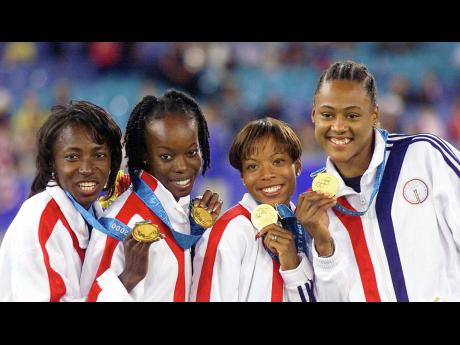
GENEVA (AP):
Jamaica's hopes of being upgraded from silver to gold in the 4x400 metres relay at the 2000 Sydney Olympics were dashed yesterday.
American relay runners who were stripped of their 2000 Olympics relay medals because teammate Marion Jones was then taking performance enhancing drugs won an appeal yesterday to have them restored. The members of the Jamaican team which finished second in the final were Sandie Richards, Catherine Scott-Pomales, Deon Hemmings and Lorraine Graham-Fenton. Char-maine Howell and Michelle Burgher who ran in the semi-finals were also eligible for an upgrade of the medals from silver to gold. The United States won in 3:22.62 with Jamaica second in 3:23.25.
The Court of Arbitration for Sport ruled in favour of the American women, who appealed the International Olympic Com-mittee's decision to disqualify them from the Sydney Games.
The court said IOC and the International Association of Athletics Federations rules in 2000 did not allow entire teams to be disqualified because of doping by one athlete.
Disappointing ruling
The IOC said the ruling was "disappointing and especially unfortunate for the athletes of the other teams who competed according to the rules."
In Sydney, Jearl Miles-Clark, Monique Hennagan, LaTasha Colander Clark and Andrea Anderson were part of the squad that won gold in the 4x400 relay. Chryste Gaines, Torri Edwards, Nanceen Perry and Passion Richardson were on the 4x100 bronze medal squad.
All, but Perry, joined the appeal.
In 2007, Jones admitted she was taking performance-enhancing substances in Sydney and also lost her individual gold medals in the 100 and 200 metres and bronze in the long jump.
"The panel found that at the time of the Sydney Olympic Games there was no express IOC or IAAF rule in force that clearly allowed the IOC to annul the relay team results if one team member was found to have committed a doping offence," CAS said.
She spent about six months in a Texas prison in 2008 for lying about using performance-enhancing drugs and her role in a cheque-fraud scam.
She has since made a comeback in basketball with the Tulsa Shock of the WNBA.
"I've totally moved on," Jones told The Associated Press yesterday in San Antonio. "I'm moving forward."
Jones said she had not heard about the CAS decision and had not spoken to her former Olympic teammates recently. She declined further comment.
The CAS panel of three lawyers acknowledged that the ruling might be unfair to relay teams that competed "with no doped athletes helping their performance," but the decision "exclusively depends on the rules enacted or not enacted by the IOC and the IAAF at the time of the Sydney Olympic Games."
The IOC has now lost two CAS rulings within five weeks involving Olympic medals stripped in doping cases.
"The IOC will continue to enforce its zero tolerance policy in the fight against doping for the sake of the athletes' health and to ensure fair competition," the IOC said in a statement.
Belarus hammer throwers Vadim Devyatovskiy and Ivan Tsikhan won their appeals last month against disqualification from the 2008 Beijing Games and regained their silver and bronze medals, respectively. Both had elevated levels of testosterone in doping controls but the CAS panel said the tests were invalid because international laboratory standards in Beijing were not respected.
The CAS inflicted a further defeat on the IOC yesterday, ordering the Olympic body to pay 10,000 Swiss francs (US$9,500; euro7,350) toward the athletes' legal costs.
The case was heard over two days in Lausanne, Switzerland, in May when the relay runners' legal team argued they should not be punished for cheating by Jones.
Unanimous decision
The panel agreed unanimously yesterday that the IAAF's rule in 2000 was the decisive point.
The court also confirmed its own precedent set five years ago in a previous doping case involving U.S. relay runners at the Sydney Olympics.
That panel determined that teammates of Jerome Young should not lose their 4x400 gold medals after he received a retroactive ban from 1999-2001 - meaning he was technically ineligible to compete in Sydney.
Young's relay partners - Michael Johnson, Antonio Pettigrew, Angelo Taylor, Alvin Harrison and Calvin Harrison - won their appeal to CAS after the IAAF annulled their result.
However, the IOC did strip the entire team of the medals in 2008 following the admission of doping by Pettigrew.
The IAAF amended its rules in 2003 so that relay teams could then be disqualified if one member was caught doping.