
Stop demonising Warmington ... But scrap CDF
Published:Sunday | October 31, 2010 | 12:00 AM
Martin Henry, Contributor
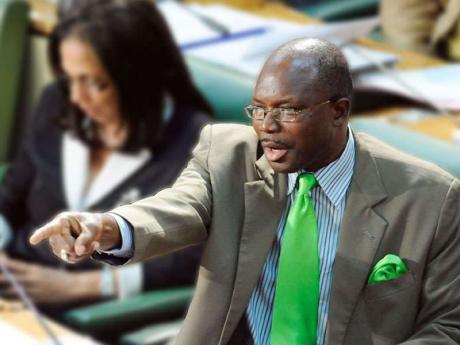
THERE IS much that I like and admire about Everald Warmington, the 'controversial' member of parliament (MP) for South West St Catherine and minister of state for water and housing. I am, therefore, unwilling to join in any wholesale 'demonising' of him.
Warmington can be arrogant and rude, but his pointedness, independence and courage are like a breath of fresh air, in a legislature filled with party yes-men and women, afraid of their own shadow - and of their party leader.
Warmington, although now caught up in the dual citizenship imbroglio and Office of the Contractor General's (OCG) investigations of conflict of interest practices, is a man who has returned home to give public service in politics, a largely thankless undertaking; as the not so young man Greg Christie has returned to give public service as contractor general. Anthony Hylton comes to mind on the Opposition People's National Party side as someone who has come back to give back through politics. Parliament needs more Warmingtons.
Apparently he is also a pretty good member of parliament (MP) on the ground. Warmington has one of the strongest vote majorities, outside of the couple of Jamaica Labour Party garrisons, on the government side, having won his South West St Catherine seat by some 3,000 votes in the 2007 general elections. He, like that other 'troublemaker', Robert Montaque, MP for Western St Mary, is indispensable to the meagre-majority Golding Government. It, therefore, borders on the comical when media demands that Golding disciplines the renegades and he publicly agrees to meet them in private, keeping up the appearance of disciplinary action being taken.
No hurry
Warmington has made it known to party, party leader, and public, that it is the people of South West St Catherine who sent him to parliament, and it is only they who can remove him. And from his margin of victory last run, they may be in no hurry to.
I wish I could pay the other 59 members of parliament to adopt this bold independent stance. What a vibrant parliament of the people's representatives we would have, instead of the crowd of party hacks who we now have occupying Gordon House. With the thin majority margin on the government side and a hungry Opposition, it is just such a glorious moment for elected representatives to assert their independence.
And, sorry, Everald Warmington, defiantly and arrogantly 'running up' his mouth, poses no significant danger to press freedom.
Despite slipping a couple of points in Reporters Without Borders' (RWB) ranking this year over last year, moving from 23/178 to 25, Jamaica has one of the freest media in the world. 'Press Freedom slides in Jamaica - report', is a bit of a stretch for a headline. The same local media story noted that the RWB report "lauded the Government's commitment to reforming the libel laws," although it "chastised the slowness of it". Furthermore, the RWB Report said, "Jamaica has a very honourable record in freedom of expression and media safety, only slightly diminished by the occasional physical assault."
Warmington-tamer Prime Minister Bruce Golding has swung into action to placate media, using the occasion of a courtesy call upon him by the new executive of the Press Association of Jamaica to reaffirm the government's commitment to press freedom in Jamaica. Unfortunately, this newspaper, which has led the recent charge in defense of press freedom, buried the story on page B15 of last Wednesday's publication.
Tensions
There are everlasting, inherent tensions between politics and government, on the one hand, and media on the other hand in a free society. And eternal vigilance is the price of freedom. But media should be careful about bawling "wolf!" too loudly and too often. While politics and government can and do threaten media freedom, almost by their very nature, media can and do damage political and civil service reputations. I strongly commend the editor-in-chief of this newspaper for running a page 2 'We erred, we apologise' note to readers in last Wednesday's publication correcting the unwarranted dragging of Minister of Education Andrew Holness into a rather shallow Sunday Gleaner front-page story about his wife's lawful engagement in a controversial real-estate project, and also for ascribing a damaging quote to the CEO of the Public Sector Transformation Unit, Patricia Sinclair McCalla, which she did not, in fact, say but which was only inferred. Minister Holness also had the right of reply honoured.
Columns speak
Having 'big up' the war-boat Warmington, who much of media would prefer to 'small down', and thereby earned the ire of media colleagues, let me now strongly disagree with Everald Warmington and the other 59 parliamentarians and large numbers of their licky-licky constituents over the Constituency Development Fund (CDF). The CDF is a far greater clear-and-present danger to good governance than Warmington's noisy 'threat' to press freedom. I, like The Gleaner, have written extensively against the CDF as a dangerous blurring of the separation and balancing of powers among the branches of government which the Constitution sought to achieve. Let the old columns speak:
The main ground of support for the CDF is that the people's representative has to have a little something in hand to assist constituents and to undertake 'development' projects in the constituency, at his or her own discretion.
There are at least two things fundamentally wrong with this: It is not the job of the MP and when these functions are usurped it is bound to have a corrupting influence on the political system.
Ask the average MP, not to mention his or her constituents, what the roles and responsibilities of a member of parliament are, and at the top of the list is likely to be providing some kind of direct benefit to the 'people'. A media colleague became most indignant in discussion over my call to scrap the CDF. "So how is the MP to help the people, especially the poor and the most vulnerable?"
The CDF helps the MP more than it helps the people; and it corrupts the system. The CDF, a partisan political fund, is not conducive to the "peace, order and good government of Jamaica."
The first and foremost objective of an elected representative, especially of the career-politician type, which dominates modern democracies, is not the 'development' of the constituency and the welfare of constituents, it is to get re-elected. No breathing politician, an egotistic and corruptible human, not an angel from heaven, would fail to consider how to use the resources at their disposal, including state money handed to them, to improve their chances of re-election. Now much of this can be done lawfully and even reasonably equitably. But the dangers of corruption are large, particularly in our tribalised political environment.
A fundamental function of our constitutional arrangement, as for other democratic constitutions, is the balance of power, with appropriate checks and balances, to try and avoid the abuse of invested power that will hurt the rights and freedoms of citizens. In the constitutional scheme of things, an independent and neutral public service implements the decisions and policies of Government.
Strong temptation
An MP, armed with state-revenue resources, has only two options for pursuing 'development' in their constituency: to dictate to public-service agencies in the discharge of their duties, or to create a parallel delivery system. In either case, the strong temptation to reward their people will become a reality on the ground in too many instances. In essence, the money will be used to 'buy votes', one way or another.
So, how is a member of parliament to help their constituents? What the Constitution envisaged, but is now badly hobbled in practice, is that MPs would be able to make laws and help to craft policy directions for the "peace, order and good government of Jamaica", and that benefit the piece of Jamaica they were elected to represent.
'Creng-creng' projects
The CDF cannot be reformed, cannot be managed to remove its inherent tendency to abuse and corruption. The very management unit in the Office of the Prime Minister for the CDF has been registering complaints, in the security of in-camera sittings of the parliamentary committee, about MPs' (mis)use of the fund. The St Aubyn Bartlett-labelled 'creng-creng'projects, a label applied in the privacy of closed committee sittings, will always be coming up.
Bartlett's frank behind-closed-doors comments about the problems dogging the CDF exposes the true character of the fund.
The OCG has had reason to launch an investigation into a media-unearthed road project by MP Natalie Neita-Headley, as 'Christie probes Natalie', according to this newspaper.
Weeding out 'creng-creng' and endlessly regulating the little left will most certainly kill the CDF. The fund should be spared that slow and undignified death in the public eye, or a return to the "creng-creng" behind closed doors, by scrapping it now and diverting the money to public agencies for small but significant cross-country development projects.
Jamaica has inched up this year on Transparency International's Corruption Perception Index. And the Professor Trevor Munroe-led National Integrity Action Forum, which has brought together state and private-sector anti-corruption forces, including the media, has popped the champagne.
Thanks to the recent media exposé, the danger of the CDF to the fight against corruption is finally gaining public awareness and traction. Don't stop the progress. The Parliament should scrap the fund now, freeing MP Warmington, rambunctious chairman of the CDF Committee, to apply his strengths to more productive and profitable - and less dangerous - parliamentary activities.
Martin Henry is a communications consultant. Feedback may be sent to medhen@gmail.com or columns@gleanerjm.com.