
'What Is Fi Yuh': A nicely balanced family play
Published:Monday | November 29, 2010 | 12:00 AM
Marcia Rowe, Contributor
THOSE WHO are close to, or are a part the Jamaican theatre circuit, will know that the name Robin Baston is synonymous to some excellent lighting designs. He has also proven to be a great technical director. As proof of his creativity, Father Ho Lung's epic drama YES comes readily to mind.
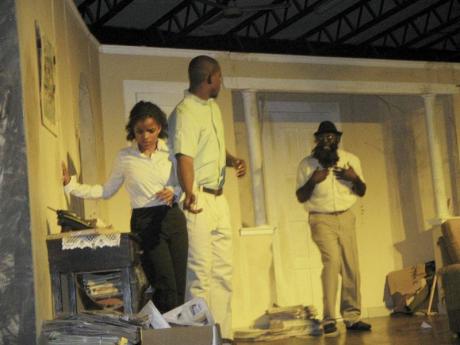
It is, therefore, not surprising that his second penned and directed play, What Is Fi Yuh, staged at the Campion College Auditorium, on Old Hope Road, last Friday, was an exposé of fantastic lighting, a well-crafted detailed set, good acting and nicely written on a topic with a difference - "dead lef". However, for all the brilliant lighting, the script had weaknesses.
With its title What Is Fi Yuh taken from a part of a popular Jamaican saying ('What is fi yuh caan be un fi yuh'), the play highlights triumph over adversity - albeit somewhat superficial, but nonetheless refreshing.
The plot of the story begins with the death of Bernard J. Blyth, an old man who lived alone in a well-constructed but run-down house, in an upscale neighbourhood. A young couple, Jeff and Carlene Blyth, in trying to fulfil their desire to purchase a home of their own, were conned into bidding for the house by a larcenist Bernard Smith. Smith, also known as James Catchcore, also has a hand (accidentally) in the death of Bernard Blyth. But the story is not a police drama, so Baston deviated from that path. Instead, he takes the audience on a journey of wrangling, punctuated with lots of laughter over a house.
In the absence of a will, Bernard Blyth's lawyer must find his nearest relative(s) in order to dispose of the house. And with some twist and turns that revealed some fascinating character traits, the couple that was conned out of hard-earned money triumphs.
The entire story is set in the house of Bernard J. Blyth and highlights five characters. It begins tepid, with a bit too much reported background information on the characters; this may, perhaps, be because of the one setting. But the story becomes exciting with some long laugh-out-loud scenes.
It was in these very comedic scenes that Baston's brilliance in directing came to the fore. Aided by perfect and timely lighting, the surreal scenes were reinforced with wonderful use of the stage. But alas! In other scenes, there was a tendency to overuse downstage centre, thus resulting in a sort of disconnect at times between characters and set, especially as Baston chose to use the Bertolt Brecht technique whereby the characters speak to the audience, often in the case of Bernard Smith-James Catchcore.
Complementing performances
Led by the experienced Christopher McFarlane, who played a bombastic Smith-Catchcore, the cast of four - André Morris as Bernard J. Blyth and Jeff Blyth, Laveda Thompson as Carlene, and Deru as the lawyer, gave very complementing performances. There seemed to be great understanding of their roles, though not given much opportunity to show growth in their one-dimension characters, except for Morris.
In his role as Jeff Blyth, Morris had to show growth from the easy-going man at the beginning of the play to a more assertive one towards the climax of the story, a feat he executed well. Thompson, in her role as the lone female, diminutive in stature, she took on the challenges of Carlene in a convincing manner. Her most engaging moment came in the scene where she tried to trick Smith.
While McFarlane made both his roles pleasurable to see and listen to, Deru gave a creditable performance
What Is Fi Yuh was technically sound. The set was well-constructed and decorated from the realistic-looking cobwebs across the doorways to the brownish-looking newspapers that reeked age. The tightly cued lights and sound were only marred by long blackouts. Cheryil Mais' costumes were simple, but effective.
On a whole, What Is Fi Yuh is an ideal family play. There is nothing to be embarrassed about, that is, unless you work at the inland tax revenue centres.