
Fray undergoes historic test
Published:Saturday | April 2, 2011 | 12:00 AM
Jermaine Lannaman, Gleaner Writer
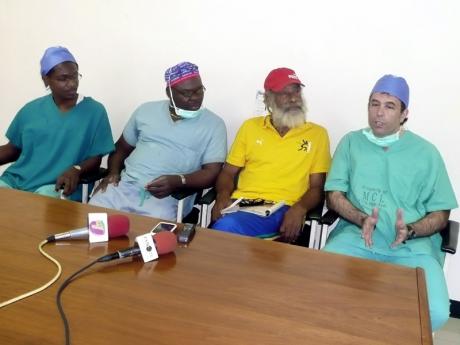
The University of Technology (UTech), in association with the University of Glasgow, conducted an historic biopsy test on Olympian Michael Fray on Thursday, as they continue to try and find out some of the possible reasons behind Jamaica's track and field success over the years.
The test, which took place at the Winchester Medical Centre, saw a team of medical officials - headed by the consultant surgeon and an associate professor and head of the Caribbean School of Sports Science, Dr Neville Graham, and University of Glasgow's Dr Yannis Pitsiladis - spearheading the procedure.
They took a sample of Fray's thigh muscle tissue, an experiment they will be continuing on several other Jamaican athletes in the coming months.
"It was nothing major. I did not feel anything," said a smiling Fray at a press conference shortly after the completion of the procedure.
"They put in a needle and took out a sample and I'm the first Jamaican to be involved at this stage of the study, " added Fray, who competed in the 100 metres, 200m and 4x100m at the 1968 Olympic Games in Mexico City.
10-year study
Thursday's experiment represented the start of a second phase of the study, which began approximately 10 years ago with Pitsiladis being the lead scientist.
Phase one included the testing of athletes, including Great Britain Olympian Colin Jackson, regarding their genetic make-up and whether or not this was one of the reasons behind elite athlete performances.
This phase, however, has proved to be inconclusive and is currently ongoing.
This has resulted in Pitsiladis coming to Jamaica where he and his team of research assistants, some of whom will be UTech students, plan to test between 40 and 50 athletes in phase two of the study.
These findings, he pointed out, will then be compared and contrasted with similar studies that will be done in Kenya and Ethiopia, whose athletes, like Jamaica's, are world beaters.
"The aim is to, over time, get a better understanding of the making of world-class athletes. We also hope that at the end of our experiments that, where possible, we will be able to identify and establish means of how athletic performances can be sustained," said Pitsiladis.
Graham said he was excited at the advent of phase two of the study.
"Today marks the continuation of years of study into the topic, and for UTech to be part of this latest initiative, we are excited," he said.