
WikiLeaks, commission of enquiry and political violence
Published:Sunday | June 12, 2011 | 12:00 AM
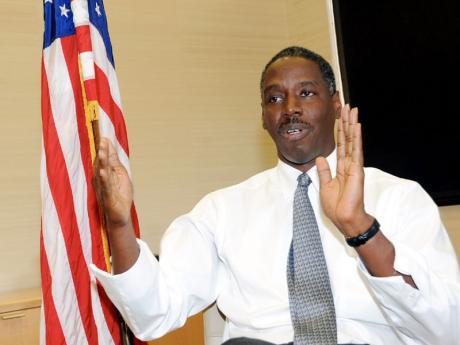
Martin Henry, Contributor
I have very mixed feelings about publishing the WikiLeaks diplomatic cables, and I can just imagine the editorial and managerial agony of The Gleaner in deciding to do so.
By the way, diplomatic transmissions are no longer telegraphic 'cables' sent along undersea copper cables or paper memos in inviolable diplomatic pouches; they are email transmissions, hence the possibility of quick and easy mass leakage like the WikiLeaks. There is always a sting in the tail of new technology! And language tends to lag behind technology. So we still have diplomatic 'cables'. In the case of IT, law is also seriously lagging behind the technology.
The WikiLeaks cables in the public domain are the products of espionage. The young soldier and army intelligence analyst, Bradley Manning, whom it is alleged used his advanced computer skills and access to steal the cables, is facing a sentence of up to life imprisonment on 20 counts. And the US government wants to bring criminal charges against WikiLeaks founder Julian Assange.
But once the cables are in the public domain, it hardly matters which media house in the world republishes them. With a little bit of effort, anybody, anywhere, with access to the Internet can have access to them. What The Gleaner has done, in its view as a public service in the tradition of media to inform the public about 'public affairs' which are largely about the conduct of government, is to sift out and repackage the Jamaica cables from the 250,000, or so, which were stolen and then published.
Mild missives
The sharp exchanges between the governing Jamaica Labour Party and The Gleaner over the publication of select (and edited) Jamaica cables underscore the moral, legal, political and diplomatic conundrum which the WikiLeaks disclosures pose. The PNP and the US Embassy have wisely held their peace.
The prime minister feels that his Government, specifically, and politicians, in general, are being attacked by the "power brokers" of North Street, who had earlier, in a string of editorials, had the temerity to compare the political parties to gangs. But the Gleaner WikiLeaks stories, as the drama unfolds, hyped by media sensationalism, are well balanced between the parties and the governments they have formed between 2005 and 2010 and even cover non-political state and private-sector actors.
Daryl Vaz, government information spokesman, has challenged the paper to publish all the cables. And it is not hard to understand, and even to share, Vaz's bravado. The cables published to date are, in general, rather mild missives, rather than bombshells, assessing the Jamaican Government, State and society, and key players. The transmissions have been crafted with some original first-hand data which an embassy would naturally have from normal diplomatic contacts (the intelligence service seems very absent), lots of secondary data, and lots more inferences from what is more and more appearing to be a Big Brother with a big-stick stance.
And there are some positive things. One must hope that The Gleaner is not exercising the media predilection to overpresent the negative at the expense of the positive. And unless the paper is saving the worst for the last, or feels excessively constrained by libel laws, there really is no earth-shattering bombshell of 'Bruce's secrets' and 'Portia's secrets'.
While Big Brother would not think of them as a positive, I just love those instances when our leaders declared Jamaica a sovereign state and, accordingly, took diplomatic decisions not in kowtow support of US foreign policy as directed to do.
Absolutely, the most negative aspect of the cables concerns the influence of criminality upon politics and governance, and the threat it likely poses to the integrity of the Jamaican State. But this hardly breaks new ground. Which Jamaican doesn't 'know' this better than any American chargé d'affaires does, or can? What is new ground is the expressed desire of both political party leaders, at some stage, to break free from criminal influence upon their party and Government and seeking help to do so.
Stolen property
The Gleaner petulantly challenged Vaz to table the WikiLeaks cables in Parliament using parliamentary privilege to escape any libel prosecution. Without skipping a beat, Vaz shot back that he could not table stolen property!
But as the paper has rightly noted, the leaked - and published - cables give us rare and unprecedented insight into what our major diplomatic partner, which happens to be the world's lone superpower, thinks about us and the relationship. It appears to me, post-WikiLeaks, the same as pre-WikiLeaks, to be a robust if sometimes rocky relationship between friends with a huge size and power differential. And the cables - read between the lines - as the transmitters have themselves done with Jamaican data, tell us as much about the thinking and attitude of the US Embassy here as they do about Jamaican affairs and public actors. And some of that thinking seems plain wrong, if not
downright malicious. The cables' assessment of Portia Simpson Miller's leadership as weak and leaving the "once-vibrant party [she leads] in shambles", for example, seems to be well off track.
Foregoing, for the moment, any assessment of her competence in the top jobs of party leader and prime minister, Simpson Miller is anything but weak. She is one of the toughest and wiliest politicians this country has ever had. I have been a Portia-watcher since the 1970s and first from inside her constituency of South West St Andrew when she was organising it.
The dispatches in other places openly acknowledged her need, like her counterpart Bruce Golding in the JLP, to balance political forces and to accommodate undesirables within the party and the Government, which are features of democratic politics everywhere in the world as is the fatigue of parties in long-haul government. Ask Obama, whose secretary of state, Hillary Clinton, to whom embassies report, was his bitterest and nastiest rival for the presidency. Ask the British Labour Party in and out of government and about the Tony Blair-Gordon Brown relationship.
The cables oversold the PhDs - Omar Davies and Peter Phillips - vis-à-vis Portia Simpson Miller. And the expressed fear of her sidelining them completely failed to materialise.
WikiLeaks has opened up a can of worms about the conduct of diplomacy; about the right of the public to know versus the very obvious need of government to have secrets; about ethical conduct in media and media responsibility; about laws governing use of public domain information which were stolen to get into the public domain; and about the management of the Internet. Those many worms will be crawling about the globe for a while.
The report of the Manatt-Coke commission of enquiry is to be placed before Cabinet tomorrow and tabled in Parliament on Tuesday.
We don't yet know what the report says. There have been no Wiki-leaks on it - at least none published! What we do know, without any Wiki-leaks of US diplomatic emails, is that the events leading to the Coke extradition request; to the hiring of the law firm Manatt, Phelps & Phillips to thwart the request; to the Tivoli Gardens incursion to extract 'Dudus' from a fortified and armed garrison which left 70-plus people dead; and to the Manatt-Coke commission of enquiry, have their genesis in the history of political violence and the association of crime and politics.
Not interference
Cables have reported pleadings by the JLP Government begging the US government to understand the sensitivity of the Coke extradition and its likely economic, social and political implications. And that is data, not inference. The US Embassy here could conclude that the GOJ was in danger of being captured by criminal elements, having been infiltrated by suspected criminals at both the political level and at the constituency community leadership level.
To balance things out, cables have raised concerns about criminality and politics on the PNP side and provided fairly hard data from the horse's mouth that the PNP Government "lubricated" influential community leaders, including handing out money, to keep PNP communities out of the Opposition JLP-led demonstrations against price hikes on September 6, 2005.
Whether those pacification payments were from the state Treasury is yet to be established.
I have just acquired Amanda Sives' book, Elections, Violence and the Democratic Process in Jamaica, 1944-2007. This important scholarly addition to the literature on politics and criminality, although only published last year, is scarce already. The UWI bookshop was reporting out of stock and Sangster's Book Stores had to shop around its branches to locate for me the last copy at its Springs branch.
"The link between violence and partisan identities emerged when the political parties and their trade union affiliates sought to strengthen their own position within the newly developing political landscape of the 1940s," Sives reiterates. "Not only has violence been part of the political identity construction," Sives points out, "it has assisted in its continuation." But, ironically, "Jamaican democracy has remained resilient", which is an important subtext of the US Embassy dispatches.
They say a picture is worth a thousand words. Sives' book is sprinkled with election advertisements and cartoons appearing in The Gleaner, with the JLP and PNP accusing each other of violence. There is an excellent chapter on 'The Arrival of the Garrison'.
Martin Henry is a communication specialist. Email feedback to columns@gleanerjm.com and medhen@gmail.com.