
PM vs Party leader
Published:Sunday | October 30, 2011 | 12:00 AM
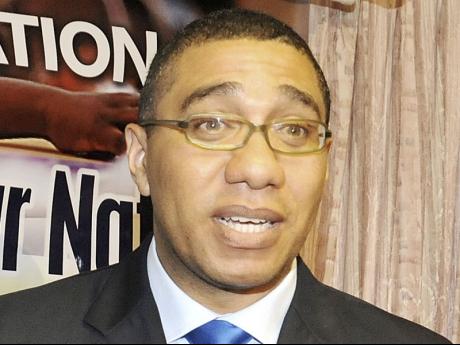
Prime Minister Andrew Holness, still in waiting to be leader of the JLP, will be keynote speaker at the annual conference of the East Central St James constituency. The party comes first. The appearance of the leader-in-waiting, exchanging business suit..
Here is a little statistical tidbit for 39-year-old Prime Minister Andrew Holness as he hurries off to his first major public engagement today in East Central St James: More than 39,000 Jamaicans missed his swearing-in last Sunday. They were unable to tune in because they were murdered since he was born in 1972. The criminal violence which consumed the lives of the overwhelming majority of these fellow citizens has its tap root in the gangster politics of the country and the garrison enclaves which it has created and which have functioned as crime incubators.
Prime Minister Holness, still in waiting to be leader of the Jamaica Labour Party (JLP), will be keynote speaker at the annual conference of the East Central St James constituency. The party comes first. But probably not in the west in the next general election, where the PNP is strongest except for its Kingston garrisons, if undecided voters there choose not to forgive and forget that their new prime minister first came as a bell-ringing, green party man.The appearance of the leader-in-waiting, exchanging business suit for green shirt and bell, is one more clear indication of an early election, which almost everyone now expects.
The retention of the Golding Cabinet, with a couple of adjustments, and Mr Holness' own retention of the education portfolio, much to the displeasure of the Jamaica Teachers' Association, is a clear sign that this is a stopgap Cabinet.
Complete reform process
I have no substantial quarrel with Mr Holness' stopgap Cabinet. Pushing local government out of the Office of the Prime Minister (OPM) and pulling in the public service makes sense. What local government really needs is completion of the dawdling reform process and getting out from under the armpits of central government with its own revenue streams and powers for parish development. The shameless postponements of local government elections, which are due every three years, by both the Golding and PNP administrations before wanting to avoid a 'referendum vote' on the performance of central government, is a blot upon serious governance.
We have to wait to see how the new public-sector efficiency portfolio assigned to Daryl Vaz differs from the public service portfolio retained by Senator Arthur Williams, with both in the OPM. Flashbacks to the 1970s cut across Ministry of National Mobilisation held by D.K. Duncan and the 1990s Ministry of Development Planning and Production headed by P.J. Patterson pop into mind. Neither was a great success in pushing the country forward economically. Nor has the Public Sector Modernisation/Transformation Programme of the Golding administration, inherited from the previous People's National Party (PNP) administrations which inherited it from the Seaga administration, been any great success.
PM Holness told his ministers at the main swearing-in last Tuesday afternoon that "the Jamaican people want to see decisive, instrumental and quick action because their challenges and problems are urgent". If only the urgency of being in East Central St James today for the party, with more than half the Cabinet lined up to speak, headed by the prime minister himself, could be transferred to governance!
Delroy Chuck has had leader of government business in the House added to his recent assignment as minister of justice in the last Golding reshuffle. We have to hope that he will do much better than Andrew Holness in the role of leader of the House. Even when compensation is made for his status as an opposition PNP backbencher, the member for Central Kingston, Ronald Thwaites, in his 'From the Backbench' Gleaner contribution last Monday, categorically stated that "new Prime Minister Andrew Holness has no good record to stand on as an efficient leader of government business in the House of Representatives". Senior Gleaner Parliamentary Reporter Arthur Hall made essentially the same negative charge on Earl Moxam's 'That's A Rap' programme, on which we both appeared on swearing-in Sunday.
Ignored issues
Thwaites charged that "the volume of issues on the Order Paper which he [Holness] has either evaded or ignored during his ample tenure as House leader portrays him as having a narrow, defensive view of the legislature; someone with a weak commitment to the free discussion of profound national issues".
The national transformation which Holness spoke about with such feeling at the Terra Nova and at King's House absolutely requires a vigorous and engaged Parliament of the people's representatives, from Western Westmoreland through East Central St James, West Central St Andrew, and Central Kingston to Eastern St Thomas, regardless of party affiliation. The Opposition and the backbenches must be fully engaged.
"It will be to the peril of the nation if he carries the same mindset to the prime minister's chair," Thwaites warns.
Mr Holness' ascension to the office of prime minister has been very much the doing of the young professional affiliate of the JLP, G2K, which cleverly got then outgoing Prime Minister Bruce Golding to act from its script for young leadership. We must watch that the Government is not unduly controlled by this or any other group. There is nothing to suggest that a BlackBerry Government is superior to any other. Indeed, the BlackBerry posse provided the prime minister with a pitifully weak rendition of the country's political history for his inaugural address. That history must be properly understood if a better future is to be created as promised.
One ominous sign of G2K victory intoxication is its demand for an apology from the leader of the Opposition for leaving the swearing-in ceremony early. The group went so far as to suggest that her leaving [as it turned out, to keep a long-standing, prior engagement] was a diss to the prime minister's stated objective to eliminate garrison politics and to advance consensus building. The conceited and condescending apology of G2K does not speak well for new and "better politics". The leader of the Opposition must be supported in her description of the action of G2K as "out of order". It very definitely is not consensus building.
Intimidated by arrogance
As Prime Minister Holness whizzes across the country today in state vehicles by air and land to a party engagement, a little bit of political history. But first, according to Ronnie Thwaites, two Tuesdays ago, "orderly traffic on East Street in downtown Kingston was corralled off by the blaring horns of three fast-moving multimillion-dollar vehicles" convoying then Minister Holness to Parliament. Forced to pull his 12-year-old deportee off the road, "we were all suitably intimidated by this unnecessary show of arrogance," he reports.
There is a little book on my shelf, 'The Past is Always Present'. Its fundamental thesis is that the present and, indeed, the future, are determined, to a large degree, by the events of the past, sometimes the long-forgotten past.
The formation of the modern political system of this country was accompanied by violence and corruption almost from the very start. The documentation is now extensive and readily available. I have written a lot about it in this space. The first commission of enquiry into political violence, the Hearne Commission, was held in 1949 when the PNP was only 11 and the JLP six. The last commission of enquiry in 2011 had its roots in garrison politics. In-between both, the destructive tribal politics of this country has been the biggest impediment to its development.
Born into garrison politics
Mr Holness was born in the decade when garrison politics peaked and was consolidated. When he was only eight years old, his constituency of West Central St Andrew had the highest level of political violence and the largest number of deaths during the long election campaign of 1980.
The Yappists and the Russians fought pitched battles and burned out swathes of the area, turning hundreds of citizens into refugees. I had relatives, two young girls at the time, boarding on the border street of Balmagie Avenue between the contending forces, who could describe the attacks and counterattacks, the armed guards, the guns hidden in innocent people's homes, the nightly fires - and the bodies in the streets. My informants were not able to say how the abundance of long guns, as they described them, and the far greater abundance of freely available ammunition were supplied, so I cannot report.
As I said last week, the people of inner-city West Central St Andrew are not poor and subjected to higher-than-average levels of violence because of some mysterious cause of history. Jamaica is not where we are today with the fourth-highest murder rate in the world, a low per capita income, and a mountain of debt by sheer accidents of history. The destructive tribal politics of this country has been the biggest impediment to its development.
The rich prospect and promise of the Five-Year Independence Development Plan, 1963-1968, were quickly derailed by acrimonious party politics in the Parliament and the diversion of energy into battles on the streets.
The first state of emergency (SOE) was declared over politically motivated violence in Western Kingston in 1966, a mere four years into Independence. The SOE of '76 was in response to political violence. And the most recent of 2010 came out of garrison politics.
The next general election for which the JLP leader-in-waiting and prime minister-in-practice is in East Central St James today drumming up support, be it December or whenever, will not be as violent and as corrupt as some of the past, thanks to what is now the Electoral Commission of Jamaica (ECJ). The ECJ, its predecessor first established in 1979, is perhaps the country's most outstanding product of cross-party collaboration around a serious national issue. There is room for more. And Prime Minister Holness has promised to take us there. G2K, to whom he is indebted, should help, not hinder.
Martin Henry is a communication specialist. Email feedback to columns@gleanerjm.com and medhen@gmail.com