
Obama goes Down Under - US president fulfils long-awaited promise
Published:Sunday | November 20, 2011 | 12:00 AM
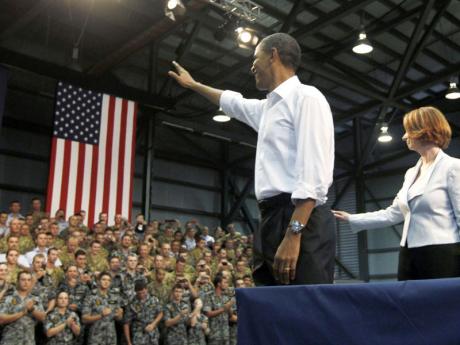
CANBERRA, Australia (AP):President Barack Obama has fulfilled his promise to visit Australia after a long delay, arriving in the capital city of Canberra last Wednesday afternoon for a day-and-a-half trip focused on renewing bonds with an exceptionally close United States (US) ally.
Air Force One crossed the international dateline as Obama travelled from Honolulu to Australia. Obama was to hold meetings and a news conference last Wednesday with Australian prime minister, Julia Gillard, who greeted him upon his arrival.
For Obama and Australia, the third time's the charm. He cancelled two earlier visits, once to stay in Washington to lobby for passage of his health-care bill, and again in the wake of the oil spill in the Gulf of Mexico.
Obama's visit has been eagerly anticipated in Australia, and he was welcomed with an official arrival ceremony at Parliament House. The president stood with his hand over his heart as a military band played the Star Spangled Banner, and told Australian dignitaries that he was sure he would enjoy his time in their country.
Obama also spent a few minutes shaking hands and talking with schoolchildren waiting for him in the marble foyer of Parliament House before signing a guest book and heading into a private meeting with Gillard.
At the centre of the president's trip was an expected announcement on the expansion of the US military presence in Australia, positioning US equipment there, increasing access to bases and conducting more joint exercises and training.
China threat
The moves would counter an increasingly aggressive China, which claims dominion over vast areas of the Pacific that the US considers international waters, and has alarmed smaller Asian neighbours by reigniting old territorial disputes, including confrontations over the South China Sea. Defense Secretary Leon Panetta has said that the goal is to signal that the US and Australia will stick together in face of any threats.
Deputy national security adviser Ben Rhodes, speaking with reporters on the flight to Australia, said that serving as a counterweight to China's growing influence was just one factor in the ramped-up US military presence in Australia.
Others included being able to respond more quickly to natural disasters in the region, such as the devastating earthquake and tsunami earlier this year in Japan, and fighting terrorism and piracy on the high seas to help keep sea lanes of commerce open.
An increased US presence would help the United States "protect our interests, protect our allies" and help it "play its critical role as an anchor of stability and security in the region," Rhodes said.
Kim Beazley, Australia's amba-ssador to the US, said the mere fact of Obama's appearance in the country was "enormously important" to Australians. And for the US, Australia's geographic location in the burgeoning Asia-Pacific makes the longtime ally an increasingly important one as China's might grows.
Strategic location
"It's an area where the United States has got considerable freedom of action, considerable interests, growing interests," Beazley said in an interview. "And Australia is well-located strategically."
Following meetings with Gillard last Wednesday, Obama addressed the Australian Parliament on Thursday before travelling to Darwin on Australia's remote northern coast.
It's the first time a sitting US president has been to Darwin, where US and Australian forces were killed in a Japanese attack during World War II. Obama visited a memorial to the dead and also visited a military base in Darwin where he spoke to Australian troops and US Marines. The visit comes as the US and Australia mark 60 years as defence-treaty partners.
In a region of the world where volatility threatens, Obama's visit is in large part about underscoring the tightness and steadiness of the relationship with an ally that has fought alongside the United States in nearly every conflict since World War I.
He's doing so in ways large and small, from promoting increased military ties between the two countries, to a planned visit with Gillard to a local school. A school visit was also part of the agenda when Gillard visited Obama at the White House in March.
Security high on agenda
Obama will use his remarks in Australia to discuss the broad US agenda in the Asia-Pacific, but while economics and trade have been the focus of the days he's just spent in Hawaii hosting the Asia-Pacific Economic Cooperation summit. In Australia, the focus shifts to security.
Admiral Robert Willard, head of the US Pacific Command, noted that the US has a military presence in the South China Sea, but he said many of those forces are deployed from the west coast of the US or from Japan or South Korea, where the US maintains bases.
"Any opportunities that we have to locate forces in the Southeast Asia region relieves some pressure on that need to, at great expense, deploy and sustain forces," Willard told reporters traveling with Obama in Honolulu last Sunday.
"We have a very, very tight, close relationship with our Australian friends," he said.
Australians have generally been understanding about the president's previous cancellations. Obama's predecessor, George W. Bush, was heckled when he spoke to the parliament in 2003, not long after the Australian government divided the nation by sending troops to support the invasion of Iraq. For a president facing poor poll numbers in the U.S. and the prospect of a difficult re-election campaign, the Australian audience may be as welcoming as any Obama could find at home.
From Australia, Obama went to Indonesia for a security summit with Asian nations, before finishing his nine-day trip and returning to Washington today.