
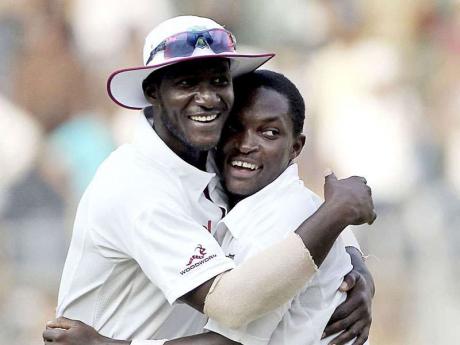
WI celebrate after up-and-down performance
Published:Sunday | December 4, 2011 | 12:00 AM
Tony Becca, Contributor
The latest Test series between the West Indies and India ended in a draw in Mumbai two Fridays ago, a result that left the contest, after victories in Delhi and Kolkata, with a 2-0 victory for the home team but with the visitors celebrating what was, in their opinion, a fairly good performance.
The result, however, was more disappointing for the West Indies than even the scoreline suggests, and but for a few improvements, was nothing to shout about, not for a team that for many years was near to the top of world cricket, and for one prolonged period, for 15 years, was the unbeaten, undisputed champions of the world.
After starting out with a string of five victories over India without losing a match, and losing only twice while playing to only two draws in the other 11 matches up to 2001/2, this defeat made it a painful four in a row, two at home and two away from home, and without winning a match at that.
The draw in the final match of this series, however, was a thrilling affair, even though the West Indies should thank their lucky stars for what was really a narrow escape.
The match, only the second time in the history of Test cricket that a match was drawn with the scores level, finished with the scoreboard reading: West Indies 590 and 134, India 482 and 242 for 9, with the scores level when India, with two wickets in hand and needing one to tie and two to win off the last delivery, scored one run and lost a wicket by the run-out route with the batsmen going for the winning run.
Glorious performance
The last day of the match was packed with excitement as 17 wickets fell during the day and India, looking 243 to win off 64 overs, at one stage riding high on 101 for one after 19 overs and apparently heading for victory.
As thrilling as the last day was, as exciting as the finish was, and regardless of Darren Sammy's belief that it was a glorious performance by the West Indies, it was a thin line, one run, between being cheered by West Indians and being heckled by West Indians.
After piling up 590 in the first innings, the West Indies just missed being ridiculed as the first team in the history of Test cricket to post such a massive first innings total and lose.
And as far as the action was concerned, the West Indies probably deserved to lose the match.
There was no reason, if they were playing to win, why the West Indies, in the first innings of the match, did not declare on the second afternoon at around 550, why they batted to the close of the day at 575 for nine, and why, especially with Fidel Edwards and Devendra Bishoo at the wicket, they batted into the third day before they were bowled out.
And it also seemed a bit strange that when India batted in the last innings of the match and needed 243 to win off 64 overs the West Indies started, a few minutes before lunch, with one slip, no one close to the bat, and men out, way out, guarding the boundary.
It would seem that with fast bowlers Edwards and Ravi Rampaul bowling, with Gautam Gambhir and Virender Sehwag batting, that with the West Indies fast bowling history against India, and India's batting history against the West Indies fast bowlers, that the West Indies fast bowlers would have been given a chance of picking up a wicket or two, especially in the few minutes before lunch.
The match was not a limited-over match, the field could have been adjusted any time, and getting 243 runs off 64 overs was never going to be easy, not on the last day of the match, not on a pitch that the West Indies were just dismissed for 134 runs, with eight wickets falling for 34 runs.
Even if the chase was considered easy, an early wicket or two could have caused the sort of pressure that could have destroyed India.
There is a reason why, in the history of Test cricket, very few teams have scored more runs than India required in the fourth innings to win a match.
Instead of patting themselves on the back for what was really a narrow escape from embarrassment, had they been brave, had they demonstrated some confidence in themselves, the West Indies may well have celebrated a victory, even though a hollow one, one which would have come after the series was lost.
Was there really something to celebrate, something to be happy about?
There were definitely some things, enough to make coach Ottis Gibson and company feel good, especially where it concerned training and practice, playing for the team, and commitment.
The West Indies players, most of them, appeared to have come out of India better than when they went there, and if that is so, that is good.
The players, as a team, looked together, they fought hard together, and the captain, even though he does not bat well enough to get into the team as an all-rounder, even though he does not bowl well enough to get into the team as a bowler, and at times seemed lost on the field, he appears capable of motivating the players, and to lead the players in a fight to the end.
Disappointment
Individually, the batsmen played well at times, and all of them, with the exception of Carlton Baugh and Sammy, played at least one good, long innings, hinting that they can stay there, as they did in the first innings in Delhi, in the their second innings in Kolkata, and in the first innings in Mumbai.
The disappointment, however, was the way the batsmen played India's spin bowlers.
With the exception of Shivnarine Chanderpaul and Darren Bravo, and to an extent Kirk Edwards, the batsmen continued to look lost against the spin bowlers, two relatively new spin bowlers. They seemed afraid to go down the pitch to the spin bowlers, probably because they were unable to do, and probably because they did not know which way the ball was going,
In scoring 304 in Delhi, 463 in Kolkata, and 590 in Mumbai, while scoring 180 also in Delhi, 153 also in Kolkata, and 134 also in Mumbai, the batsmen once again demonstrated their inconsistency, or their fear, or their inability to play good spin bowling.
They continue to lose wickets in bunches.
Chanderpaul apart, the batsman who batted consistently and brilliantly at times was Bravo.
The left-handed batsman, who scored the most runs on either side in the series, really looked good, he exuded class while batting against pace and spin, and although it is still too early to say, he seems destined to become a great batsman.
On the other hand, and although they kept the West Indies fighting, with Ravi Rampaul and Sammy taking eight and nine wickets, respectively, at averages of 28.62 and 34.77 in three Test matches to top the West Indies bowling, the West Indies bowling paled in comparison to India's.
For the home team, Ravichandran Ashwin took 22 wickets at 22.90, Pragyan Ojha 20 at 22.50, and pacer Umesh Yadav accounted for nine at 21.22.
The series, partly because of the ability to fight, sometimes, mainly because of Bravo's batting, including two superb innings, one of 123 runs and one of 166 runs, appeared good for the West Indies, and maybe those were the reasons for the celebration by the West Indians.
The performance, however, in cold, hard facts, as emphasised by Baugh's brilliant wicketkeeping and poor batting, and Marlon Samuels' hot-and-cold batting, was poor and inconsistent cricket by the West Indies, and that by a team which, up to 16 years ago, was the best in the business.