
The great non-debate
Published:Sunday | December 25, 2011 | 12:00 AM
Ian Boyne, Contributor
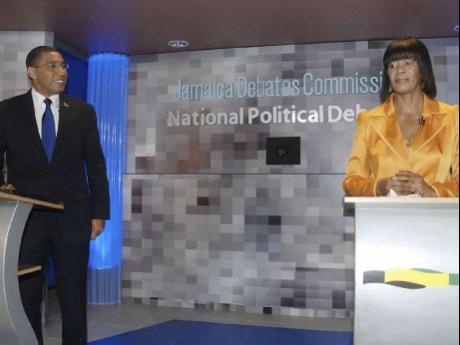
The Jamaica Debates Commission emerged as the biggest loser in the recently concluded political debates, with its last debate being the most transparently deficient in format. The most common reaction of viewers and listeners the Wednesday morning after the leadership debate was frustration and disappointment, their high expectations having been dashed.
People kept repeating, to my annoyance, that the leaders did not address this and that slew of issues - most of which were never put to them, and those which could not possibly have been dealt with seriously in 90 and 45 seconds. If more time had been allotted to the debaters, more issues could have been broached.
The United States Commission on Presidential Debates does not have the monopoly on effective debate formats. In fact, there are increasing criticisms in the US media of their sterile format, designed more for sound bites than for serious democratic engagement. Indeed, there have been criticisms going back as far as the 1960s Kennedy-Nixon debates.
From as far back as 1962, political debate scholar J. Jeffrey Auer dismissed the Nixon-Kennedy-style debates as "counterfeit". The Lincoln-Douglas debates of 1858 went on for three hours and had no moderator, only a timekeeper (which is basically what our moderators are in our format).
I am not suggesting that we go to three hours, but if sector leaders, various interest groups and editorialists really want to have multiple issues explicated and debated by politicians, those debaters will need time. The leaders' debate, which used to last for 90 minutes, was cut to only 60 minutes, with the journalistic panel reduced and replaced by 'independent' members of the public like Steve Ashley to ask their unbiased, impartial questions as a part of democratic widening, no doubt.
Grateful to commission
In fairness to the Debates Commission, it must be pointed out that it had to go through hoops to save the political debates this year, particularly the leaders' debate. I am not sure, in the end, whether the leaders' debate was worth saving in that format, but we must be generous to the commission and commend it for making valiant efforts to pull it off. I am sure its members will humbly take our criticisms and suggestions for improvements, all in an effort to help them fulfil their laudable task of strengthening democratic participation.
So, the political leaders first have to be judged in light of a format which did not favour significant engagement. Many have been unfair to them, not considering their enormous constraints. Telling me about testing people's ability to "think on their feet" and to "précis their answers" - and the importance of that being a criterion of judging leadership acumen - is a foolish copout. Some ideas need time to flesh out - and especially if people are debating, not just putting forward positions. That is an important distinction.
I well agree with Newt Gingrich when, in a debate last month, he was asked, "Down the line, in 30 seconds, if you repeal Obamacare, what's the answer?" Gingrich said the question was absurd in light of the 30 seconds which was not enough to "cover a topic that occupies 18 per cent of the economy and is life and death for the American people". We have such issues here, too.
Bold journalists
And I must say that I was very proud of my colleagues, Dionne Jackson-Miller and Franklyn McKnight for their first-rate and pointed questions. The journalists were brilliant and bold. That panel chosen was the best decision of the commission, though it should have been supplemented by at least one other senior journalist. Garfield Burford would have been appropriate there.
Portia Simpson Miller displayed enormous courage - and took incalculable risks - by saying she would move towards reviewing our buggery laws and advocated a conscience vote in Parliament. And she is not concerned about what people do in their bedrooms, strongly dissociating herself from Bruce Golding's "not in my Cabinet" statement forbidding gays. She said she would choose her Cabinet members on ability, not sexual orientation. If Labourites had drugged her to say that, it could not have gone better for them! This is one issue coming from the leaders debate which we might be talking about for some time (kudos, Dionne).
The prime minister walked through the raindrops delicately and expertly. He chose the right words, trying to appease both his liberal international and rabidly anti-gay local audience. There was no quotable quote from him (Thank God, he must have breathed a sigh of relief). But in taking an unpopular stance, Portia has demonstrated leadership and grit. A democratic leader sometimes has to lead from in front and can't be imprisoned by the prejudices of her followers. Is Portia willing to pay "the ultimate price" for this?
After all, in her presentation last Wednesday night, she explicitly diverged from Andrew Holness' neat distinction between "human rights" and "civil rights" as it concerns gays, saying unequivocally that the issue of the buggery laws relates to human rights. Overseas gay activists and members of the international donor community must have been delighted by this glimmer of hope, but the question is, can Portia cross it to reach 'the other side'?
'Holness underwhelmed'
But one thing which must have been disturbing to the Jamaica Labour Party from Wednesday night listening to media analysts is that so many seem convinced that the PM did not shine, and that, in Emily Crooks' words, he "underwhelmed". Many had high expectations of a knockout punch to Mrs Simpson Miller, which they said never materialised. Most of the responses I have heard say it was a tied debate, with some arguing that Mrs Simpson Miller actually won (which some had deemed unthinkable).
To be sure, Portia Simpson Miller went in with lower expectations. Because of people's patronising attitudes and some middle-class prejudice, some had two different standards of judgement. I am not really into the winning and losing assessment, but I thought the prime minister's closing was particularly effective and affective. His words were well-chosen and strategic. He played the generational card well from his opening statement and deftly marketed himself rather than just the JLP.
One young analyst on TVJ, betraying his inexperience, thought this a drawback. But for Holness, too much reference to the team would backfire, as the team is seen as damaged. He has to market himself as a third alternative to the failed pre-Independence generation in both parties.
For Portia, it was strategic to make reference to her team because of perceptions of her capacity. So the two leaders had to employ opposite strategies because of their particular contexts.
Holness' reference to Trafigura was to achieve at least some moral - or immoral - equivalence with his opponents ("All a wi have the same problems"), and, better yet, to show that he was better at dealing with his party's scandals, for he was open and transparent while the PNP, allegedly, was trying to cover up.
Holness knows that the PNP's campaign on the issue of corruption and scandals carries far more traction than the economic issues. He was very strategic on Wednesday night. It must be noted, too, that both leaders showed the utmost respect and civility towards each other. We can't eat our cake and have it. We agree that the team debate was marred by rudeness and impoliteness, so don't say now that that debate was better than Wednesday's, associating loudness and aggressiveness with good debating and a calm, decorous demeanour with being soft and "not saying nutten". Our leaders both excelled in this area.
The JLP's launch of its manifesto last Monday again reinforces the point that there is significant policy coherence between the two parties. I totally disagree that this is our most crucial election. It is not. In my view, it does not matter which party wins, as both are committed to most of the critical things which this country needs to grow sustainably. I believe the PNP's manifesto is far superior to the JLP's in terms of its economic philosophy and strategies.
The JLP manifesto, while containing some impressive ideas for economic development, is too market-fundamentalist. Some of its ideas for growing the economy are simplistic and overly optimistic. The JLP manifesto correctly captures some of its key economic achievements, and the PNP should just acknowledge these rather than talking nonsense about the JLP mashing up the economy. The achievements of low interest rates, low inflation, stable foreign exchange rate, the Debt Exchange and the critical divestments which save us considerable sums are all laudable achievements in an era of global crisis.
Governance reforms
Where I believe, though, the JLP manifesto stamps its absolute superiority and distinction is in the area of governance reforms. The JLP's ideas for deepening democratic governance, the devolution of authority, transparency, accountability and anti-corruption are exceedingly impressive.
It's most ironic that the PNP makes so much noise about corruption and scandals and yet does not, in its manifesto, advance the kinds of genuinely progressive ideas on governance that the JLP has in its manifesto. When you look at both what the party has already achieved in Government, proposals in the legislative train and new proposals it is truly very impressive.
If the PNP wins the next election, it should carry on this bold governance revolution. We can't afford for these first-rate ideas to go to waste simply because the party which proposed them loses power. This is where civil society needs to press whoever wins the election to adopt the best ideas of the losing party, as both organisations have excellent ideas.
I am convinced that the JLP needs the PNP's ideas on economic policy and strategy and that it will learn bitterly if it wins that its market-only posture will fail to generate employment and sustainable economic growth. A few days from the election, I feel proud that the two main political parties have come as far as they have and have produced two manifestos with ideas which can really advance this country.
The JLP trumps the PNP (by far) on governance issues and the PNP (significantly) trumps the JLP on the economy. But, more important, what unites them is far greater than what separates them. And therein is the great hope of December 29.
Ian Boyne is a veteran journalist. Email feedback to columns@gleanerjm.com.