
Manley's mission
Published:Sunday | November 4, 2012 | 12:00 AM
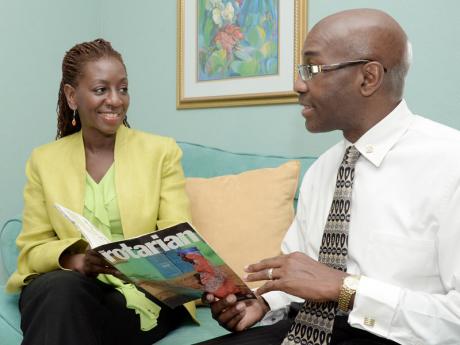

He will tell you that he is a very determined person and that whatever he sets his mind to do gets done.
You may think that's easy to say, but for the man who won a multimillion-dollar award for a double-leg amputation against Metropolitan Parks & Market (MPM) and the largest-ever personal-injury settlement in the history of Florida, you will see that his actions support his words.
"My personal desire is to strive for excellence. If I feel strongly about something, then I will be its chief advocate and I will go to the bitter end to get the outcome I've set myself," said Manley Nicholson, president of the Rotary Club of Kingston and partner in the law firm Nicholson Phillips. Now practising law for more than 15 years, Nicholson is licensed to practise both in Jamaica and Ontario, Canada.
One conversation with him makes it clear that he feels strongly about many things. For example, he has a highly developed social conscience and is particularly passionate about helping young Jamaican males resist the lure of a life of crime.
This particular passion has steered him on to a multimillion-dollar legacy project to help 93 young men incarcerated at the Rio Cobre Correctional Centre in St Catherine. The project - BACK2LIFE - is the Rotary Club of Kingston's (RCOK) major project for 2012-2013.
"I chose this project because of its connection to my profession. I see it as a way of making a meaningful contribution to society and the criminal justice system," he said, adding that it was a joint brainchild with his wife and law partner, Lorna Phillips.
"Lorna is the project manager. She has experience working in some of these institutions through her volunteer work, so her experience and management skills make her well suited to manage BACK2LIFE," he said.
Nicholson said the project, which was launched on July 7, is one of the ways he can give back to Jamaica. "My involvement in Rotary has given me an avenue through which to serve. I feel like I am contributing to national development through the work of the club. I do believe we will be able to help many of these young men walk away from a life of crime," he said.
He is eager to get as many hands on board to make it a success. "We want to take this project into the diaspora so that Jamaicans overseas can participate. Notwithstanding the distance, they can do things such as offering scholarships," said Nicholson, himself a returning resident to Jamaica.
"I have been back in Jamaica since 1996. I wanted to work in a developmental context, to work where I could contribute and see the results of such contribution," said Nicholson, who studied and lived in Canada for 17 years.
"A developed society like Canada has achieved much of what they want and I had a homeland which needed technical skills. Rather than stay there and criticise what was happening here, I decided to come home."
While in Canada, Nicholson had set up a real-estate business, but his early love of the law turned out to be the stronger passion.
"Although I was financially successful as a real-estate broker and business owner, I felt something was missing, so I went into law, my childhood passion," he explained. "For me, law amounts to solving problems for people. We sometimes inherit laws that are not appropriate for our culture, and due to our adoption of the English law we find that justice is not necessarily meted out equitably. Championing the cause of the less fortunate and the voiceless is a passion for me."
Many of the 93 young men involved in project, he said, are products of troubled backgrounds which made them vulnerable to crime. He cited research which showed that a variety of factors contributed to youth turning to crime, including poor parenting, lack of adequate supervision and frustrations with school or being illiterate or semi-literate. These factors make them open to negative peer pressure and the influence of dons or donmanship.
In trying to combat the problems which led the boys to the Rio Cobre Centre, BACK2LIFE will use several strategies, including mentorship, life coaching and boosting family interaction.
"The big picture is crime reduction, which will take some time to show a measurable outcome. In the short run, our aim is to help those 93 incarcerated young men, wards as they are called, in the correctional system find an alternative path to the one they are on," said Nicholson.
"Even before they are released, we want to see improvement in how they handle anger and conflict. We want to see respect for law and authority. We want to see the personal development strategies take root and see them setting goals and planning how they are going to realise them. This way, they can prepare to become functional young men when they re-enter society."
He is particularly keen on mentorship as an effective method to meet the boys' needs for good role models, and points to the many successful mentorship programmes both abroad and in Jamaica.
"To have this male figure in their lives, this one-on-one relationship with a positive male showing them care and attention, is not something many of these boys would normally have," he said.
His commitment to mentorship is not surprising. Nicholson is a firm believer in the philosophy that it takes a community to raise a child. But for him, it's a lesson he learnt from personal experience rather than from a book or much-used theory. Reflecting on fatherhood, he said he saw where one of his sons would have achieved more if he had been exposed to mentorship.
"I have a son who had challenges as a teenager, and I don't think by myself, as a father, I had fulfilled all his needs. With more positive influences in his life, the outcome would have been much better for him than where he is right now," he said.
And for Nicholson, himself a father of two boys and a girl, family, whether nuclear or extended, is important, both for the young men in the project as well as personally. As such, under the Rotary project, work will be done with the families of the wards at Rio Cobre to help them better support the boys when they leave the facility.
Coming from a family of nine children, five boys and four girls, Nicholson can attest to the power of family to shape one's destiny. He said it was his brother, A.J. Nicholson, who inspired him to pursue a career in law.
"I lived with my oldest brother, A.J., when I came from Rock River, Clarendon, at age 12, to attend Ardenne High School and I saw greatness in him," he said. "A.J. had studied law in England, and he went on to become the attorney general of Jamaica. I was influenced by his accomplishments."
His father, who was a police officer, also helped to cement his relationship with law.
"He was an officer of the court, and as the upright sort of individual, he was influenced me although he died when I was quite young," he said.
Now he has the chance to influence others and he is going full speed ahead.
- Contributed