
Ikebana: Mastering the Art
Published:Sunday | July 21, 2013 | 12:00 AM


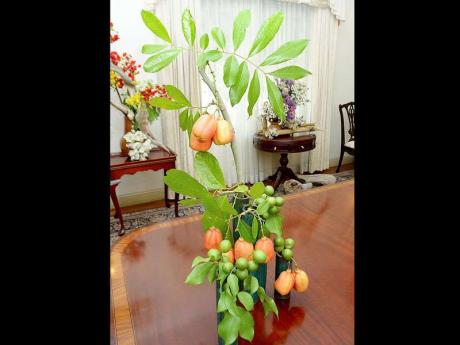


Nashauna Drummond, Acting Lifestyle Coordinator
Sayoko Takase, wife of Japanese ambassador to Jamaica Yasuo Takase, loves flowers. It's evident in the way her voice becomes high pitched, laced with excitement, and the way her face lights up when she speaks about them. Her love for flowers and her almost lifelong fascination with them is what brought the Outlook team to her Seaview Avenue home recently.
Takase is a Kommon level Ikebana practitioner - one level away from master, an art she has been developing since she was in primary school.
"I am very lucky I had flowers in my garden," she said of her childhood home in Tokyo, while explaining how she got involved in the Japanese art of floral arrangement. She would use these flowers to make her own arrangements.
"One day, Ikebana master Yoshi (Kauho) Kato came to my house and saw my arrangement and he said, 'Sayoko you have talent, I want to teach you.' Learning Ikebana was very interesting for me. Ikebana is a great way to express yourself and show off the true beauty of flowers," she said.
Takase
was trained in the Sogetsu school of Ikebana, founded in 1927 by Sofu
Teshigahara. This technique is characterised by the use of a tall,
narrow vase, with other materials arranged at an angle. Most Ikebana
schools employ a triangular shape in their arrangements which, Takase
explained, is the best way to show off the beauty of flowers. But having
mastered the basics, Takase now loves to express herself with freestyle
designs.
She told Outlook that her
favourite things to work with are bamboo and lily. But almost anything
can be used in Ikebana - stones, driftwood and dry branches. "You can
use driftwood or anything from nature, even dead things. Ikebana makes
it come alive," she explained.
For Takase, the art of
Ikebana is very relaxing and goes beyond her indulgence in working with
what she loves. "Ikebana is one of the ways for me to love flowers. When
I see flowers, I am very happy. When I touch it, I'm becoming calm.
When I smell it, my mind goes to heaven and I'm very relaxed and
happy."
With her two favourite ingredients, Takase
demonstrated how her arrangements come alive. She noted that of all the
countries to which her husband has been posted, Jamaica is her favourite
because of the wide variety of flowers that grow on the island. When
she arrived in Jamaica in November, it was her first visit, but since
then she has been able to really see the country and
get to know its people.
She told
Outlook that her husband has hosted quite a few
receptions and these give her a chance to do her
designs.
Unlike the oasis (green sponge- like
material) used in western floral arrangements, Ikebana uses kenzan,
which holds the flowers upright.
As she nipped a
flower and inserted it into one of the pieces of bamboo strategically
placed on the table, she took a step back and looked at the result like
an artist creating a masterpiece, checking to see that the end result
matched the image in her head.
"When I buy the flowers
and I look at them, something comes into my mind," she revealed. As she
picked up a palm leaf from the pile on the living room floor, she ran
her hand along it explaining that in Japan she cannot get them so
large.
Holding the palm at arms length, she nipped off
a few leaves before bending it and inserting it into her design. What
started out as a single lily among bamboo shoots came to life in a
matter of minutes through the art of
Ikebana.
Photos by Ian Allen/Staff
Photographer