
A job half-done
Published:Friday | May 9, 2014 | 12:00 AM
By Peter Espeut
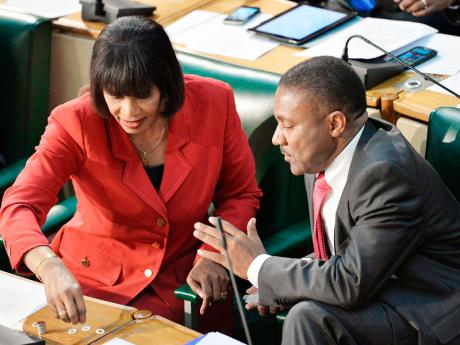
It could not have been easy for PNP leader Portia Simpson Miller to embarrass one of her most loyal lieutenants by so publicly removing from him the high-profile responsibility of driving the process to reduce the price of electricity to Jamaican consumers.
When she was campaigning to become party leader, and when she was fighting to retain that position, Paulwell was one of only three members of parliament to loyally stand by her side. Party leader Simpson Miller owes loyal Comrade Paulwell.
It is, therefore, testament to the tremendous pressure Prime Minister Simpson Miller faced that she divested Minister Paulwell of this aspect of his portfolio. The power of the private sector over our governments - orange or green - is not to be underestimated, for it is the private sector that pays the piper - that provides the vast majority of party funding.
FIGHTING REAL PROBLEMS
If the Jamaican private sector wanted an end to garrisons and their dons, that aspect of political thuggery would be just an unpleasant chapter in our distant history. If the private sector wanted to cut the real and apparent links between political donations and political favours (contracts, waivers and the like), campaign-finance reform, with full transparency, would already be in place. If the private sector wanted Jamaica to be a global model of environmental conservation, the world would be beating a path to our doorstep.
When placing blame for the sorry plight in which Jamaica finds herself, we must be careful not to blame just one partner in the crime. We need to take note that the International Monetary Fund conditionalities are designed not just to keep our borrow-and-spend governments in check, but also to limit some of the favours they can grant to their patrons.
The private sector made it quite plain that, despite his exuberant foibles, they were not asking the prime minister for the removal of loyal Comrade Paulwell as minister of science, technology, energy and mining. They said that was her decision, not for them to call.
But not even the strong language of the contractor general, nor the alarm bells sounded by the Inter-American Development Bank, has roused her to go to those lengths.
REASON FOR DISMISSAL
But I wonder if Mr Paulwell's own words might not give her good reason to dismiss him.
In his Sectoral Debate presentation last Tuesday, Minister Paulwell attempted to explain why he signed the April 4, 2014 Energy World licence, and why he amended the licence on April 14, 2014. It boils down to the fact that, under the law, no one can generate electricity without a licence from him as minister; and the law gives him the authority to change and stipulate whatever conditions he "thinks expedient".
But it is best to let him speak for himself:
"Mr Speaker, having received the recommendation from the OUR, the minister becomes responsible for the terms and conditions of the licence, in keeping with the Electric Lighting Act. This role is also reflected in the OUR Act, which states that no entity shall provide a utility service without a licence issued by the minister.
As the terms of the licence are the purview of the minister, it may be amended "as he thinks expedient" (Section 3(a) of the Electric Lighting Act)". (Source: page 11 of the minister's published speech.
So, the prime minister has determined that a public-private sector enterprise team will take over the process of selecting the firm that will build and operate a 381MW gas-fired power plant such as to reduce electricity costs to the nation. When that enterprise team makes its selection and reports to the prime minister, who will sign the licence?
If Phillip Paulwell is still the minister of energy, according to law, he is the only one who can sign and issue the licence to whosoever the enterprise team selects.
But before that, Paulwell, as minister of energy, has the discretionary right to vary the terms of the licence "as he thinks expedient". As long as he remains minister of energy, he still has the authority to interfere in the process. Potential foreign investors and the IDB are aware of this fact.
So, Madam Prime Minister, your job is only half-done. Your 'pasero', Mr Paulwell, said, "I owe a debt of gratitude to the Most Honourable Prime Minister for her unwavering faith and confidence in my ability to lead this important ministry" (page 4). On that day to come, he still expects to have the last word. How much do you really owe him? And how much do you owe Jamaica?
Peter Espeut is a sociologist. Email feedback to columns@gleanerjm.com.