
Ain't no catching Ottey yet
Published:Sunday | June 23, 2013 | 12:00 AM

Orville Taylor
VCB still as not good as evergreen queen
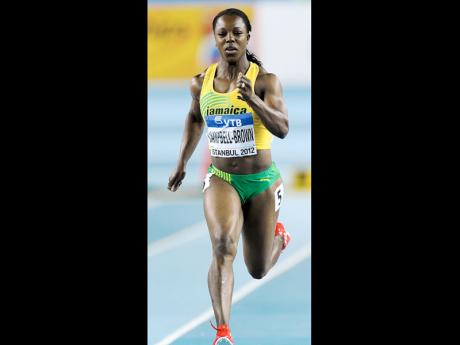
Now that she, like her 'idol' Merlene Ottey, has found herself on the wrong end of a drug test, star sprinter Veronica Campbell-Brown (VCB) is facing the greatest scrutiny of her life. Nevertheless, contrary to expectations, this is not a discussion as to whether she is guilty or not. Rather, the question is, who is the greatest Jamaican female sprinter of all time?
Of course, it is simply a toss-up between the two, although Shelly-Ann Fraser-Pryce can also stake her claim, having won two individual Olympic titles. Moreover, Fraser-Pryce is the national record holder at 100 metres. Remarkable, but she is not quite in this league.
VCB has impressive credentials, and erroneously my colleague writer labelled her 'the most decorated' Jamaican athlete. Well, she has won World Youth, World Junior, World Championship and Olympic sprint titles.
Of course, that is a bit unfair, because Ottey did not compete in the Youth Championships, since they began in 1999, when she was already a veteran, representing the country for more than 20 years by then. To be a top sprinter for more than two decades is mind-boggling. Similarly, the Junior Championships were inaugurated in 1986, when Ottey was in the second quarter-century of her life. In any event, why are we even talking about kiddies' medals? After all, do Dexter Lee's back-to-back World Junior gold match Michael Frater's World Championships silver or Donald Quarrie's 1976 Olympic or Lennox Miller's 1968 silver?
SENIOR LEVEL
So, let the argument begin at the adult level. VCB has won two individual Olympic gold medals for the 200 metres. Along with her two bronze, her individual Olympic total is four. At the World Championships, she owns two gold medals for the 100m and 200m, respectively, and four silver for the short sprints. Thus, her total outdoor medals are 10. Those are not monkey numbers. Only an Olympic 100 metres jewel is missing from her crown.
Add to those her two gold medals for the indoor 60 metres and she has a grand sum of six global sprint gold medals, making her net-medal gain 12. With six global gold medals, one can be forgiven for calling her the golden princess. And don't forget, she is one of the fastest women in history. With a personal best of 10.76 in 2011 and an amazing 21.74 set in winning the 200 metres in Beijing, she has entered a category that few women can even aspire towards.
And in comes Merlene Ottey, monikered the Bronze Queen. Ottey was competing when Eastern Europe was not open and many of its female athletes were more masculine than I am and as tough as the GSAT math problems. Furthermore, they were so flat-chested, none of them could win in a photo finish. Ottey has never won an individual Olympic gold medal. Nonetheless, she has two individual silver medals and five personal bronze. Merlene's Olympiad total: seven. VCB's Olympic haul; four. Unless you are using politician maths, seven is more than four, although one must accept the weighting of the gold.
Yet, like VCB, she has two World Championships gold. Along with those are three silvers and five bronzes - 10 medals in all. Her total outdoor medals in Olympic Games and World Championships are 17.
Nevertheless, indoors, she is a nonpareil: three gold medals, two silver and a bronze; six indoor medals. Thus, Ottey has five global gold, seven silver and 11 bronze - 23 medals. VCB's balance sheet has, six gold, four silver, and two bronze - 12 medals. If we add the Commonwealth Games to the mix, the separation between Ottey and VCB is clearer. Ottey's three gold and one silver medal outshine VCB's three silver. However, despite being very prestigious in the past, the games exclude the Americans and Eastern Europeans. Thus, they are not truly global.
BEYOND THE GOLD
One can argue that the one more gold by VCB trumps all the others. After all, when the IAAF ranks its competitors at the end of its championships, it has a medal table with gold medals in descending order of magnitude. However, it also has a placing table, where points are given for finishing in the top eight. Countries with more medals are located higher on the table.
Yet, the argument can get deeper. Sprinting technology had improved significantly since the 1980s and 1990s. Running surfaces are better and faster, and running shoes and other gear enhance performance. Therefore, VCB has all the reasons to be running more quickly. However, she is not. Her 10.76 is very speedy. Still, it is slower than Merlene's 10.74, run when she was all of 36 years old. Say, wow!
Imagine: At her peak, which lasted more than two decades, her personal best in the 100 metres would put her ahead of all the current crop of sprinters with the exception of Carmelita Jeter and Shelly-Ann. And if you ask me, given the faster tracks and new technology, Ottey would run down and catch both. Look at how she caught American Gail Devers in both the Olympics and World Championships, even though the photo-finish judges said she didn't. Merlene has a jaw-dropping 57 consecutive 100 metres victories in competitions. And if Asafa Powell is the sub-10 king, she is the sub-11 empress, with 67.
OTTEY'S RECORD STANDS
Despite VCB being the national and, arguably, world 200 metres diva, her 21.74 is still behind Grace Jackson's 21.72 and Merlene's national record of 21.64. Running flat out like a lizard drinking water, American Allyson Felix, VCB's true rival, would be a 'donkey lengths' behind Merlene at her best.
And if you think, Ottey, whose body still looks solid and feminine at 53, is good outdoors, you need to take her indoors. Ottey holds the national 50 metres record of 6.00 seconds and the 60 metres mark of 6.96. The latter was a world record when she set it in 1992 at age 32.
Indoors, she is still, 20 years later, the world record holder at 200 metres, with a scorching time of 21.87. Even more amazing is that she threw her 5' 9" body around a cramped and uncomfortable track in doing so. No other woman has ever broken 22 seconds indoor.
In comparison, VCB's indoor 50 and 60 metres times are 6.08 and 7.00 seconds, respectively. Furthermore, her 200 metres is a modest 22.38. VCB has never set a world record or dominated her peers as Ottey did.
Thus, the argument is settled. Nonetheless, both have failed drug tests. Ottey was found to have 'horse tonic' nandrolone in her body in 1999 and VCB apparently did not know that the banned diuretic was contained in an innocuous cream she had declared she was using. Ottey was exonerated and reinstated scot-free; and from remarks by the IAAF, VCB's violation is a storm in a pee cup.
This is another Jack Mandora story, but I choose Ottey.
Dr Orville Taylor is senior lecturer in sociology at the University of the West Indies and a radio talk-show host. Email feedback to columns@gleanerjm.com and tayloronblackline@hotmail.com.