
Seeking better returns ...French shipper sends Dutch 'fixer' to Kingston port
Published:Tuesday | February 27, 2018 | 12:00 AM


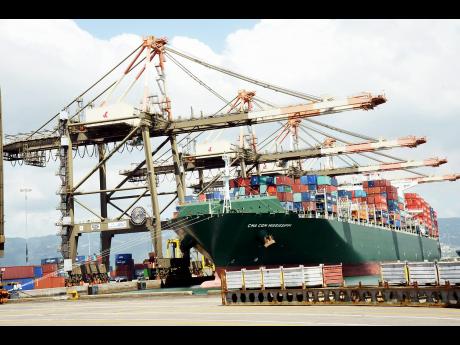
Johannes 'Hans' de Jong, who is known as the problem solver for his bosses at the world's third-largest shipping line, CMA CGM, parachuted into Kingston in January to drive up business for the cargo port, while managing its expansion.
De Jong, as the new CEO of French-owned port concessionaire Kingston Freeport Terminal Limited (KFTL), wants to attract new international shippers to Kingston, while refining the port systems to get persons and their cargo in and out of the container terminal in 30 minutes, which would amount to a one-third reduction in the current turnaround time.
In an interview with the Financial Gleaner, the port executive said his bosses deploy him around the world to fix problems as they arise, and that his assignments typically last about two years.
Prior to his arrival, KFTL was run by Olivier Tretout, CEO, who has returned to CMA CGM headquarters.
De Jong wants to quickly deliver higher key performance indicators, or KPIs - but kept silent on specifics - and expand the port to attract larger vessels and shipping companies, saying the measures under consideration should serve to drive returns on investment for the French shipping company.
'Jamaica could be better'
KFTL took over the port in July 2016. But amid system changes, several technical and logistical problems arose last year, leading to delays in the clearance and shipment of goods.
"Jamaica could be better," said de Jong, who added that Jamaica was not considered a problem terminal, but needed improvements. "The objective is to get the results expected and then leave," he said.
The Dutch national has lived most of his life overseas. He has worked in over 15 countries in Eastern Europe, Africa, the Middle East and Asia, places where CMA CGM mostly operates under public-private partnerships.
His last appointment was in Malaysia, for two years, where he oversaw a terminal with a capacity of 9.4 million TEUs per year, or about five times larger than Kingston's capacity of about 1.8 million TEUs.
"I am an international manager with a two- to three-year shelf life in a country," said de Jong.
Just this month, KFTL announced that it upgraded some 600 metres of berth space, with plans to double that amount by year end at a total cost of US$150 million. It would also see the inclusion of two additional new cranes by April, upping the total to 16.
"At that stage we will be able to attract larger customers," de Jong said. "We are at the stage of upgrading our facility before we can tackle the problem of additional clients ... . This is how it works in this business; you build capacity first, otherwise you will choke yourself to death."
KFTL does four times more trans-shipment business in terms of tonnage than domestic cargo.
Trans-shipment, or moving containers from ship to ship for transit to a final destination, totalled 4.84 million metric tonnes at KFTL for the first seven months of 2017 and 748,000 metric tonnes for domestic cargo. Both equated to higher volumes than a year earlier, according to the latest data from the Port Authority of Jamaica.
KFTL said the port recorded 1.47 million TEUs for all of 2017.
It now takes around 45 minutes for traders to clear containers, but for de Jong that period is unacceptable.
"I can see in Jamaica that 30 minutes is not always achieved," he observed, while noting the port would now strive for that target.
Last year, as problems at the port began to affect businesses, customs brokers had complained publicly that the time to clear containers at the facility were longer than one hour. KFTL embarked on a damage-control campaign that involved direct meetings with business and trade groups, while working through what it described as technical problems, to address the delays.
In an update on Tuesday, president of the Customs Brokers Association, Mitze Gordon Burke-Green, told the Financial Gleaner that there were no pressing issues for its members at this time, saying terminal delays were no longer prolonged.
Meeting financial targets
De Jong said the Kingston port is meeting its financial and developmental targets, and is on track with a number of financial and operational KPIs.
"Since the project is set out to achieve a positive cash flow and revenue within the context of a 30-year concession, then we are meeting them. There is no doubt whatsoever," he said, without disclosing figures to back up the assertion.
As part of his problem-solving management style, de Jong says he tends to focus on deliverables, training and then succession planning. That usually results in an existing manager, whether a local or expatriate, taking up the helm on his departure.
In addition to the completion of the 600 metres of berth upgrades, KFTL also upgraded the nautical access in August 2017 after months of dredging to deepen the shipping channel.
Those projects have enabled the port of Kingston to accommodate larger Panamax container vessels of up to 14,000 TEUs.
KFTL, which is a consortium of CMA CGM and Terminal Link, is expected to invest approximately US$509 million over two phases of the concession, with the possibility of a third negotiable phase.
Phase one of the port expansion, at US$259 million, includes capital dredging to a draught of 14.2 metres to be completed within five years, and strengthening of the existing quay walls to accommodate the larger vessels and equipment. This aims to increase capacity to 3.2 million TEUs.
Phase two involves a US$250-million plan for further dredging to a draught of 15.5 metres and to grow capacity to 3.6 million TEUs.
Phase three, which is contingent on a future agreement, involves the development of a new deep-water berth with a draught of 15.5 metres.
The concessionaire will pay a fixed US$15 million per year as lease for the port, and a variable fee of eight per cent of gross revenues to the Port Authority.